Pages

Showing posts with label parenting trends. Show all posts

Thursday, February 27, 2020

Parental Guilt: a Double Edged Sword Inside a Conundrum


When I write about dysfunctional family dynamics on my blogs, in response I often get parents and adult children reacting in completely opposite ways to the very same post: the parents think I am putting the blame all on them, and the adult children likewise feel I’m singling them out. Of course, the parents had the issues that are creating difficulties before the kids ever came into existence, so this makes them somewhat more responsible, but they are reacting to binds that they themselves were put into by their own  parents. In turn, their parents were reacting to their parents, and so on.

Of course, when people feel blamed for something they don’t really like, but sort of know they had something to do with, they tend to feel guilty, which tends to make them defensive. Defensiveness, in turn, causes them to tune out discussions of what they might be able to do differently in order to fix the family problem. That would be bad enough, but there is something else that amplifies this problem even more. The fact that they felt guilty even before reading my stuff is often the main problem that caused them to give off destructive double messages to their kids in the first place.

The women’s movement was great in terms of opening up fulfilling opportunities for women for which they are more than qualified. However, it is also a big factor in creating a lot of parental guilt as when both parents are working, this has made many of them feel like they are neglecting their kids. As I have written, the Phyllis Schlaflys of the world pile on the guilt. This cultural argument has two effects on the parents: anger at their kids for complicating their lives, and attempts to make up for their frequent absences by overindulging their kids and trying to be friends with them.

The latter behavior creates all the issues that parenting columnist John Rosemond has been writing about for years: it makes the kids feel inadequate. My view on this is slightly different than his: I think the kids start to believe that the parent’s constant need to cater to them is evidence that the parents need to be caretakers to remain mentally stable, so the children start to act as if they are inadequate so the parents can continue to feel needed.

If the parents’ anger predominates, this can lead to acting out by the child to provide the parent with a feeling of justification for being angry and therefore not as guilt-ridden.

If the parents go back and forth between compulsive caretaking and anger, the child develops one of the major characteristics of borderline personality disorder: spoiling behavior. When the parent gets too angry the child tries (and usually succeeds at) making the parent feel guilty, but then when the parent feels too guilty, the child finds ways to make them angrier.

Because the issue of parental guilt is so central, this creates a conundrum for anyone trying to get the family to discuss what is really going on so that it can be stopped or at least minimized – including any family member attempting to do this, a therapist trying to help the family, or a writer of blogs trying to get people to focus on real issues rather than looking for scapegoats or facile explanations for the self -defeating behavior of family members. When any of these folks bring up what the parents are doing “wrong,” this tends to make the parents feel even guiltier, which is the source of the problem in the first place. The problem then gets even worse rather than better.

When I had such a parent in therapy, I was able to find a way to finesse this, by discussing how their child may be mis-reading them, which tends to be a less guilt-inducing way to put it. Also, I can empathize with the bind that the parents are themselves feeling, having formed a preliminary hypothesis about why their own parents acted as they did.

This is much more difficult to accomplish when writing for the public, because readers tend to quickly focus more on anything that seems at first glance to be less than empathic with their own plight. I do talk about how the problems have been passed down from prior generations, so if we have to blame anyone, let’s blame Adam and Eve and be done with it. I also make use of a great quote from John Rosemond: "Taking responsibility for something and self-blame are horses of two entirely different colors. The former is empowering; the latter is paralyzing." However, I can’t discuss these ideas in detail in every single post or they would all be twice as long as this one. And anyway, disclaimers like that are often ignored in the heat of the moment.

Tuesday, August 26, 2014

The Culture Wars, Parental Guilt, and Out-of-Control Children: The Dilemma


The following post comes mostly from chapter 2, Don’t Blame Us,  of my last book, How Dysfunctional Families Spur Mental Disorders:

The women’s movement in the United States, combined with economic changes that made surviving on only one income increasingly difficult for families, led to one of the fastest and most massive cultural shifts in history. Almost overnight, women entered the workforce in huge numbers. Female ambition was fully unleashed for the first time ever, and flourished. However, women who wanted to get to the top in their field in business or the professions ran into a roadblock. 

They found that, in the business and professional worlds, they were expected to act just like the men in one respect. They could not use the needs of their children as a reason for refusing to put in the long hours necessary in today’s economy to climb the corporate ladder. The United States had during this same period of time grown to become the most workaholic country on earth, eventually surpassing even Japan.
         
Women who wanted to and who were told that they could “have it all” by the ambient culture found that doing so was not as easy as some famous women made it look. Since their husbands were only just beginning to share in child care, and were as much or more involved with their careers as they had ever been, who would be around to take care of the children? Horrific stories about bad things happening to children left to their own devices and locked in their homes without parental supervision after school (deemed latch-key children by the media), began to circulate widely.

Debates over working mothers became one of the most important theaters of operations in the culture wars that continue to rage on to this day. Reactionary forces that never believed in equality for women in the first place began to spout off about all the damage being done by working mothers to their offspring. The voices of people like Phyllis Schlafly, a career woman who made a career out of attacking career women, became louder and more shrill. Unfortunately, researchers in major academic centers began to give more ammunition to voices like hers.

Widely publicized studies showed that children in families in which at least one parent stayed home with them did, on the average, better in life on some dimensions than those children from families in which this was not the case. Of course, many children from two-career families do splendidly or even better than many of their more closely parented peers, while many children of stay-at-home mothers often fail spectacularly in life, but the press ignored the scatter and put most of its focus on the “average” end result.

Of course, many families were able to negotiate the cultural changes successfully and continued to calmly set limits with their children while encouraging them to have egalitarian attitudes towards gender roles. Many others, however, were just feeling overcome by too much guilt to do that.        

The most devastating source of guilt: Many career women found that they were faced with considerable criticism about their choices in life from within their own families. The baby boomers, who were the first large wave of career women, had themselves been raised by parents from the World War II “greatest” generation. This earlier generation of women had been, on the whole, raised to conform to the old female gender role stereotypes. 

They were taught that they supposed to be totally fulfilled by being nothing but wives and mothers, as their mothers had been before them. However, as I described in the post of 9/21/11, unlike their own mothers, some of these women had had a taste of career fulfillment during the war, but had to give it up at the end of the war. 

Since these women had been raised from birth to believe in the old roles, they accepted their fate, at least on the outside. Inside, many of them subconsciously resented having to give up the excitement of their careers. Some carried this covert resentment with them for the rest of their lives. As parents are wont to do, they tried to vicariously experience what they were missing through their children. 

When they had daughters, they often pushed the girls to go out and get what had been denied to them – a satisfying career. Perhaps it was no accident that the baby boom generation was at the forefront of the feminist movement of the1960’s. Feminism had been an undercurrent in society for decades before then, but “women’s lib” virtually exploded.

As the female boomers hobnobbed with one another and talked among themselves about how women could now do anything they wanted, many faced a rather disturbing negative reaction from both of their parents when they spoke about this at home. The parents would suddenly become hostile and/or withdrawn, sometimes for no apparent reason.

Many male boomers, on the other hand, were the objects of some strange reactions from their parents as well. They had started to realize that sharing the burdens of being the family breadwinner was not such a bad idea after all. However, their fathers seemed to think less of them if they were not dominant over their wives, especially if they earned less money than their wives. 

In the meantime, some of their mothers acted helpless and dependent around them at times, but because of the mothers’ covert resentment at males for keeping them from pursuing careers, emasculated the sons who tried to take care of them in any way. 

For example, one of my patients told of an incident in which his World War II generation grandmother fell in the bathroom and broke her hip. When my patient tried to come to her aid, she refused to unlock the bathroom door. She said that she "did not want to be a bother."

These parents were not being mean-spirited when they acted like this. The parents had grown up with certain gender role expectations and believed in them. They also worried, because of their own experiences, that successful women might have a difficult time finding a mate. They believed that men would find feminists too aggressive, and in any event would be threatened by any female who might be too able to manage her own life and finances without a husband. 

These fears were stoked to near hysteria among both the boomers and their parents by a story in Newsweek in 1986, since discredited, which purported to show that college-educated women who were still single at the age of 35 had only a 5 percent chance of ever getting married.

More important than the possible reactions of male chauvinist peers, the parents of the boomers, just like their children, worried about what might happen to their grandchildren if one of their parents were not in the home to raise them as much as in past generations. How would such children fare in life?

In addition to this concern, a covert but pernicious issue lurked in the back of the minds of a significant number of the former riveting Rosies. When their daughters became successful in business, the mothers were reminded of what they themselves had given up right after the war. They had pretended for many years that having given up their jobs was really no big deal to them. Some became quiet, some became depressed, and others became actively critical of their daughters’ ambitions, especially when grandchildren came into the picture.

Boomer females were extremely confused by their parents’ mixed message that seemed to say to them, “I’m so proud of you for your career success, but stop doing what you’re doing.” Many were left with a highly unsettling feeling caused by this strange lack of support. They wanted and planned to go on with their careers, but somehow they did not feel quite right about it. They became somewhat confused about exactly what their role in life should look like. 

Men found that they were criticized by their girl friends if they opened a car door for a woman - or if they did not. Accompanying the role confusion for both sexes was the nagging, unnamed sense of guilt about their children that was mentioned above, which was then further increased by the other cultural developments.

Paradoxically, the existence of parental guilt of this magnitude had effects on parenting behavior that may be the real reason why children of two career families do slightly worse on average than those with stay-at-home mothers. Changes in parenting styles driven by guilt are probably far more destructive to children than the fact that both parents are working per se.

All of this confusion and ambivalence created two different groups of women who, while superficially polar opposites from one another, shared the exact same conflict. One group had careers but covertly envied the stay-at-home mothers, while a second group stayed at home with their children but covertly envied the career women. The latter group also had quite secret - or so they thought – deep-seated urges to escape the drudgery of doing housework and shuttling children around all day long.

Many parents in two career families worried covertly but obsessively that they were short-changing their own children. Some stay-at-home mothers, on the other hand, subconsciously worried that their hidden resentment over their burdens and their choices in life might adversely affect their children. In response, both of these groups began to monitor their children carefully or any sign of distress that might indicate even the slightest parental failing. A good percentage of them became so obsessed with their children that they spent every spare moment with them, often at the expense of their marriages.


This popular Facebook meme advocates gross over-parenting, and following this advice often leads to disastrous results.


For the career women, the guiltier they felt, the more concerned they became with turning any time they did spend with their children into “quality time.” They tried to make up for their frequent absences to their children by catering to their every whim. The stay-at-home mothers began to do the exact same thing. They also became overcome with guilt as their resentment over the perceived drudgery of their life, as well as their hidden desires to escape from it, built up over time.

Everything that happened in the home began to center around the children. John Rosemond’s nightmare world of non-traditional parenting was born.


Tuesday, August 19, 2014

The Culture Wars, Parental Guilt, and Out-of-Control Children: Introduction


The popular parenting advice columnist John Rosemond writes about an epidemic of poor parenting practices that has been accompanied by an epidemic of out-of-control children. For instance, he notes that behavior such as children biting their parents has become increasingly common. 

In a recent column in the Memphis newspaper (8/31/14), he noted that in cases of parents whose children are disrespectful and refuse to do what they are told, the parents often are not actually telling their child what to do. Instead, they are “…pleading and bribing and bargaining and cajoling and encouraging and then, when all that fails, demanding and threatening and screaming.” 

He points out that there is a huge difference between saying “You could really help mommy out by picking up these toys” versus “I want you to pick up these toys right now.” If the child asks "Why?" he recommends the old standby, "Because I said so!" He correctly points out that children will usually, although of course not always, do what they are firmly and unambiguously told to do.

It seems that whenever anyone dares to point out that that maybe the problem in cases of out-of control, temper-tantrum-throwing children is not the child but the parents, they are often met with rage and accusations of “parent bashing.” This is accompanied by protestations that their child is in some way a problem child who was, I guess, just born that way. 

Such parents will react this way even when their children are running wild in a restaurant or in a store or even in church, and it is blatantly obvious to anyone who has eyes and actually looks that they are doing absolutely nothing to control the kids' behavior.

A good example of such an angry response was seen in a recent column by advice columnist Amy Dickinson. In an earlier column (6/30/14), Ms. Dickinson had responded to someone who asked about the best way to advise a parent with an out-of-control child with the following:

 Talk to them about it and be supportive and uncritical. This is not a mutually exclusive concept. Tell them, "You can turn this around. Do you want to hear some of the things that have worked for us?" At the risk of providing yet another resource your sister-in-law will ignore, I highly recommend the work of Jo Frost, the ‘Supernanny.’ She enters households like your sister-in-law's, diagnoses the family dynamic and then offers sound and practical fixes.”

After she published that letter, another letter writer responded (7/15/14):

Dear Amy: "Perplexed" sounded like a sanctimonious parent with two "perfect" children, complaining about a family member with a typical tantrum-throwing 3-year-old. I can't believe you didn't call him on this. — Not Perplexed Parent

While toddlers of course do sometimes throw tantrums, parents routinely letting them run wild and doing absolutely nothing at all about it is something else entirely. Ms. Dickinson wisely responded that she “…felt sorry for the tantrum-throwing little boy whose parents let him rule the household and then worried about his behavior. Calm and confident parenting would benefit this child, and I hope the parents get a clue.”

When out-of-control children escalate their behavior, in some cases things can get really out of hand due to a variety of factors that differ somewhat with each particular family. Parents may in frustration start to become abusive verbally and/or physically, or they may just abdicate their role as parents completely – something known in the literature as biparental failure. Or do all of the above at different times.This latter pattern can be the beginning of a process by which a child starts to develop borderline personality disorder.

These problematic parental practices seem to be becoming more and more common. What is behind this? The explanation I have proposed, as I have discussed briefly in previous posts, is that there has been a relatively sudden - on the adapting to cultural changes time scale - and all-encompassing cultural shift that has led to a dramatic increase in the level of guilt among parents. The guilt has in turn led an increasing number of parents to become over-solicitous of and afraid to discipline their children. The kids act out in response, which then causes the parents to get angry with them.

What is this shift? Well, it’s the all of the elements of the cultural upheaval that happened during the infamous 1960's. In particular, it was the emancipation of women combined with economic changes that made surviving on only one income increasingly difficult for families. 

Now don’t get me wrong. The emancipation of women is of course one of the greatest things to have ever happened, as are most of the other changes that occurred during the sixties: civil rights for minorities, the revolt against mindless conformity, and the sexual revolution.

So it is not the new freedoms themselves that are the problem, but the reactions of people to the changes, and the difficulties some families have in adjusting to the new cultural contingencies. As many pundits have pointed out, we are still even now fighting over the sixties. Almost constantly. It is referred to as the “Culture Wars.” It’s part of the reason we have “red” states and “blue” states on the election maps of the United States.

For example, many people still have not got the message that the sexual revolution was won by the revolutionaries. Surveys show that around 90% of both men and women today are not virgins when they get married. And that’s just the people who will admit that. However, you would never know that from listening to the abstinence preachers. 

And of course we have those people who give lip service to encouraging abstinence while somehow still recommending that we should be more “realistic” about the fact that teenagers are going to have sex and therefore we should teach them birth control. They cannot bring themselves to say that having sex responsibly is really just an OK thing to do.

A lot of people continue to feel the need to lie about sex. Anyone really think the Jonas Brothers pop group kept those promises with the “promise rings” they wore, when they were constantly being besieged by legions of groupies? And some promise ring wearers admit that they do not consider oral sex to be “sex.” How bizarre is that?

In fact, there are still many casualties being generated from the sexual revolution of the sixties, even though it’s been over fifty years. One wonders if all the people having unprotected sex do so as a way of punishing themselves for having sex because they feel guilty about it. 

They like to make excuses for being careless, such as saying that condoms interfere with their “spontaneity.” Well perhaps, but so does an unplanned pregnancy or an STD. The real issue is that these people still cannot tell themselves and others that they believe deep inside that they are not doing anything wrong.

I recall a middle aged divorcee I saw for therapy, the son of a minister, who was trying to justify the fact that he had sexual relations with a woman he went out with. I asked him, “So are you saying you don’t really agree with the teachings of your church on this issue?” He replied that the teachings were absolutely correct, but then added, “It’s just that I have these needs…” (Therapists should definitely not face palm during sessions. I didn't but I sure felt like it).

I mentioned the time scale by which individuals and families adapt to cultural changes. The process moves a lot more slowly than most people realize (cultural lag). After all, people are raised by parents who grew up in a somewhat different time. The parents, in turn, were raised by grandparents who grew up in yet another different time. And so on and so forth. Old rules get passed down from one generation to the next, even when they have become obsolete and counterproductive due to cultural shifts.

The rapid cultural changes in gender roles during the last few decades is what I believe to be behind all the parental guilt that we are seeing today, and which have led to the problematic parenting patterns which seem to be increasing in prevalence.

It is hard to believe that just four or five generations ago, even in advanced industrial countries like the United States and England, women were treated in ways that are not all that much different from the way they are treated today in highly traditional Muslim societies like Saudi Arabia. Just the other night, on the Ancestry.com plugfest television show, Who Do You Think You Are (on TLC, formerly on NBC), actress Cynthia Nixon discovered that her 3X great grandmother, Martha Curnutt, killed her abusive husband, Noah Casto, with an ax in 1840s Missouri.

Actress Cynthia Nixon on Who Do You Think You Are?

The show’s narrator explained that she did not really have much choice. The law would not protect her, and her husband apparently told her in no uncertain terms that he was going to kill her. It was not just that women did not obtain the right to vote for another 80 years (in 1920 in the US – less than three generations ago). They were completely at the mercy of their husbands. The narrator explained that in United States until the late 1800's wives were ruled by a legal doctrine called coverture. 

Coverture stripped women of almost all civil rights upon marriage, and they were considered legally indistinct from their husbands. Women could not keep any money they earned, own property, sign legal documents, serve on juries, get educated without their husband's consent, or retain custody of their children in the event of divorce. Men were legally allowed to physically punish (although not kill) their wives, and wives had no legal right to refuse sexual relations.

Some aspects of coverture lasted until the 1960's in some states. In fact, it was not until 1973 that women could serve on juries in all 50 States.

Flash forward to the 1950’s - in my lifetime. When I was a child very few married middle-class women had careers. Children could play outside freely without fear of strangers coming into the neighborhoods because their mothers were almost all home, and were all looking out for all the kids behind the scenes. These mothers were the granddaughters of the women that were ruled by coverture! 

Despite the mothers mostly all being at home, kids were seldom actually actually spending a lot of time with their parents. They kept busy playing with each other. Since I grew up in sunny Southern California, it was almost always nice enough to play outside, and that is where we all were sent. And a lot of it was free play, not organized activities - although there was Little League if you liked that sort of thing.

These mothers, who came of age in the thirties and forties, had no idea what was about to hit them when their daughters became college aged and joined the "women's lib" movement en masse.

In my post about the family dynamics of borderline personality disorder from 9/21/11, I discussed the peculiar situation of these women, who as Rosie the Riveter types got a taste of what it was like to have a career, only to sent back to the kitchen with advice from the government to get barefoot and pregnant again at the end of World War II.  


As mentioned, their daughters came of age during the Women’s Lib movement, which set up a real “generation gap.” I discussed how those developments led to tensions which spilled over into the future parenting practices of the younger of the two generations. I would refer the reader to that post, as a prelude to part 2 of this one, which will discuss the details of the individual and family dynamics that have been creating today’s dysfunctional parenting styles.

Wednesday, March 23, 2011

Debunking De Biederman

Joseph Biederman, the Harvard guru who advocates for the use of antipsychotic medication on children, is a psychiatrist who almost single-handedly started the current craze of psychiatrists and primary care doctors diagnosing acting-out children as having bipolar disorder.  I discussed in previous posts some of the issues involved both in Dr. Biederman's behavior and in the diagnosis of "pediatric bipolar disorder," particularly in my post of March 9, 2010, Recipe for Producing Frequent Temper Tantrums in Children.


Dr. Joseph Biederman

Dr. Biederman argued that the symptoms of bipolar disorder in children are very different from those of adult bipolar disorder.  In particular, he said that manic or depressed mood episodes, required by the DSM to last for a minimum of four to seven days in adults for mania and two weeks for bipolar depression, could last for mere minutes in children. Symptoms of bipolar disorder seen in children but not in adults, he opined, included temper tantrums and "explosive irritability."  Not that he had any clear scientific evidence connecting such symptoms to adult bipolar disorder. I'm guessing he just pulled these ideas out of his butt.

Tantrums, rage, emotional instabilty, low frustration tolerance and the like are all symptoms of borderline personality disorder in adults.  These types of symptoms fall under the rubric of affective instability or mood dysregulation, also called neuroticism by personality theorists. 

Individuals high on this variable get depressed, anxious, or angry quite easily and take much longer to calm down than average person. Patients with borderline personality disorder are frequently misdiagnosed as bipolar in the world of today's psychiatry (see my post of April 7, 2010, Borderline or Bipolar?).

Is similar diagnostic bungling being seen today with out of control children who exhibit affective instability?  Well, according to a new review of all of the existing studies in the February 2011 edition of the American Journal of Psychiatry by Ellen Leibenluft, the anwer is quite clearly yes.

From the abstract: "An emerging literature compares children with severe mood dysregulation and those with bipolar disorder in longitudinal course, family history, and pathophysiology. Longitudinal data in both clinical and community samples indicate that nonepisodic irritability in youths is common and is associated with an elevated risk for anxiety and unipolar depressive disorders, but not bipolar disorder, in adulthood.

Data also suggest that youths with severe mood dysregulation have lower familial rates of bipolar disorder than do those with bipolar disorder. While youths in both patient groups have deficits in face emotion labeling and experience more frustration than do normally developing children, the brain mechanisms mediating these pathophysiologic abnormalities appear to differ between the two patient groups."

In the absence of validated biological laboratory tests for a psychiatric disorder, the time course of symptoms, clustering of the symptoms in close family members, and differences in brain physiology and mental abilities on various mental tasks are the most important indirect ways of assessing whether two similar appearing psychiatric syndromes have something important in common. In each of these ways, comparing short-term affective instability to the longer term symptoms seen in bipolar disorder shows that the phenomena are not the same thing.

It is also important to note that irritability is a criterion for at least six different psychiatric diagnoses in children (manic episode, oppositional defiant disorder, generalized anxiety disorder, dysthymic disorder, posttraumatic stress disorder, and major depressive episode).

Of course, not even Leibenluft discusses the possibility that -  just maybe - affective instability in children is reactive to a chaotic family environment.  Interestingly, in an interview in the January 21, 2011 Psychiatric News, she was quoted as saying, "The phrase we commonly hear from parents is that they have to 'walk on eggshells.'"

 
Translation: the kids in these families are determining what the adults do or say, not the other way around.  A situation in which parents seem to be afraid of their own children is very bad for children, who tend to badly need to be taken care of and given limits by their adult caretakers - despite the kids' protestations to the contrary.  There is very strong evidence from the attachment literature that such situations actually create affective instability in children.

So what might Biederman's answer be to this new data?  Amazingly, according the Leibenluft, Biederman's research group and some other groups maintain that it is "nonetheless reasonable to apply a bipolar diagnosis to children with such a clinical presentation. One important argument for this position is that children with severe nonepisodic irritability manifest severe mood symptoms and are as severely impaired as those with classic bipolar disorder, but without a diagnosis of bipolar disorder their access to the mental health services they need might be limited."  (p.129-130).

Wow. In other words, we should label kids who actually have behavior problems as having bipolar disorder, so instead of doing family therapy, we can treat them with sedating drugs that have not been approved as safe or efficacious in children, and which have a lot of potentially extremely serious toxic side effects (metabolic syndrome) in people including death. 


An amazing display of sick, twisted phony logic worthy of Ann Coulter.

(See a great review of the issues involved in the case of a child named Rebecca Riley who died at the hands of parents who were trying to bilk the psychiatric disability system.  It also shows how easy it is to fool some psychiatrists).

Friday, March 18, 2011

Patient Advocates, or Unwitting Drug Company Shills?

In my post of May 3, Preying on Human Misery, I discussed how big Pharma took advantage of the parental desperation that I described again in the recent (February 26) post, Couch Potatoes UnleashedMany of today's parents absolutely panic whenever their kids start acting out or having even the most inconsequential of emotional problems.  They at first obsess about whether or not they might have done something terribly wrong to cause it, but soon begin to look for something else to blame - anything else - that might account for the problem that does not involve family relationships.

Thinking their children's problems might be due to family discord tends to make them feel even guiltier and even more panicky. Often they do not realize that it is their own guilty and panicky behavior which feeds into their kid's problems and makes those problems far worse then they might be otherwise.  And thus, a vicious circle is created.  More parental guilt and anxiety leads to more acting out and more emotional distress in the child, which leads to more parental guilt and anxiety, and so forth.

A few years ago, Big Pharma took one look at the Child and Adolescent Bipolar Foundation (CABF) and decided that here was a great population to exploit in their continued efforts to expand the definition of bipolar disorder in order to sell more atypical antipsychotics to unsuspecting patients (See my post of March 22, The Zyprexa Documents).

They helped fund the CABF and used their paid-off "experts" like Joseph Biederman, as well as their sophisticated psychological marketing techniques, to spread the word that  a brain disease was the source of these children's problems, and that their medications were the solution.  Soon, entire families began to label their members with various and sundry psychiatric disorders, a few of which were completely bogus, and others of which they simply did not have.

To their credit, CABF eventually stopped accepting drug company money.  But by then the damage had already been done.

Big PhARMA's strategy of using advocacy groups to increase sales was by no means limited to CABF, and by no means limited to psychiatry.  This marketing strategy is ingenious, hard to catch, very sneaky, and very effective. According to a new study in the American Journal of Public Health, not-for-profit patient health advocacy groups like the American Diabetes Association also get money from drug companies in the form of grants that—more often than not—are not disclosed to the public by those groups. 

These grants are not made because the drug companies have the best interests of the common man at heart.  What they want is for the patient groups to help push their drugs and medical devices.  It works.

The National Alliance on Mentally Illness (NAMI) has been a major target for Big Pharma.  This group was already on the warpath against psychotherapists - particularly family therapists and psychoanalysts - for unfairly blaming major mental illnesses like schizophrenia and autism on poor parenting.  Many members were all too anxious to absolve dysfunctional family interactions of having any role at all in any psychiatric disorder or behavior problem at all for the reasons discussed above, and so became easy targets for the pharmaceutical industry.


Like the famed Pied Piper, the industry played a tune that members of the advocacy group were delighted to hear - that they had absolutely no control over the way their children acted or turned out, and that the proper medication would solve all of their problems.
 
The website ProPublica reports: 

"From 2006 to 2008, the group took in nearly $23 million in drug company donations—about three-quarters of its fund-raising. At the time, NAMI’s executive director told The New York Times that “the percentage of money from pharma has been higher than we have wanted it to be” and promised greater disclosures.

In the area of neurosciences, [drug company Eli] Lilly gave NAMI $450,000 for its Campaign for the Mind of America. NAMI has advocated that cost should not be a consideration when prescribing for patients. 'For the most severely disabled,' insisted NAMI, ‘effective treatment often means access to the newest medications such as atypical anti- psychotic and anti-depressive agents. . . . Doctors must be allowed to utilize the latest breakthrough in medical science . . . without bureaucratic restrictions to the access for life-saving medications.’ To the degree that NAMI’s campaign succeeded, the market for Lilly’s neuroscience drugs expanded."

PhARMA marketing departments often seem to know more psychology than many mental health providers.

Saturday, February 26, 2011

Couch Potatoes Unleashed

There seems to be an epidemic of what I refer to as "parent-noia" going around the US today.  Parents everywhere seem to live in absolute terror that they might not be doing right by their kids.  The minute kids start having even the most inconsequential emotional problem or start acting out, the parents immediately ask themselves, "What did I do wrong?"

In yesterday's newspaper, parenting columnist John Rosemond described what he called, "America's Hidden Domestic Abuse Problem."  He spoke of an "epidemic of children of all ages who assault or threaten to assault their parents when they don't get their way.  Unheard of 50-plus years ago, this sort of outrage is not at all uncommon today."

Parents who have this happen to them, as Rosemond points out, are often heard to desperately inquire, "What am I doing to make him so angry with me?"  The correct answer to this question?  You are letting your children get away with this free of any serious consequences.  That's what.

Often the parental self-flagellation is short lived and followed quickly by a search for something or someone else to blame.  This makes such parents particularly vulnerable to unscrupulous doctors and drug companies who will provide them with such a scapegoat.  "The child has a diseased brain," the doctors insist.  "Childhood bipolar disorder.  ADHD.  Maybe both.  We'll help you solve the problem by drugging your child with both an upper and a downer."

Other parents who do not like this medicalized answer look for something else to blame.  For quite a long time in the eighties, juvenille delinquents or suicide-attempting youths were hospitalized in for-profit psychiatric hospitals for months until their insurance ran out.  The problematic behavior was often blamed by the psychiatrists at these facilities on popular culture, particularly heavy metal music.

This nonsense came to a head in July of 1990 when the group Judas Priest went on trial, accused by two sets of parents of having driven their kids to suicide through subliminal messages in their music.  Thankfully, they were acquitted on all charges.

Let's see.  I just listened to the album St. Anger by Metallica.  I have an irresistable urge to go out and murder someone.  But wait.  I also just listened to the song, I Think I'm Going to Kill Myself by Elton John.  I now have an irresistable urge to kill myself instead.  Which should I do??  Such a horrible dilemma!  (I do hope that no readers think I'm being serious).

The latest scapegoats are violent video games.  Studies were done that showed that youths exposed to these games experienced an increase in aggressive thoughts immediately after playing said games.  Proof positive, it was said, that the games were contributing to youth violence.  Of course, the increase in aggressive thoughts was extremely temporary and not accompanied by any specific acts, but those salient facts were always left out of public discussions.


My theory is that kids who spend hours playing video games do not have a whole lot of hours left in their day to be out raising mayhem or consorting with gang members.  In fact, they seem to be couch potatoes to me.

We finally have a new study whose results show that violent video games do not predict serious acts of aggression in youths, at least among a sample that was mostly Hispanic.  (Ferguson CJ. Video Games and Youth Violence: A Prospective Analysis in Adolescents. J Youth Adolesc. 2010 Dec 14).  In fact, nor did exposure to television violence. 

What was correlated with acts of aggression in this study?  Current levels of depressive symptoms were strong predictors of serious aggression and violence across most outcome measures.

Draw your own conclusions and share them with me with your comments.

Sunday, January 2, 2011

A Former Freddie the Freeloader Speaks Out

By far the most frequently read post on this blog has been the one entitled Freddie the Freeloader and Minnie the Moocher from August 10.  According to my blogpost stats, it has outdistanced the next most read post by almost 70%.  No doubt some of these viewings were from people merely doing Google searches looking for the image of the Red Skelton character that is in the post.  Nonetheless, I get the feeling that there are a lot of Freddies and Minnies out there and that people who see it happening want to know what they can do to help.

Letters about this subject are also very common in the advice columns of the columnists listed in my previous post.  Lots of siblings and in-laws fretting about parents who were enabling a freeloader, or from parents themselves who think their freeloading child is just intrinsically incompetent and wondering what to do about him or her. 

One recent letter caught my eye, however (http://www.creators.com/advice/annies-mailbox/tokens-of-appreciation-on-christmas.html).  A former Freddie reported that his parents finally got wise and cut off the money flow.  The former Freddie expressed his appreciation for that.  He really hit the nail on the head:

"I am a 28-year-old male who was spoiled growing up. My every wish was entertained. No surprise that when it came time to spread my wings, I failed to launch. I was terrified of growing up and its attendant responsibilities. I tried moving out a few times, but never took it seriously because I knew my safety net (my parents) was always there to bail me out.

When I lived with them, I was a disrespectful and lazy slob who never contributed to the household. My loving parents, especially my mother, put up with it for many years, but they finally put their collective foot down. Because they stood up to me, I can proudly say that I am a man. I now live in a luxury apartment with my wife. We take pride in our place and keep it spotless. Money is tight, but I manage my finances and work hard.

I can now say no to myself because my parents finally did. And I have a better relationship with them and the rest of my family now than I did before. Please, parents, don't be afraid to say no to your children. They will thank you for it later."

Bingo. 
 
Most of the parents of freeloaders have been told by a lot of people that they are enabling their children and causing them to act in an impaired fashion, but they refuse to listen.  They don't seem to believe that it is true.  In fact, their typical response is to get angry at the person giving the sage advice, as well as to become extremely defensive.

Readers: Why do you suppose that is?  I provide my own theory in Chapter Two (Don't Blame Us) of my new book.

Saturday, November 13, 2010

None Dare Call it Acting Out

Recent headline (November 11, 2010) in the Memphis Commercial Appeal newpaper:  "Survey: 1 in 10 U.S. children has ADHD."  One in ten.  Imagine that!  "Biological" psychiatrists believe that ADHD is a genetic and/or neurodevelopmental disorder.  I can't think of any other such disorder that effects 10% of the entire population.

The survey was performed by the U.S. Goverment.  According to the newspaper article, this represents a "sizable increase from a few years earlier that might be explained by growing awareness and better screening."  Specifically, the number represents an increase of 22% from 2003 to 2007.  The actual numbers of affected kids would be 5.4 million children - an increase of about one million in that period of time. Two thirds of the children were on medication.

Of course, the study seemed to just assume that the diagnoses were all valid.  Surely there are more parents aware of ADHD than ever before, so the "increased awareness" part of the story is undoubtedly true. 

The statistics for the "incidence" of childhood bipolar disorder (also called pediatric bipolar) are even more striking.  Prescriptions for powerful psychiatric drugs to young children for this disorder quintupled in less than four years.  The graph below shows the amazing increase in private office visits for bipolar disorder in children under twenty. 

Source: Pharmed Out

Of course, real bipolar disorder often first manifests in sufferer's late teens, and rarely occurs in children - as reflected in the number of office visits shown in '94-95, before pediatric bipolar diagnosis became a fad.  For decades, the incidence of bipolar disorder was pegged at about 1%, but now suddenly it is almost 5%.  This figure includes many who are diagnosed as "bipolar II" or "bipolar NOS" (see my post of July 24, 2010, Counting Symptoms that Don't Count for a discussion of how the designation NOS has been misused in defining bipolar disorder).

The dramatic increase in diagnosis of both ADHD and pediatric bipolar (without any change in the gene pool) is more strong evidence for the main thesis of my book, How Dysfunctional Families Spur Mental Disorders.  An upspoken and unholy alliance between pharmaceutical companies, biological psychiatrists, and overwhelmed and guilty parents has led to the disappearance in many mental health circles of the use of the term acting out in children in favor of a brain disease model for out-of-control children. 

As defined by Psychcentral.com, acting out is performing an extreme behavior in order to express thoughts or feelings the person feels incapable of otherwise expressing. Instead of saying, “I’m angry with you,” a person who acts out may instead throw a book at the person, or punch a hole through a wall. When a person acts out, it can act as a pressure release, and often helps the individual feel calmer and peaceful once again. For instance, a child’s temper tantrum is a form of acting out when he or she doesn’t get his or her way with a parent. Self-injury may also be a form of acting-out, expressing in physical pain what one cannot stand to feel emotionally.

Heaven forbid we should look at the problematic parenting trends described in detail by parenting columnist John Rosemond or the staggering incidence of child abuse and neglect in creating acting out.  How much more comforting for parents to think they bear no responsibility for how their children turn out.

Wednesday, October 20, 2010

Teacher, Teacher, I Declare...

After I posted Preying on Human Misery on May 3, which was critical of the way the Child and Adolescent Bipolar Foundation often  unwittingly supports the labeling of acting-out kids as having brain disorders, one of the people associated with the organization wrote me an angry e-mail.  It took note of the question I had posed, "Why would any parent want their child to be labeled with a brian disorder?"   I was told in no uncertain terms that no parent would ever want this, just as no parent wants their child to be labeled with a life threatening illness. 

In my e-mail reply, I said: "Of course many parents resist the drugs, thank goodness, but other parents we see everyday in our clinics demand both the diagnosis of bipolar disorder and the drugs, and when told their children do not need drugs, they go elsewhere.  Are you aware of this?  It’s also happening all over the country.  Your statement that there are no parents who want their children to be diagnosed with a brain disorder is demonstrably incorrect.  And I am not even including the parents who coach their children to act certain ways in order to get what are known as 'crazy checks' from the government." 

Parents who insist that their children are diseased in this manner, often with the backing of a mental health professional, tend to want to blame all of their family's problems on everything and anything but themselves. 

We are seeing another example in schools, in which today's parents may blame "bad teachers" for all of the academic and disciplinary failings of their children.  Stories abound about how teachers, when they send home notes describing problematic behavior in one of their students, are met with irate parents who defend their child, verbally attack the teacher, and are willing to complain about the teacher's "outrageous prejudice" against their darling child to the school principal or even to the district superintendent.  Several commentators have pointed out that, in the good old days, such a child would be punished at school and then later again at home.  The parents believed the teacher's side of the story, and never became so damn defensive.

Frighteningly,  the theme of never holding parents to account for their children's behavior has been picked up by politicians of both political parties, as they attempt to "fix" our "broken down" educational system.  In the case of politicians, however, there may be a second motive behind just catering to the prejudices of the electorate.  One must wonder if the "blame the teacher" movement is designed to destroy public schools.  This issue was covered nicely in a recent op-ed column by Bill Maxwell (http://scrippsnews.com/content/maxwell-dont-turn-teachers-scapegoats):

"No Child Left Behind, for all intents and purposes, is a blueprint for blaming teachers and making the privatization of our public schools more palatable by offering charter schools as the panacea.  Now President Barack Obama has succumbed to the Blame the Teacher Syndrome with his Race to the Top program. A mainstay of the program is improving public education by rewarding or punishing teachers when their schools do or do not close the so-called achievement gap...'Whenever data is generated by any credible source, the correlation between poverty and educational achievement is so strong it is impossible for any unbiased individual to ignore,' writes Jack Random of dissidentvoice.org, an online newsletter. 'When schools are ranked according to quality, those on the top of the list are invariably wealthy and predominantly white while those at the bottom are invariably poor with high proportions of minorities.'"

The politicians' idea is that teachers might actually lose their jobs if their classes' performance on standardized tests does not improve - as if teachers are magically in control of just how motivated to learn the students assigned to them are.  Aside from the lack of wisdom of using standardized tests (which lead to "teaching to the test," a lack of emphasis on teaching critical thinking skills, as well as outright cheating in order to compete), this idea clearly turns teachers into scapegoats.   While there are no doubt incompetent teachers, I highly doubt that they are concentrated in the poorest performing schools.  For that to be true, it would have to have been planned that way. 

Well, come to think of it, maybe it has been planned that way to some degree. The most inexperienced teachers are often sent to work in the most difficult districts, especially in an economic environment in which thousands of teachers have been laid off nationwide - usually with the most senior teachers having, well, seniority. The experienced teachers not only get to keep their jobs, they often have had a chance to land the best school assignments. 

When you combine that process with the way schools are funded using local property taxes, so the schools in the poorest districts have often had the fewest resources, you can see why some minorities get paranoid that the government is conspiring to "keep them in their place."


I propose that we test the proposition that teachers are to blame for the poor performance of their students on standardized tests.  After one year, we should have the schools with the lowest and highest test averages trade faculties.  That way, after a second year, we can see if the supposedly "better" teachers did much better with what are probably the most difficult students, and if the test scores of the students of the supposedly "bad" teachers declined significantly.  Anyone wanna bet on the outcome?

Sunday, October 10, 2010

Freddy the Freeloader and Minnie the Moocher Part II: the Hidden Agendas

In my post of August 10, I wrote about how I have been seeing more and more twenty-somethings (and, I might add, thirty- and sometimes forty-somethings) who are freeloading off of their parents with their parents' almost compulsive cooperation.  The parents may complain a lot, but cooperate they do.  The parents' enabling behavior, as time goes on, produces and then reinforces the "incompetent" behavior of the future Freddy the Freeloaders and Minnie the Moochers.  If the parents compulsively do everything for their "kids" and expect nothing from them, their kids get the idea that providing for children is an extremely vital activity for their parents, and continue to offer up themselves so that the parents can continue with the role they seem to want to play so desperately.

But what's going on with the parents?  Often you can show these parents reams of expert opinion from all kinds of opposing camps that all almost unanimously say something to the effect that, "If you don't let kids do for themselves, they never learn how."  If you quote these experts, said parents will, more often than not, get extremely defensive.  All the while, they will completely ignore the "evidence."  The fact that the expert opinion is in a sense proved to them every day that their children act helplessly seems to go in one head and out the other. 

The parents may rush their kid to some horrid psychiatrist who will assert that the kids' failures are really due to some sort of brain pathology, and immediately put the offspring on medication that obviously does not change the kids' overall behavior one bit.  Nonetheless,the parents will then hurry off to join the Child and Adolescent Bipolar Foundation instead of looking at their own seemingly counter-productive behavior, in order to have their bizarre views reinforced by like-minded parents.

Actually, in a way I disagree with the experts who believe that offspring growing up in this environment "never learn" to take care of themselves.  What dysfunctional individuals are and are not able to do, and what knowledge they do or do not possess, is not something they are necessarily going to admit to for fear of not being able to continue in their role of "losers who are totally dependent on their parents."  Quite often they are secretly very capable individuals indeed.  How do I know this if they will not demonstrate competence nor admit to any if they have it?  Simple.  If they learn to trust a therapist, and if the therapist knows how to ask the right questions, they will then admit to said competence and then demonstrate it in order to remove all doubt.

So again, what's going on with the parents?  I find that there are several possibilities, but the most common are three in number. 

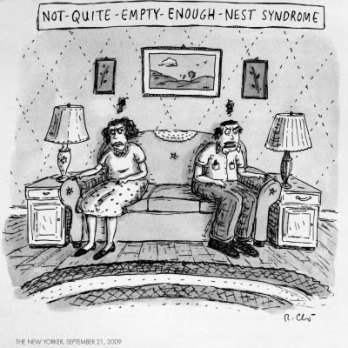
The first is sort of a pathological empty nest syndrome.  These parents are so wrapped up in taking care of children that they would literally have an existential crisis if the kids left, and not know what to do with themselves any more.  They might become extremely depressed.  If they are covertly conflicted over the very role of being a parent and feel guilty about those feelings, they may also have a compulsive need to parent and yet constantly be angry with their children for continuing to be around.  This is the situation that is most frequently seen in offspring who develop borderline personality disorder (BPD).   "Don't leave me - I hate you." 

Sometimes the offspring who develops BPD has a child out of wedlock and then acts too incompetent to take care of the child. The child then must be raised by its grandparents.  The child becomes a sort of gift to the parents.  This is one of the major reasons for the huge spike in the number of grandparents raising grandchildren in the US seen over the last couple of decades.  But that's a matter for another post.

The second family dynamic in which a Freddie or a Minnie results is when the child is triangulated into the parents' relationship.  They parents do not get along with each other but remain so focussed on the alledged inadequancies of their hapless offspring that there is almost no time left for them to get on each others' nerves.  If the child "grows up" and moves away, they then start fighting with each other more and more. 


In a milder version of this dynamic, an adult child moves nearby and is "on call" for the parents to mediate disputes.  Usually it's a daughter but not always.  Mom will come over and say things like, "Your father won't do [such and such] for me. But he'll do it if you ask!"

Said daughter will often not marry because when she asks Mom why she does not ask for help from the daughter's brother or sister, Mom says, "Well, she has a family and I don't want to bother her."  In other words, "She has a family and you don't."  Since Mom seems to need someone to do this, daughter takes Mom's statement as an instruction for her to remain single. Otherwise Mom is in trouble.  The daughter will accomplish this feat in a number of ways.  She might choose to stay celibate, but if this is unsatisfactory, she may instead date - but nothing but a series of commitment-phobic or married men.  At least then she gets to have sex and companionship.  Silver lining.

The third common family dynamic is the most interesting.  To the outside world as well as to the family, the parents appear to be taking care of their incompetent child, but underneath the surface, the child is actually taking care of the parents’ emotional or physical needs. I refer to this shell game as Who is Taking Care of Whom? because the answer depends on the answer to another question: exactly which needs are we talking about here?

In my new book, How Dysfunctional Families Spur Mental Disorders, I describe an interesting example of this.  It is the story of a man in his late thirties who still lived with his parents. He would rarely keep a job for long, often stole money from them, and ran up significant bills on their credit card without permission.

Oddly, the parents always left money lying around the house in plain view, and never once called the credit card company to make sure he could not use the card any longer. They never once suggested that he move out. In fact, whenever he offered to, they would tell him that he was too incompetent to make it on his own. Of course, they certainly had reason to believe that such was the case, but from the patient’s point of view, they did this because they secretly wanted him to stay there and continue his seemingly outrageous behavior.

During his therapy, the other side of the Who is Taking Care of Whom shell game gradually emerged. As they used to say on the great TV show Pushing Daisies, the facts were these: the parents were elderly and lived in an extremely crime-ridden and dangerous neighborhood. Several other elderly residents had been burglarized and in some cases assaulted and almost killed. Almost all of the original inhabitants of the block on which they lived had moved out because of the escalating crime rate, but the patient’s parents refused to budge. Furthermore, they were developing physical infirmities which made them easy targets, and would act in careless ways that almost invited victimization.

The patient originally presented to me as a very angry and potentially explosive individual. Many of my office staff was fearful of him. In his neighborhood, he acted like a dangerous and possibly crazy fellow in many different and very public ways that communicated a strong message that he might go postal at a moment’s notice. His behavior said, “Do not mess with me.” In all probability, because of this behavior, his parents and their house were never touched by crime. Despite his angry appearance, he was in fact a highly fearful and non-violent person. His false self had the effect of protecting his parents from crime while at the same time making it appear to everyone else that he was abusing them and seemed to most others to be completely dependent on them. His apparent “abuse” of his parents took place with their full cooperation.