Pages

Showing posts with label Who's Taking Care of Whom. Show all posts

Tuesday, April 21, 2015

The Dysfunctional Family Role of the "Loser"


It seems like a lot more adults in the United States are living with their parents than ever before. Some of this is completely reasonable and is in no way indicative of significant family dysfunction, as economic conditions have led many twenty-somethings to require much more time to get their financial ducks in a row so they can move out and be more independent. 

In other cases, however, this phenomenon is due to significantly dysfunctional family dynamics. If the pattern continues into the adult children's thirties, forties, or even later, the odds that dysfunctionality is the culprit skyrocket. 

In  a previous post, I discussed some typical patterns that create this pattern, and pointed out that the adult children remain enmeshed with their parents because, covertly, they are taking care of some of their parents' needs. They may be mediating disputes between bickering parents who for whatever reason will not get a divorce; they may be helping take care of sick, elderly, or just plain lonely parents; they may be providing free cooking and housekeeping services for families that for a variety of reasons are not being done by someone else.

Or in some cases, all of the above!


This is the shell game that I refer to as Who is Taking Care of Whom?

I have seen cases of such patterns that continue throughout the entire lifetime of the adult child. You can find many examples of a sixty-something year old man or woman living with an eighty-something year old mother or father. The adult child's siblings may all be independent, but the "identified screw-up" seems to be the parent's favorite child.

Usually in these instances, the parent is taking care of all of the adult child's financial needs, including for housing, food and spending money, so said adult child does not have to work outside of the home.  The reason they do not work, however, is actually because they already have a full time job: taking care of their parents.

On the surface, it seems to all the world - and even to many peripheral family members - that the adult child is using the parent, and said adult child normally receives all of the blame for the dysfunctional living arrangement. They are accused of using the parents because of less than admirable motives.  Many such folks readily accept this blame, and in fact act in many ways to confirm everyone else's worst fears. They do this to protect the image of their parents, and in the process sacrifice their own reputation.

Another variety of this pattern is when the adult child living with parents pretends to be a failure who always seems to need the help of their parents. That is the version of the shell game that is the subject of today's post. The adult child appears to be a big loser in both love and work. Said adult children will venture out into the real world from time to time, only to return in relatively short order with their tails between their legs.

So how does one go about becoming such a loser?  Let me count the ways.

They may flunk out of school for various and sundry reasons that are not actually the real reasons. Alternatively, they may get a degree in something that qualifies them for a profession that is rapidly disappearing from the current landscape, so they cannot get a permanent job.

They may make impulsive decisions that get them in trouble in way one or another, and subsequently lose any job they do manage to land. They may even develop various medical or mental illnesses, some of which are real and some of which are feigned and some of which are both, but all of which appear to be far more disabling than these particular illnesses should ever be in real life (the role of the defective). Drug or alcohol problems are common.  Some of these folks are massively obese.

They may get themselves fired from a whole series of jobs, again for reasons which may appear legitimate but are masks for the real motivation of the job loser. Or they might take a job knowing that the company they work for is actually planning layoffs.

These people may also or instead play the role of loser in their love lives.  They may look like they are really trying to meet romantic partners by going to singles events or signing up for dating websites, but somehow very little comes of it. Or they choose partners - or a series of partners - who are abusive, have drug or alcohol or commitment problems, or are in other ways dysfunctional, so their parents have to come and rescue them from dangerous or dead-end relationships. Sometimes repeatedly.

Because of these patterns, the parents - who are in reality highly dependent on Mr. or Ms. Loser - often criticize the poor judgment of their offspring unmercifully.  

The more the parents criticize, the more the adult child continues making the same mistakes over and over again. The parent then feels justified in continuing to make the criticisms. On the rare occasions when the adult child expresses anger at the parent's constant harping and verbal abuse, the parent can point to the child's irresponsible behavior as justification for it.

In a very real sense, the adult child is purposely giving the parent this ammunition to use against him or her, although they do not have to think about this consciously while doing so because their behavior is habitual and automatic. This allows the parent to avoid feeling guilty for both their criticisms and for the fact that they are contributing to their own child's impairment. The parents, of course, act in this manner because they themselves are playing their own roles within the family.

Some are stuck in bad marriages because of family/cultural/religious prohibitions regarding divorce.  Some are females who are stuck in outdated gender roles with a prohibition against women being independent.  Some need their child to act out their own repressed anger because they cannot do so themselves - often due to family rules prohibiting anyone from being "selfish" enough to put their own needs above those of other family members.


There is a very incisive and sophisticated comic strip called Momma by Mell Lazarus that absolutely nails the family dynamics described above. A son named Francis is the identified loser.  He apparently does have his own apartment, which of course Momma is paying for, but he is constantly doing everything in his power to act out the various negative characterizations of him that Momma compulsively throws his way. 


It's kind of sad that a cartoonist understands this dynamic better than many therapists.

Sunday, October 10, 2010

Freddy the Freeloader and Minnie the Moocher Part II: the Hidden Agendas

In my post of August 10, I wrote about how I have been seeing more and more twenty-somethings (and, I might add, thirty- and sometimes forty-somethings) who are freeloading off of their parents with their parents' almost compulsive cooperation.  The parents may complain a lot, but cooperate they do.  The parents' enabling behavior, as time goes on, produces and then reinforces the "incompetent" behavior of the future Freddy the Freeloaders and Minnie the Moochers.  If the parents compulsively do everything for their "kids" and expect nothing from them, their kids get the idea that providing for children is an extremely vital activity for their parents, and continue to offer up themselves so that the parents can continue with the role they seem to want to play so desperately.

But what's going on with the parents?  Often you can show these parents reams of expert opinion from all kinds of opposing camps that all almost unanimously say something to the effect that, "If you don't let kids do for themselves, they never learn how."  If you quote these experts, said parents will, more often than not, get extremely defensive.  All the while, they will completely ignore the "evidence."  The fact that the expert opinion is in a sense proved to them every day that their children act helplessly seems to go in one head and out the other. 

The parents may rush their kid to some horrid psychiatrist who will assert that the kids' failures are really due to some sort of brain pathology, and immediately put the offspring on medication that obviously does not change the kids' overall behavior one bit.  Nonetheless,the parents will then hurry off to join the Child and Adolescent Bipolar Foundation instead of looking at their own seemingly counter-productive behavior, in order to have their bizarre views reinforced by like-minded parents.

Actually, in a way I disagree with the experts who believe that offspring growing up in this environment "never learn" to take care of themselves.  What dysfunctional individuals are and are not able to do, and what knowledge they do or do not possess, is not something they are necessarily going to admit to for fear of not being able to continue in their role of "losers who are totally dependent on their parents."  Quite often they are secretly very capable individuals indeed.  How do I know this if they will not demonstrate competence nor admit to any if they have it?  Simple.  If they learn to trust a therapist, and if the therapist knows how to ask the right questions, they will then admit to said competence and then demonstrate it in order to remove all doubt.

So again, what's going on with the parents?  I find that there are several possibilities, but the most common are three in number. 

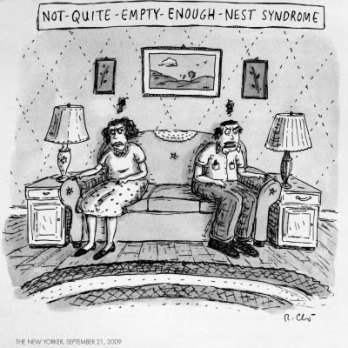
The first is sort of a pathological empty nest syndrome.  These parents are so wrapped up in taking care of children that they would literally have an existential crisis if the kids left, and not know what to do with themselves any more.  They might become extremely depressed.  If they are covertly conflicted over the very role of being a parent and feel guilty about those feelings, they may also have a compulsive need to parent and yet constantly be angry with their children for continuing to be around.  This is the situation that is most frequently seen in offspring who develop borderline personality disorder (BPD).   "Don't leave me - I hate you." 

Sometimes the offspring who develops BPD has a child out of wedlock and then acts too incompetent to take care of the child. The child then must be raised by its grandparents.  The child becomes a sort of gift to the parents.  This is one of the major reasons for the huge spike in the number of grandparents raising grandchildren in the US seen over the last couple of decades.  But that's a matter for another post.

The second family dynamic in which a Freddie or a Minnie results is when the child is triangulated into the parents' relationship.  They parents do not get along with each other but remain so focussed on the alledged inadequancies of their hapless offspring that there is almost no time left for them to get on each others' nerves.  If the child "grows up" and moves away, they then start fighting with each other more and more. 


In a milder version of this dynamic, an adult child moves nearby and is "on call" for the parents to mediate disputes.  Usually it's a daughter but not always.  Mom will come over and say things like, "Your father won't do [such and such] for me. But he'll do it if you ask!"

Said daughter will often not marry because when she asks Mom why she does not ask for help from the daughter's brother or sister, Mom says, "Well, she has a family and I don't want to bother her."  In other words, "She has a family and you don't."  Since Mom seems to need someone to do this, daughter takes Mom's statement as an instruction for her to remain single. Otherwise Mom is in trouble.  The daughter will accomplish this feat in a number of ways.  She might choose to stay celibate, but if this is unsatisfactory, she may instead date - but nothing but a series of commitment-phobic or married men.  At least then she gets to have sex and companionship.  Silver lining.

The third common family dynamic is the most interesting.  To the outside world as well as to the family, the parents appear to be taking care of their incompetent child, but underneath the surface, the child is actually taking care of the parents’ emotional or physical needs. I refer to this shell game as Who is Taking Care of Whom? because the answer depends on the answer to another question: exactly which needs are we talking about here?

In my new book, How Dysfunctional Families Spur Mental Disorders, I describe an interesting example of this.  It is the story of a man in his late thirties who still lived with his parents. He would rarely keep a job for long, often stole money from them, and ran up significant bills on their credit card without permission.

Oddly, the parents always left money lying around the house in plain view, and never once called the credit card company to make sure he could not use the card any longer. They never once suggested that he move out. In fact, whenever he offered to, they would tell him that he was too incompetent to make it on his own. Of course, they certainly had reason to believe that such was the case, but from the patient’s point of view, they did this because they secretly wanted him to stay there and continue his seemingly outrageous behavior.

During his therapy, the other side of the Who is Taking Care of Whom shell game gradually emerged. As they used to say on the great TV show Pushing Daisies, the facts were these: the parents were elderly and lived in an extremely crime-ridden and dangerous neighborhood. Several other elderly residents had been burglarized and in some cases assaulted and almost killed. Almost all of the original inhabitants of the block on which they lived had moved out because of the escalating crime rate, but the patient’s parents refused to budge. Furthermore, they were developing physical infirmities which made them easy targets, and would act in careless ways that almost invited victimization.

The patient originally presented to me as a very angry and potentially explosive individual. Many of my office staff was fearful of him. In his neighborhood, he acted like a dangerous and possibly crazy fellow in many different and very public ways that communicated a strong message that he might go postal at a moment’s notice. His behavior said, “Do not mess with me.” In all probability, because of this behavior, his parents and their house were never touched by crime. Despite his angry appearance, he was in fact a highly fearful and non-violent person. His false self had the effect of protecting his parents from crime while at the same time making it appear to everyone else that he was abusing them and seemed to most others to be completely dependent on them. His apparent “abuse” of his parents took place with their full cooperation.