Pages

Showing posts with label triangulation. Show all posts

Tuesday, September 27, 2016

Confronting Problematic Parents: Getting Siblings and Other Interfering Relatives to Butt Out


In this blog, I have written many posts about the different strategies for metacommunicating or openly discussing any ongoing repetitive dysfunctional interactions between parents and adult children. The goal is to put a stop to them to everyone's satisfaction. Whenever people attempt to initiate this process, somehow word seems to get out to the rest of the family that something is afoot, and everyone gets scared. 

I'm not always sure how this even happens; my patients may swear up and down that they have not said anything yet to anyone. But sometimes even relatives that did not seem to be involved at all seem to just come out of the woodwork and get involved.

Even so, it is usually predictable which family members are going to try to interfere and abort the whole process. Doing this, in the family systems literature, is called triangulating oneself into two other people's relationship. Despite appearances to the contrary, it is not done out of spite but out of fear— often the very same fears that the person who plans to metacommunicate has about the whole process. Most often the triangulator is a sibling, but sometimes it's an aunt or an uncle.

If it's a grandparent, that complicates matters quite a bit, so I will not be discussing that here. Sometimes one's own spouse may get in the way - that is a indicative of a very important marital issue - and again will not be addressed in this post.

Before getting started with the metacommunication process with a primary attachment figure like a parent, it is usually first necessary to try to prevent these other relatives from interfering. In this section I will discuss strategies for accomplishing this. Another caveat: the larger the family, the more potential triangulators there are. If multiple people are likely to get involved, this can make things more complex by orders of magnitude - so if you have a small family and want to do this, be thankful.

As with all metacommunication, detriangulation strategies need to be developed and tailored to the individual family member who is being targeted. I will just be presenting a prototypical, basic strategy here.  

The most typical detriangulation strategy consists of four tasks:

1. First, metacommunicators inform the potential triangulator about their plans to talk to the parental figures, and explain the justification for doing so. They explain what they may have discovered about the family dynamics, and also explain in some detail the approach with the parent they plan to take. The planned approach is something that should have already been worked out by the person, with or without the help of a therapist trained in effective techniques and strategies.

2. The metacommunicators then ask the triangulator what concerns he or she may have about the consequences of the aforementioned plan. As I mentioned, these concerns often turn out to be nearly identical to the reservations that the metacommunicators had when they first considered embarking on the process. 

For siblings and other relatives, the concerns usually center around a fear that the primary target will not be able to handle the confrontation, and may decompensate in some way, or that the confrontation may create tensions in other important dyadic relationships within the family (for example, between the parents). Sometimes, a sibling may fear having to step into a family role previously played by the metacommunicator.

3. Third, the metacommunicators attempt to reassure the triangulator about his or her concerns. The metacommunicators describe how they plan to prevent the negative reactions in the parents that the potential triangulator is concerned about.

They also admit to the triangulator that they themselves have had similar concerns. Even though they may have felt the same exact way in the past, however, metacommunicators often become extremely annoyed with the relative for having any negative attitude towards the plan. As difficult as it may be to muster, an empathic response based on identifying the triangulator's feelings in oneself is far more effective in getting the triangular to keep out of it.

If a metacommunicators can remain empathic during this discussion, the potential triangulator may even make helpful suggestions about how the patient can refine the strategy!

4. Last, and very importantly, the metacommunicators make the following type of statement to the potential triangulator: "I really think it would be best if I handled this myself, so I would appreciate if you did not talk to Mom about this before I have had a chance to do it. However, if you feel that you must warn her or discuss with her the issues as they apply to you, then go ahead and do so." 

The last sentence is designed to reduce the likelihood that the potential triangulator will go ahead and interfere! Family systems folk call this a paradoxical request. The statement appeals to the triangulator for cooperation while indicating that the patient will not be drawn into a power struggle about it.

Many times, a sibling, for example, is already aware that the family behavior patterns are problematic in the way the patient describes, and becomes only too happy to let the metacommunicators try to take care of it. Furthermore, if the triangulator were to broach the taboo subject with the target, the initial negative reactions might fall on him or her. Better someone else than them!

If the triangulator does go ahead and spill the beans, so to speak, the metacommunicators will be in a better position to ask the target about what the triangulator had said. Knowing this will help them better understand any negative reactions from the target that were set up by the triangulator’s interference. 

Tuesday, April 21, 2015

The Dysfunctional Family Role of the "Loser"


It seems like a lot more adults in the United States are living with their parents than ever before. Some of this is completely reasonable and is in no way indicative of significant family dysfunction, as economic conditions have led many twenty-somethings to require much more time to get their financial ducks in a row so they can move out and be more independent. 

In other cases, however, this phenomenon is due to significantly dysfunctional family dynamics. If the pattern continues into the adult children's thirties, forties, or even later, the odds that dysfunctionality is the culprit skyrocket. 

In  a previous post, I discussed some typical patterns that create this pattern, and pointed out that the adult children remain enmeshed with their parents because, covertly, they are taking care of some of their parents' needs. They may be mediating disputes between bickering parents who for whatever reason will not get a divorce; they may be helping take care of sick, elderly, or just plain lonely parents; they may be providing free cooking and housekeeping services for families that for a variety of reasons are not being done by someone else.

Or in some cases, all of the above!


This is the shell game that I refer to as Who is Taking Care of Whom?

I have seen cases of such patterns that continue throughout the entire lifetime of the adult child. You can find many examples of a sixty-something year old man or woman living with an eighty-something year old mother or father. The adult child's siblings may all be independent, but the "identified screw-up" seems to be the parent's favorite child.

Usually in these instances, the parent is taking care of all of the adult child's financial needs, including for housing, food and spending money, so said adult child does not have to work outside of the home.  The reason they do not work, however, is actually because they already have a full time job: taking care of their parents.

On the surface, it seems to all the world - and even to many peripheral family members - that the adult child is using the parent, and said adult child normally receives all of the blame for the dysfunctional living arrangement. They are accused of using the parents because of less than admirable motives.  Many such folks readily accept this blame, and in fact act in many ways to confirm everyone else's worst fears. They do this to protect the image of their parents, and in the process sacrifice their own reputation.

Another variety of this pattern is when the adult child living with parents pretends to be a failure who always seems to need the help of their parents. That is the version of the shell game that is the subject of today's post. The adult child appears to be a big loser in both love and work. Said adult children will venture out into the real world from time to time, only to return in relatively short order with their tails between their legs.

So how does one go about becoming such a loser?  Let me count the ways.

They may flunk out of school for various and sundry reasons that are not actually the real reasons. Alternatively, they may get a degree in something that qualifies them for a profession that is rapidly disappearing from the current landscape, so they cannot get a permanent job.

They may make impulsive decisions that get them in trouble in way one or another, and subsequently lose any job they do manage to land. They may even develop various medical or mental illnesses, some of which are real and some of which are feigned and some of which are both, but all of which appear to be far more disabling than these particular illnesses should ever be in real life (the role of the defective). Drug or alcohol problems are common.  Some of these folks are massively obese.

They may get themselves fired from a whole series of jobs, again for reasons which may appear legitimate but are masks for the real motivation of the job loser. Or they might take a job knowing that the company they work for is actually planning layoffs.

These people may also or instead play the role of loser in their love lives.  They may look like they are really trying to meet romantic partners by going to singles events or signing up for dating websites, but somehow very little comes of it. Or they choose partners - or a series of partners - who are abusive, have drug or alcohol or commitment problems, or are in other ways dysfunctional, so their parents have to come and rescue them from dangerous or dead-end relationships. Sometimes repeatedly.

Because of these patterns, the parents - who are in reality highly dependent on Mr. or Ms. Loser - often criticize the poor judgment of their offspring unmercifully.  

The more the parents criticize, the more the adult child continues making the same mistakes over and over again. The parent then feels justified in continuing to make the criticisms. On the rare occasions when the adult child expresses anger at the parent's constant harping and verbal abuse, the parent can point to the child's irresponsible behavior as justification for it.

In a very real sense, the adult child is purposely giving the parent this ammunition to use against him or her, although they do not have to think about this consciously while doing so because their behavior is habitual and automatic. This allows the parent to avoid feeling guilty for both their criticisms and for the fact that they are contributing to their own child's impairment. The parents, of course, act in this manner because they themselves are playing their own roles within the family.

Some are stuck in bad marriages because of family/cultural/religious prohibitions regarding divorce.  Some are females who are stuck in outdated gender roles with a prohibition against women being independent.  Some need their child to act out their own repressed anger because they cannot do so themselves - often due to family rules prohibiting anyone from being "selfish" enough to put their own needs above those of other family members.


There is a very incisive and sophisticated comic strip called Momma by Mell Lazarus that absolutely nails the family dynamics described above. A son named Francis is the identified loser.  He apparently does have his own apartment, which of course Momma is paying for, but he is constantly doing everything in his power to act out the various negative characterizations of him that Momma compulsively throws his way. 


It's kind of sad that a cartoonist understands this dynamic better than many therapists.

Tuesday, November 12, 2013

Guest Post: Addictions and Development

Today's guest post is by Emma Haylett. She decribes growing up with an alcoholic father who literally tried to recruit her as his drinking buddy, and in the process put her smack dab in the middle (triangulation) of her parents' relationship. This may be a telling example of someone in the role of go-between.


A Revelation

My father bought me my first 6-pack of beer. I was only 14 at the time and drank it behind closed doors, away from him and the rest of my family. It was a late summer night and I remember my mother was already hidden away in her room, lights off, TV on such a low volume like she was whispering with ghosts. Dad sat in a broken recliner watching western violence, occasionally calling my name to come drink with him. Instead, I wrote. I started writing before I popped the first cap and continued to do so after all of them were empty and stagnant around me.

I knew the other kids at my school drank. I knew my dad drank. I watched him every day, but what I didn’t realize was the problem he held. Within the next two hours, I was dizzy and tired. The spoken words of my father were surrounded in quotation marks intermittently written down the page, phonetically spelled out: “Em-uhh,” “ehmm,” and “c’mon to the livin’ room, now.” 

As my state of clarity became more and more unclear, my dad’s stayed exactly the same. I didn’t know he was permanently inebriated until pouring over my notes the next morning. This revelation became something of an alcohol abuse study for years.

My mother never noticed the extra beer my father bought. I think she always assumed Dad was going to drink them, and it was a fair enough assumption. As he pressured me to drink them, I would sip slowly and watch him become more intolerable by the bottle. It didn’t taste good and I don’t remember it feeling good either. 

His speech slurred to the point of intelligibility and his breath was something similar to a laboratory experiment gone wrong. His actions embarrassed me – he would yell at the television if a star delivered a line poorly, and wrap his arm around my shoulder to tell me how to buy liquor underage. Whenever my mother entered the room, his face became tired and uninterested.

One evening, after Dad was snoring deeply in the chair, my mother sat me down and asked me if I drank with him. Of course I didn’t lie – I told her he would give me a few bottles and we would watch TV together. She told me Dad wasn’t healthy and that what he was drinking wasn’t, either. She told me he was always cracking cans since he was about my age, partying much too hard with his friends and family. I wasn’t old enough, she very sternly told me, “and your dad’s decisions reflect poorly upon this family.” I stopped drinking with him after that night.

Family Treatment

Dad was kinder in the early hours of the day and progressively became more incoherent and rude towards the time he usually passed out in the recliner. I come to realize, from lengthy trial-and-error experiments, that the trick to getting lunch money, permission to go out on school nights, or even a small favor was asking him in the mornings after his first coffee with a whiskey cream substitute. 

My mother took the opposite route and, when she thought I wasn’t around, suggested rehab programs later in the evenings, or else, she threatened, she would leave…again and again. But she never did. Their relationship became empty threats with the two of them screaming about whose turn it was to buy essential toiletries with the little money we had, and who was going to raise their daughter standing behind them unnoticed.

There was more hidden behind my father’s alcohol addiction than what was obvious: the empty bottles clacking together as he put another one down was always accompanied by false affection when we had father-daughter talks around the dining room table late at night about being a responsible adult, trust, and his image of love. I learned that being responsible was saving a bit of grocery money for a tall bottle of cheap alcohol. Trust was believing him when he said, “Just one more,” and love was “don’t tell your mother” followed by a bribe.  

Promises to attend my school-sponsored activities came to a screeching halt as the more dangerous drugs became the better part of him. I once found him asleep in the truck idling in the driveway with the windows down and a burnt cigarette between his still fingers. The long stem of ash flaked away as I shook him to remind him that he was supposed to take me to school.

Emotional Detox

I lied to my friends. I lied to my teachers, and I lied to myself - for years. It goes without saying that I don’t trust long or often. I had a hard time believing my ex-fiancé Jake was going for a quick run to the gas station without bringing home a brown paper sack around a bottle or plastic baggie of some substance. I am reminded of being alone when my new neighbor’s empty beer cans crash and echo against each other as she pushes her trash bins to the curb every Thursday morning. I am still angry at my mother who should have tried harder to get my father some help.

I always wished he would have even considered alcohol rehab. I firmly believe our family life could have been different, saved even, with detox and therapy. As an adult, I hesitate to show affection and honesty. I have daylight visions of my father wrecking the truck. I lose hours of sleep over the conversations I should have had with Jake about trust and what it means to be loved without stipulations.

Looking back, it’s hard to know what it is I was feeling. From adulthood, it is easy to know that my father was using me as a crutch, as a tool with which to hurt my mother. And I dutifully played the part of loyal daughter to both of them. I was a substitute, in many ways, for their relationship—an embodiment of the good in my father as my mother saw him, a (albeit young) drinker still capable of offering love - and so she ignored it. For my father, I was a female who served as his caretaker and confidant, a secret-keeper who acted without judgment, an enabler. While my father was dependent upon alcohol, I was simply (or not so simply) using it—more on that here. This was my first experience as an enabler too.

I do remember feeling trapped in between them and, because they were my parents equally, wanting to please both. If I could do it simultaneously, even in secret, it felt like a win. I didn’t like the taste or feel of alcohol, but I also didn’t like the way my father breathed my name until I came out. For me, this drinking was easier, especially since I never outright lied to my mother. Like my father, I had my justifications.

Therapy

I’ve learned that addiction is better treated as a disease. With a non 12-step program, doctors treat addicts with proper medical treatment as you would any other chronic medical illness. Working with addicts in this program has taught me that sometimes you can’t rely on having faith or attending self-help meetings. Sometimes real help (however you find useful to define it) is necessary. 

Addicts can come to an understanding of trust and commitment, as well as formulating a self-betterment plan that is supported by people like me. I provide the guidance and encouragement as well as sensitivity to the issue.

My father would always get upset if the word “addiction” was even quietly muttered.

I realize what it is like to be an addict. I watched and recorded one my entire life. To approach the issue with proper intelligence and caution is critical – to provide them with real courage and motivation rather than standing idly by will push the addict towards getting the appropriate help and the chance of staying healthy will greaten. It’s a very rewarding opportunity to be there for somebody and to see them succeed.

I help myself by helping people overcome these dangerous addictions. I help them make that sensitive reconnection to their family and children. There is always hope that they can raise their kids to live without being exposed to the fear and emotional emptiness that that I hold inside and that is so overwhelming. Getting help can change more than one life. That first step is always the hardest, but I know in my heart of hearts it can make a difference.

Author Bio: Emma Haylett finds comfort in writing. When she’s not helping coordinate non 12 step recovery programs for addicts and their families, you can find her watching terrible made-for-TV movies.

Tuesday, May 15, 2012

Getting Significant Others to Tell You the Truth, Part I: Judgments Masquerading as Descriptions


As I have mentioned in many posts in this blog, the key to effective problem solving for dysfunctional families is to initiate metacommunication (talking about the nature and manifestations of rules by which the family operates, as well as talking about the way the family communicates), and then learning how to do it effectively.  Many strategies were discussed previously in my two series, Ve Have Vays of Making You Talk and How to Disarm a Borderline.  


Many of the strategies described in the Disarm posts need not be limited to dealing with family members who have significant borderline behavior, but work well on anyone trying to avoid telling you that they are purposely frustrating you because they do not want you to pursue certain lines of questioning.


In this new series of two posts, I will describe situations in which individuals with whom one is attempting metacommunication seem to be answering the questions that have been posed to them but are, in actuality, avoiding answering the questions.

In the second, upcoming post I will describe a strategy used by people who do not want to tell you their real motives for why they did or did not do something - thereby blocking your efforts to understand them and their motives better: descriptions masquerading as explanations.

In this post, I will cover a problem that crops up when one family member questions another family member about his or her relationship with a third party.  I call it judgments masquerading as descriptions.

This applies in situations in which the goal for the metacommunicator is to avoid being triangulated into the relationship of two other family members who are at war with one another.  According to family systems theory, when any two family members are having an unstable relationship, they will often rope in a third party as a sort of buffer.  


Two of the three members of the triangle may seem to gang up on the third, but there is usually much more to the story than that.  If deemed necessary, the alliances can quickly shift, so that the person ganged up upon can suddenly join either of the other two parties to gang up on the third, who had previously been allied with the other member of the triangle.  The goal of triangulation is avoidance of the underlying conflict, not its solution.


In the process of roping in a potential triangulee, so to speak, one of the original warring dyad – will call him #1 - will tell stories about the other (#2) designed to provoke outrage at #2.  #2 will be said to have engaged in some dastardly behavior or other. 

In this situation, in order to prevent triangulation, The metacommunicator (#3) should then try to get a more complete description of what has transpired, to make sure that #1 is not leaving out any information that might change #3’s perspective about both the events in question and the reasons why #2 may have reacted the way he or she did. 


When first asked about a particular interactional relationship episode, #1 may  respond with a rather global judgment about the other person involved rather than a specific description of what actually took place. 

A woman, for example, might describe her father as “controlling.”  Unless #3 knows precisely what she means by “controlling,” he or she is in no position to judge whether this characterization is accurate.  #3 might have a very different conception about what constitutes “controlling” behavior and what does not, as well as about what behavior it is that the father might be attempting to “control.”  


A typical scenario in which #3 might conclude that he or she is being misled might go something like this: #1 states globally that her father tries to control whatever she does.  Dad might, unbeknownst to #3, call her incessantly on her cell phone whenever she goes out on a date.  Upon further inquiry or observation, however, #3 learns that the father bankrolls his daughter’s every whim, no matter how reckless, whenever she asks him for money.  #3 then draws the incorrect conclusion that the patient’s characterization of the father as “controlling” is completely distorted.
           
Notice something peculiar in this particular case.  If #1 knows that #3 may come to know facts which would call into question #1’s “judgment” about #2, then the goal of #1 may be to provoke #3 into siding with #2!  In other words, the goal of the triangulators may be to create a situation in which two people gang up against them!!  Also, if #2 creates the situation in a way that keeps it rather ambiguous as to exactly who did what to whom, this allows #2 to manipulate the triangle so that the potential metacommunicator can be provoked to change sides several times over the course of a long period of time, depending on what seems useful at the time the switch is provoked.

In order to avoid this scenario, it is important to find out exactly what behavior the father engages in that leads #2 to use the term “controlling.”  In other words, what specific behaviors and suspected motives of the father are entailed by #2’s use of the term?  Even people whom most others would find very power-oriented do not try to control absolutely everything that their family members do.  They would not in most instances care, for example, what time family members brushed their teeth. 


In this case, for example, the father is attempting to control his daughter's dating life, while letting her do whatever she wants in most other areas of her life.  In fact, he seems to be enabling her to do what she wants in those other areas.  So the judgment "controlling" is both correct and incorrect simultaneously.  Nobody is one was all of the time when it comes to almost any conceivable characteristic.  To think otherwise is black-or-white thinking, or "splitting" if you will.

#3 must be a good investigative reporter and ask for specifics using follow-up questions.  He or she should ask for detailed examples of misbehavior by other family members, and run down implied but unspoken implications.  In the above case of a judgment masquerading as a description, #3 should ask for illustrative examples.  He or she could ask, “What exactly is your father trying to make you do or not do?”  If #2 responds with another global generalization such as, “Everything!” #3 should persistently ask for some prototypical examples.  


After an example of an interaction is finally given, it may still be necessary to ask for further clarification: Exactly how did the father’s behavior lead #2 to conclude that he wanted to control one of her activities?  The father’s statements as reported by #2 may sound relatively innocuous to #3, but such may not be the case.  #3 might ask, “What was it about that statement that made you think that he does not want you to get married?”

To summarize, to find out what #2 really means, #3 needs to ask for behavioral descriptions, not just the patient’s opinions regarding the other person's personalities. Metacommunicators must ask follow-up questions. They can ask for clarification of vague or confusing statements and inquire about seemingly insinuated but unspoken implications. 


To continue with the example a woman who described her father as “controlling,” the metacommunicator would learn much by asking the patient the following additional questions: What do you mean, in behavioral terms, by “controlling”? What is your father doing and saying that indicate that he wants to control you? What do you believe to be his motives for wanting such control, and on what do you base this belief? What part of your life do you think he wants to control? What exactly is he trying to get you to do or not do? How does he go about trying to control these aspects of your life? Under what circumstances does he act in such a manner, and under what circumstances does he not act that way? What are you doing or saying that might be provoking a “controlling” response?

In obtaining concrete descriptions of interactions rather than globalized judgments, it is also important to find out what the people in the described relationship vignettes actually said to one another. Finding out specifically who said exactly what to whom in reported conversations that were conflictual, adversarial, or anxiety-provoking for someone often adds a tremendous amount to a person’s understanding. Family members who may otherwise omit important details often are able to provide very accurate details of affect-rich conversations because such conversations are so emotionally salient for them. 


One should try also to elicit as much as possible about the whole conversation, not just a part of it. In particular, the way conflictual conversations end may provide important details about the patterns of mutual invalidation that often characterize poor communication in families. Statements such as “Mom did not respond at all after I told her that” are ambiguous and should trigger further requests for clarification. What did Mom actually do at the point of “no response”? It is impossible to not behave.  


Did Mom turn around and walk out of the room? Stare silently into space as if in a trance? Roll up into a fetal position? The answer to such questions allows #3 to better understand #2’s need for avoidance and ambiguity in their discussions of important issues.

The more specific and detailed the questions you ask, the more accurate the picture of the other’s relationships becomes.

Sunday, October 10, 2010

Freddy the Freeloader and Minnie the Moocher Part II: the Hidden Agendas

In my post of August 10, I wrote about how I have been seeing more and more twenty-somethings (and, I might add, thirty- and sometimes forty-somethings) who are freeloading off of their parents with their parents' almost compulsive cooperation.  The parents may complain a lot, but cooperate they do.  The parents' enabling behavior, as time goes on, produces and then reinforces the "incompetent" behavior of the future Freddy the Freeloaders and Minnie the Moochers.  If the parents compulsively do everything for their "kids" and expect nothing from them, their kids get the idea that providing for children is an extremely vital activity for their parents, and continue to offer up themselves so that the parents can continue with the role they seem to want to play so desperately.

But what's going on with the parents?  Often you can show these parents reams of expert opinion from all kinds of opposing camps that all almost unanimously say something to the effect that, "If you don't let kids do for themselves, they never learn how."  If you quote these experts, said parents will, more often than not, get extremely defensive.  All the while, they will completely ignore the "evidence."  The fact that the expert opinion is in a sense proved to them every day that their children act helplessly seems to go in one head and out the other. 

The parents may rush their kid to some horrid psychiatrist who will assert that the kids' failures are really due to some sort of brain pathology, and immediately put the offspring on medication that obviously does not change the kids' overall behavior one bit.  Nonetheless,the parents will then hurry off to join the Child and Adolescent Bipolar Foundation instead of looking at their own seemingly counter-productive behavior, in order to have their bizarre views reinforced by like-minded parents.

Actually, in a way I disagree with the experts who believe that offspring growing up in this environment "never learn" to take care of themselves.  What dysfunctional individuals are and are not able to do, and what knowledge they do or do not possess, is not something they are necessarily going to admit to for fear of not being able to continue in their role of "losers who are totally dependent on their parents."  Quite often they are secretly very capable individuals indeed.  How do I know this if they will not demonstrate competence nor admit to any if they have it?  Simple.  If they learn to trust a therapist, and if the therapist knows how to ask the right questions, they will then admit to said competence and then demonstrate it in order to remove all doubt.

So again, what's going on with the parents?  I find that there are several possibilities, but the most common are three in number. 

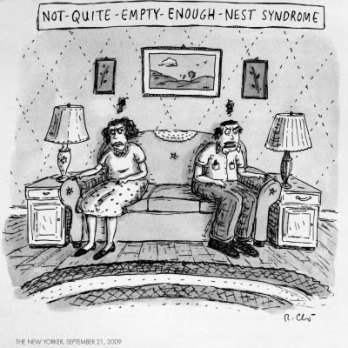
The first is sort of a pathological empty nest syndrome.  These parents are so wrapped up in taking care of children that they would literally have an existential crisis if the kids left, and not know what to do with themselves any more.  They might become extremely depressed.  If they are covertly conflicted over the very role of being a parent and feel guilty about those feelings, they may also have a compulsive need to parent and yet constantly be angry with their children for continuing to be around.  This is the situation that is most frequently seen in offspring who develop borderline personality disorder (BPD).   "Don't leave me - I hate you." 

Sometimes the offspring who develops BPD has a child out of wedlock and then acts too incompetent to take care of the child. The child then must be raised by its grandparents.  The child becomes a sort of gift to the parents.  This is one of the major reasons for the huge spike in the number of grandparents raising grandchildren in the US seen over the last couple of decades.  But that's a matter for another post.

The second family dynamic in which a Freddie or a Minnie results is when the child is triangulated into the parents' relationship.  They parents do not get along with each other but remain so focussed on the alledged inadequancies of their hapless offspring that there is almost no time left for them to get on each others' nerves.  If the child "grows up" and moves away, they then start fighting with each other more and more. 


In a milder version of this dynamic, an adult child moves nearby and is "on call" for the parents to mediate disputes.  Usually it's a daughter but not always.  Mom will come over and say things like, "Your father won't do [such and such] for me. But he'll do it if you ask!"

Said daughter will often not marry because when she asks Mom why she does not ask for help from the daughter's brother or sister, Mom says, "Well, she has a family and I don't want to bother her."  In other words, "She has a family and you don't."  Since Mom seems to need someone to do this, daughter takes Mom's statement as an instruction for her to remain single. Otherwise Mom is in trouble.  The daughter will accomplish this feat in a number of ways.  She might choose to stay celibate, but if this is unsatisfactory, she may instead date - but nothing but a series of commitment-phobic or married men.  At least then she gets to have sex and companionship.  Silver lining.

The third common family dynamic is the most interesting.  To the outside world as well as to the family, the parents appear to be taking care of their incompetent child, but underneath the surface, the child is actually taking care of the parents’ emotional or physical needs. I refer to this shell game as Who is Taking Care of Whom? because the answer depends on the answer to another question: exactly which needs are we talking about here?

In my new book, How Dysfunctional Families Spur Mental Disorders, I describe an interesting example of this.  It is the story of a man in his late thirties who still lived with his parents. He would rarely keep a job for long, often stole money from them, and ran up significant bills on their credit card without permission.

Oddly, the parents always left money lying around the house in plain view, and never once called the credit card company to make sure he could not use the card any longer. They never once suggested that he move out. In fact, whenever he offered to, they would tell him that he was too incompetent to make it on his own. Of course, they certainly had reason to believe that such was the case, but from the patient’s point of view, they did this because they secretly wanted him to stay there and continue his seemingly outrageous behavior.

During his therapy, the other side of the Who is Taking Care of Whom shell game gradually emerged. As they used to say on the great TV show Pushing Daisies, the facts were these: the parents were elderly and lived in an extremely crime-ridden and dangerous neighborhood. Several other elderly residents had been burglarized and in some cases assaulted and almost killed. Almost all of the original inhabitants of the block on which they lived had moved out because of the escalating crime rate, but the patient’s parents refused to budge. Furthermore, they were developing physical infirmities which made them easy targets, and would act in careless ways that almost invited victimization.

The patient originally presented to me as a very angry and potentially explosive individual. Many of my office staff was fearful of him. In his neighborhood, he acted like a dangerous and possibly crazy fellow in many different and very public ways that communicated a strong message that he might go postal at a moment’s notice. His behavior said, “Do not mess with me.” In all probability, because of this behavior, his parents and their house were never touched by crime. Despite his angry appearance, he was in fact a highly fearful and non-violent person. His false self had the effect of protecting his parents from crime while at the same time making it appear to everyone else that he was abusing them and seemed to most others to be completely dependent on them. His apparent “abuse” of his parents took place with their full cooperation.