Pages

Showing posts with label Claudia Gold. Show all posts

Thursday, January 29, 2026

Book Review: Getting to Know You by Claudia M. Gold, MD


The author of this book has been working on the understanding and treatment of attachment issues between infants and very young children with their parents for a long time. I followed her blog, Child in Mind. Her writing touches on many of the same issues I have been studying and writing about that affect adults in psychotherapy with repetitive self-destructive and self-defeating behavior.

I believe that these issues do not receive any where near sufficient attention from the majority of psychotherapists. They include:

  • ·        The nature of shared intrapsychic conflicts within extended families and how they develop over at least three generations. (Psychoanalysts still think this type of conflict is just within the minds of individuals).
  • ·        Our tribalistic tendencies to stick with particular behavioral rules regarding love, work, and play.
  • ·        How these rules change as culture has developed over time with a stronger emphasis on individuality and its balance with collectivist tendencies, and that individual families can have trouble changing their own rules due to what sociologists call cultural lag. We all have a tendency to stick to old rules and yet secretly admire people who can be more self-actualizing. People can be highly ambivalent about the current rules by which they operate but often won’t admit it because they would be invalidated by their own parents and extended family, and because of guilt and shame over their own problems.
  • ·        The effects of traumatic incidents on individuals and families, which can make adapting to current situations more difficult. This problem can then be passed down inter-generationally so that some people conform to old rules which would have (but no longer) made them safer. This process starts with infant attachment processes but can continue on through an entire lifetime.

In treatment, the author takes a stance toward her patients’ behavioral issues that is quite similar to the stance I took with my patients at the beginning of psychotherapy: not knowing – being comfortable with not knowing in advance or making a judgment about what’s “wrong” with a patient’s behavior, and not offering any immediate solutions to problems they bring to the office. Non-judgmental curiosity combined with active listening. Only asking questions when what is said is ambiguous or confusing. Giving them the benefit of the doubt regarding the reasons behind seemingly irrational behavior.

I strongly believe that practitioners really need to start paying more attention to such things as brain development, the intergenerational transmission of trauma, and how the interactions of family members affect the behaviors of its various member. And, of course, how to work with new parents when they seem to be having problems related to these things.

She points out that ambivalent, somewhat dark feelings are very common in new parents. She adds that when these feelings must be hidden “…because of shaming cultural prohibitions, the effect can be a downward spiral of missed cues and disconnections as caregivers struggle with feelings of self-doubt and guilt.” (p.67) This also touches on  cultural lag.

Some other vital phenomena explained in the book include epigenetics and how the brain develops in an interpersonal environment. Babies know absolutely nothing about how the world operates and learn to interact with the environment through various interactions with caregivers. This applies particularly to learning how to behave within their own social environment. Their sensory and emotional experiences are linked from birth.

The book looks at these phenomena from the perspectives of the infants, caregivers, family relationships, and culture.

I highly recommend this book to anyone interested in these phenomena.


Tuesday, November 13, 2012

Random Thoughts and Random Quotes: Parenting


Today's post comes courtesy of my Facebook Page - some random ideas, as well as some snide remarks, about the perils of parenting that I've been collecting and or making up.

Caution:  If you find yourself getting defensive when you read an item rather than just thoughtfully disagreeing with the sentiment expressed, this might mean that you are feeling guilty about the job you are doing or have done as a parent. If so, keep an open mind.  You may very well have a good reason for disagreeing, but on the other hand, you just might learn something.

I would particularly like to acknowledge and thank advice columnist Carolyn Hax, blogger pediatrician Claudia Gold, and parenting columnist John Rosemond for their amazing insights and way with words.

John Rosemond


Here's a useful retort for parents to use after being criticized by other parents for not making things easier for their adult kids all the time: “I know, right? Why couldn’t he stay safe in my basement playing video games!”

"...There are no parents more difficult to deal with, no parents who defend their children with greater ferocity, no parents more blind to reality, no parents more irrational, than the parents of bullies. They are world-class enablers and terrorists all rolled up into one. The apples don't fall far from the trees." ~ John Rosemond

The reason ADHD is more common in males has been discovered!! According to an article by Dr. Mary Seeman in the September issue of Psychiatric Times, evolutionary biology shows that boys naturally have more impulsivity, aggression, and high energy than girls. She goes on to state, "These sex traits, which served to establish social dominance among males early in the evolution of our species and aided the cause of sexual selection, are now a handicap and require therapeutic intervention." Wow, so now we know that the reason that ADHD is more common in males is "boys will be boys."

"Recently I saw several children who had been diagnosed with ADHD but for whom medication "didn't work". One mother told me about her own struggles with untreated depression. Another child spent weekends with an actively drinking alcoholic father. A third child quietly spoke with her mother of being frightened when she pulled her hair and hit her." ~ Claudia Gold M.D.

Carolyn Hax

What many child psychiatrists don't seem to know any more: "...kids are notorious for having different sets of behaviors for different environments. Just ask the dismayed parents who have watched their otherwise stubborn kids magically fall in line with the rest of the class when they enter a school or day-care environment." ~ Carolyn Hax

On parenting teenagers: "Invariably, micromanaging results in four problems: deceit, disloyalty, conflict, and communication problems." ~ John Rosemond

"Parents make sure homework is returned without error, drill their kids on upcoming tests to the saturation point, and then complain if teachers do not give the grades they think their kids deserve. By that point, it's hard to tell whose grades they are." ~John Rosemond

"If you want your children to improve, let them overhear the nice things you say about them to others." ~ Dr. Haim Ginott

When was the last time you heard a mom tell a kid to get out of her hair for an entire afternoon by saying, "It's a nice day; go play outside!"?  My generation used to hear that all the time, and we were the better for it (paraphrasing John Rosemond).

"Today's mom watches her every child-rearing step lest she commit some egregious and apocalyptic parenting faux pas that will certainly doom her child to a life spent sleeping under overpasses, or worse, not going to Harvard." ~ John Rosemond

"'Good' parenting, apparently, is trying techniques on your kid that were never used on you, even though you still turned out just fine. 'I think TV is bad, I won't let my kids watch it.' Outstanding. But how do you explain how you watched 5 hours of TV a day for thirteen years straight and still turned out ok?" ~ The Last Psychiatrist

"I'm not ADHD; I'm just naughty" ~ formerly medicated foster child on the TV newsmagazine 20/20. Out of the mouths of babes...

On "because I said so" as a valid reason to give to a child: "If a child does not like the decision a parent makes, the child will not like the parent's reason. No child has ever said, "Dad, I gotta hand it to you...when you explain yourself like that, I can't help but agree!" ~ John Rosemond

A study that appeared in the journal Pediatrics revealed that 8% of pediatricians felt they had adequate training in prescribing antidepressants, 16% felt comfortable prescribing them, but 72% actually did." ~Claudia Gold

Boston Globe Headline: "ADHD rates low among Latinos - Findings baffle health researchers." Could it be that Latino parents are more likely to still demand that their children respect them?

Parents of out of control child: "We've tried everything!" That's the problem. They did not stick with anything long enough for it to work but ran willy nilly from one disciplinary measure to another. (paraphrasing John Rosemond)

"HGTV hosts a show on decorating for Halloween that shows new ways to turn the simple joys of childhood into a needlessely expensive way to keep up with the Joneses. Suburban one-upmanship. Now that's really scary!" - Kevin McDonough


With stepparents these days, the emphasis is no longer on parent, but on step - someone to be walked on. The stepparent is effectively disempowered by the "real" parent. The "real" parent enables the child's disrespect of rules as well as of the stepparent. (Paraphrasing John Rosemond).


Thursday, July 15, 2010

It's the Relationship, Stupid!

Two of my friends recently e-mailed me an article in the New York Times by a Psychiatrist named Dr. Richard Friedman entitled Accepting That Good Parents May Plant Bad Seeds (http://www.nytimes.com/2010/07/13/health/13mind.html).

Before I could blog about it, I noticed that my fellow family issues blogger, pediatrician Dr. Claudia Gold, had beat me to the punch, with an absolutely spot-on critique of the article entitled, Neither Bad Parents Nor Bad Seeds (http://claudiamgoldmd.blogspot.com/2010/07/neither-bad-parents-nor-bad-seeds.html).

Still, I did not realize just how pernicious Dr. Richard Friendman's column was until I saw a comment on Claudia's Blog from someone calling himself J.C. He made the comment that the column made a strong implication that "Children are not dynamic, they can come broken just like computers, without any inherent ability to adapt." Reading the column again, I saw that it implied that the "son" described in the article had apparently come into the world with a heavy genetic loading for rude behavior!


His opinion: "the fact remains that perfectly decent parents can produce toxic children." Toxic children? The very phrase reminded me of Susan Forward and Craig Buck's famous (and still selling) 1989 self-help book, Toxic Parents: Overcoming Their Hurtful Legacy and Reclaiming Your Life. While Dr. Forward did hold out some hope for the adult products of abusive family environments reconciling with their parents, many therapists took note of the title and started advising their patients to divorce their "toxic" parents in order to feel better.

That sounds like good advice until you read the attachment literature. It shows that the best predictor of how well your relationship with your own children will turn out is the nature of your relationship with your own parents. This happens regardless of whether you remain in continuous contact, or not. In fact, since you unfortunately carry your parents around in your head forever (regardless of whether either you or they wish it so), "divorcing" your parents may not prevent the intergenerational transmission of highly dysfunctional family patterns. It may in some cases actually help foster it.

An awful lot of my patients try awfully hard to be the "unparents." They vow they will never treat their children the way that their parents treated them. Unfortunately, they tend to go to the opposite extreme and often end up with kids who have the same problems they do, or who have a polar opposite but still related problem.

If they felt neglected by their parents, for example, they may become overinvolved with and overprotective of their children. If you want to know what might be likely to happen if they do that, please read my very last blog post.

If their parents were alcoholics, for another example, they may compulsively drug-test their kids and repeatedly search the kids' room for contraband before the kids have ever done anything - thereby giving their children the inadvertent message that they expect their kids to abuse alcohol. In working on emotional family trees called genograms, therapists sometime see a generation of alcoholics followed by a generation of teetotalers followed by a generation of alcoholics. Try explaining that one with the concept of a genetic predisposition to alcohol. I dare you.

So were abusive parents born toxic children? Was the 17 year old boy described in Friedman's article born to be "...unkind and unsympathetic to people...rude and defiant at home, and often verbally abusive to family members"?

Friedman trots out the ignorant old warhorse explanation that the boys behavior could not possibly have been caused by "bad parenting" because "this supposedly suboptimal [parental] couple had managed to raise two other well-adjusted and perfectly nice boys. How could they have pulled that off if they were such bad parents?"

First of all, who even said that they were bad parents in the first place? Second, parents do not even remotely treat all of their children the same. Anyone with a sibling or more than one child can tell you that. Anyone remember the Smothers Brothers' comedy team schtick, "Ma always liked you best?" They built a huge career around that one routine. Do you think it might have struck a chord with anyone?

In Claudia Gold's blog post, she describes a family that she treated in which a behavior problem that was similar to the one in the Friedman article was present. She describes exactly how and why a negative pattern of interactions between a parent and a child was set in place, despite everyone's best intentions. I highly recommend her post.

Warning: speculation ahead, based on similarities to many other cases I have treated, and which may or may not apply to this one:

In the case of the particular adolescent described in the Friedman column, a clue as to what might have happened in this family was the observation Friedman himself made that ""it was clear that her [the mother's] teenage son had been front and center for many years."

Maybe too front and center. If the parents were obsessed with their son's negative attitudes and repeatedly lectured him about them ad nauseum, they may have unwittingly given him the message that they would be disappointed if they were deprived of the right to go on lecturing him. In response, he might continuously give them that opportuntity by maintaining the bad attitude.

In addition, it is possible that the parents gave signs to the boy of covert approval when he was rude to other family members. A son sometimes takes on a role that psychotherapy integrationist Sam Slipp called the avenger, in which he acts out his parents unacknowledged and for them forbidden hostility. This allows the parents to vicariously experience the expression of their negative feelings without having to own or be responsible for them.

Psychoanlysists refer to this interpersonal phenomenon as projective identification. They speak of "superego lacunae" or holes in the parents' conscience that prevent them from expressing certain feelings but which lead them to indirectly validate the expression of those very same feelings in their children, even while criticizing the children unmercifully for having done so.

It is not toxic people that create a dysfunctional family, but toxic relationships. Affixing moralistic blame to one individual in the family just makes matters worse. It turns that person into what family systems therapists refer to as the identified patient, when the real patient is the whole group. The identified patient is often a scapegoat.

Even when parents or children do horrible things to each other, labeling them as bad seeds is counterproductive.

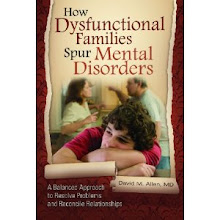
In dealing with a toxic relationship, the choice that an adult from a dysfunctional family has is not between self-exile and continuing to put up with abusive behavior. There are types of psychotherapy which can help people repair dysfunctional relationship patterns, solve problems, and reconcile with their loved ones. In my new book, I tell which psychotherapy paradigms are designed to do this. Not all therapists know how. It's not an easy task to detoxify a toxic relationship because feelings run very high, and defenses can be formidable, but it can be done.

IMHO, we need to help put a stop to the intergenerational transmission of dysfunctional family patterns, and these treatments are the best way to do that.

It is interesting that next to Dr. Friedman's article is a still from the 1956 movie, The Bad Seed, about a pretty little girl from a fine family who develops into a young murderess for no apparent reason. Such things, unless a baby comes out brain damaged in some way, happen only in lurid novels and movies.