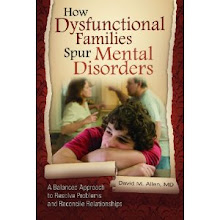
There are a plethora
of self-help books out, including the one I wrote (pictured above), advising adult children of
toxic parents on what to do. Some recommend cutting them off, some recommend
keeping them at a distance, some recommend trying to set better boundaries, some
talk about whether reconciliation is possible or not, and a few of them say it
depends on the nature of the problems.
My own view, as most
of my readers know, is to solve the problem of ongoing toxic parental behavior
by researching the family history to identify shared internal conflicts, the
reasons for them, and the effect of ambivalent double messages throughout at
least three generations on everyone involved. Then, the object is to confront
the issue head on by developing various strategies to empathically get past
parents’ formidable defenses and come to some mutual understanding of why everyone
is so miserable and what can be done to stop repetitive dysfunctional
interactions. The goal is not reconciliation per se but problem solving. Reconciliation and
forgiveness is, however, however, a typical byproduct.
The psychotherapy research
literature has had very little to say about this. It does come up in opinion
pieces in such magazines as Psychology
Today or The Psychotherapy Networker.
I think this whole
question is a much bigger issue than it appears to be, and is a major cause of
self-destructive or self defeating behavior, anxiety and unhappiness. How do I
know? Well, a few years ago I started reading newspaper advice columns on the
internet from four different advisors: Carolyn Hax, Amy Dickerson, Annie Lane,
and Dear Abby. In order to maintain their readership, these columnists have to
identify which letters are going to lead to a lot of public interest. If
subjects pop up a lot, one might conclude that the problems discussed are very
common.
And letters about this
issue are exceeding common. People are constantly asking how to solve ongoing
behavior from parents that is driving them crazy, whether they should reconcile
with parents that have been already been cut off, whether to cut off toxic
parents, guilt over a decision already made regarding a cut off, how to set
boundaries, whether to reveal a history of child abuse to siblings and
children, and how to stand up to parents without being disowned. My count of
letters like this in the four columns was 28 in 2021 and 12 through April of
this year. And I’m not even counting all the letters from parents who have been
cut off by their children for “mysterious” reasons as I described in two previous posts.
Some writers are
writing to justify their decisions on this matter, but their ambivalence about
whatever decision they have made is just blaring. If they think their decision
was so good, why are they writing about it? Some even want to warn people to
watch out for therapists who recommend reconciliation, shouting the benefits of
cut-offs from the rooftops. Do they think every situation is the same? And why
do they feel the need to shout this out by writing to an advice columnist.
As I have said many
times, cutting off an abusive parent is better than continued abuse, but those
are not the only two options. My book discusses the third option for cases that
do not involve significant physical or sexual abuse, and my psychotherapy model
is for therapists to help all kinds of cases no matter how severe. The methods
are not quick fixes, and the therapy is long term and often either not paid for
by insurance or just flat out unavailable, since this therapy model has
unfortunately not caught on. So the best solution can be very out of reach.
However, the danger of ongoing cut offs AND continuing abuse and toxicity is that the interpersonal and intrapsychic (in the mind) issues are not resolved but continuously reinforced by ANY family contact and consequently are seldom sufficiently repaired. Not to mention that the risks of passing them on to your own kids is quite high.
The
high degree of ambivalence about making or having made these decisions regarding ongoing contact shows how important family really is to just about everyone