Pages

Tuesday, February 21, 2012

Assuming Facts Not in Evidence II - Sleeping Medications


As I described in my post of January 31:

One marketing technique used by big Pharma to mislead physicians is the engineering of a journey of ideas that have never been proven into the clinical lore as if they were established facts.  So-called experts who are paid off by drug companies make presentations at continuing medical education conferences or write "review" articles for medical newspapers or throwaway journals in which they mention these so-called "facts."

In these situations, conditional phrases are said or written as a quick aside in order to leave the speakers and writers a loophole just in case a member of the audience challenges them about overstating their case. Should this happen, the speakers are then able to point to the conditional language they used and “remind” the audience that their use of this language indicates that they are not making spurious claims.  


Most of the time, however, no one in the audience will make such a challenge. The audience is left with a dangling implication that the statement is an established fact. The non-discerning physician comes away with the “take home lesson” that the assertion is true.  Research has shown that most people only remember one or two salient points from a paper or an oral presentation anyway.

I have also written about how I suspect (but cannot prove), that drug companies begin to actively spread negative information and even disinformation about drugs as soon as most brand-named drugs in a certain class become available generically.  As I wrote in my post of October 19, 2011:

Pharma-inspired or paid-off writers denigrate highly-effective drugs (antidepressants and benzodiazepines) that just happen to have gone generic, in hopes that doctors will prescribe more expensive, potentially more toxic, and less effective brand-named drugs (particularly atypical antipsychotics). 

It amazes me how drug companies have only now been releasing negative information (that had apparently been held back from the public previously) about SSRI anti-depressants -since they have been available since the mid-1980’s.

I had seen this sort of thing done before to a class of drugs called benzodiazepines, which are demonized as being far more addictive than they actually are.  Interestingly, this demonization of the drugs started anew with the introduction of three new sleeping medications (Ambien, Lunesta, and Sonata) that, although slightly different in chemical structure than benzodiazepines, do exactly the same thing in the brain.  (Ambien has gone generic, but Pharma sells a delayed-release version that is still brand named.  As we shall see shortly, this type of formulation directly undermines one of their claims - that the new drugs are safer than the old ones).

Benzodiazepines include such popular drugs as Valium, Librium, Klonopin, Ativan, Xanax, Dalmane, and Restoril.  Ambien, Lunesta, and Sonata  are technically not benzodiazepines, but they might as well be.  They are called non-benzodiazepine benzodiazepine receptor agonists.  Loosely translated, this means that they affect the same nerve cells in exactly the same way as benzodiazepine benzodiazepine receptor agonists.   

They offer no advantage in terms of addictive potential, side effects, or efficacy.  In fact, they offer some real disadvantages.  They are far more likely than the old benzo’s to cause people to do things in their sleep that they do not remember the next day, including cooking large meals and even driving significant distances!  Also, if you take Ambien and force yourself to stay awake, you get really high.

As an aside, most of the public, and many physicians who should know better, believe that some benzodiazepines are tranquilizers, while others are sleeping pills.  An old joke asks, “What is the difference between a tranquilizer and a sleeping pill?”  The answer: marketing. 

Most outrageously, the drug companies successfully lobbied the government to have benzodiazepines excluded from the Medicare drug benefit program – the only major class of drug so excluded – while not excluding the new, more expensive brand named sleepers!  This law has finally been changed to allow for the old drugs, but that change will not take place for some time.

Pharma shills have fanned out to convince everyone that the new drugs are both safer and more effective than the old ones.  With success. I frequently see physicians who seem to think that benzodiazepines are the scourge of the earth due to their addictive potential prescribing the new drugs with abandon (not to mention prescribing much more serious drugs of abuse such as stimulants).


Now, that the new drugs are better and safer is one of the widely-disseminated “established facts” that are not really facts at all.  Again, I am going to pick on an article in the psychiatrist newspaper, the Psychiatric Times.  I do so reluctantly because this publication often prints more balanced articles, but lately it has been just feeding me blatant examples of points I’m trying to make in this blog.


The article in question appeared in the January 2012 edition of the paper and was entitled, “Treatment of Insomnia in Anxiety Disorders.”  It was written by Gregory Asnis, Elishka Caneva, and Margaret Henderson.


In discussing pharmacological treatment of insomnia, they say, and I quote, “Not only are the non-benzodiazepines effective [that part is true], but there is a notion that they are safer than benzodiazepines.”  They give two reference here I will discuss shortly.


A notion?  Notice they are not actually saying here that the drugs are safer.  As I mentioned above, they do try to leave themselves an out.  However, the authors go on to make a stronger statement: “Although head to head studies comparing these classes of hypnotics have been minimal [If that’s true, than how can they draw conclusions], a recent metanalysis supports the findings of reduced adverse effects for the non-benzodiazepines.”  They give a third reference.


They explain that the new drugs have a shorter half-life, and therefore cause less residual daytime sedation, and “other  [unnamed] adverse effects."


Without even looking at the reference, they are already spouting complete bullsh*t here that strongly suggests that the new drugs are better.  So what about half-lives of the drug?  Half life is the number of hours it takes for the body to excrete 50% of an ingested drug from the body.  In truth, the different old benzodiazepines on the market have a wide variety of different half lives. 


Some of them such as Xanax have a very short or even shorter half life than the new drugs.   Some have a mid-range half life such as Tranxene. Some have a very long half life like Klonopin and Valium.  If daytime sedation is a problem, the doctor can either reduce the dose, or prescribe a shorter acting drug!  There is no need for the more expensive alternative.  If you take a delayed release preparation so you sleep through the night, then you would face just as much daytime sedation as if you took a benzo with a longer half life!


Not only that, but the shorter the half life of a sedative, the more addictive it is.  Furthermore, the shorter the half-life, the more the drugs are likely to cause “rebound” insomnia if suddenly discontinued. So, if the authors of this article are touting the importance of short half lives, perhaps they should also mention these facts, which are well known among addictionologists.  Funny that they did not, isn’t it?


So what about the meta-analysis?   I’m glad you asked, since I found it and read it.  It says quite clearly that, in the studies they are pooling, the drugs were analyzed irrespective of their differences in half life, potency (how the drugs compare in strength milligram to milligram) or dosages.  


There were no indications in direct comparisons indicating that the new drugs were safer.  There were some “indirect comparisons” (whatever those are) that were made that seemed to indicate that the new drugs were slightly safer, but again, since half life, potency and dosage were not considered, what the hell does that even mean?

Also noteworthy is that the studies meta-analyzed were in people who did not also have an anxiety disorder.

As for the other two “references,” one of them clearly attributes the results of studies that showed fewer side effects in the new drugs to their shorter half-lives.  The other never really clearly states that the new drugs are preferable to the old benzodiazepines at all, although it also discussed issues concerning drug half lives.

Let the buyer beware, baby.

Tuesday, February 14, 2012

Ve Have Vays of Making You Talk, Part VII: Begging the Question


In Part I of this post, I discussed why family members hate to discuss their chronic repetitive ongoing interpersonal difficulties with each other (metacommunication), and the problems that usually ensue whenever they try. 

I discussed the most common avoidance strategy - merely changing the subject (#1) - and suggested effective countermoves to keep a constructive conversation on track. In Part II, I discussed strategies #2 and #3, nitpicking and accusations of overgeneralizing respectively. In Part III, I discussed strategy #4, blame shifting. In Part IV, strategy #5, fatalism.

This post is the third in a
 series about strategy #6, the use of irrational arguments  (previously: non sequiturs; post hoc reasoning). Descriptions of this strategy have been subdivided into several posts because, in order to counter irrational arguments, one first has to recognize them.  I will hold off describing strategies to counter the irrational arguments until after I have finished describing some of the most common types.

Irrational arguments are used in metacommunication to throw other people. Listeners either become confused about, or unsure of the validity of, any point they are trying to make or question they are trying to ask.  Fallacious arguments are also frequently used to avoid divulging an individual's real motives for taking or having taken certain actions. 

The third major logical fallacy I will describe is begging the question. A person begging the question merely insists that an assertion is proved without offering any proof at all. If someone offers some evidence that the assertion is false, the beggar states that the evidence must be incorrect. After all, since the assertion is true, any evidence to the contrary must be faulty. 

It might seem that the absurdity of this kind of reasoning should be quite ob­vious when it occurs, but it can be quite subtle. Often an inter­vening argument for the questionable assertion is made by the beggar, which is then refuted by the disputer. The beggar then goes on to offer yet another argument, which in turn is refuted. This process continues until the beggar suddenly announces that he or she has won the case - by ignoring all of the previously refuted arguments and merely re-offering the initial unproved assertion.

I first truly understood this process one day in college when I caught myself doing it. I was engaged in a friendly argu­ment with a fellow student over the relative merits of the space program during the sixties. My friend took the position that going to the moon was a complete waste of money, because there were important human needs here on earth for which the money could be used. I was and am of the opinion that scien­tific knowledge is valuable for its own sake, but at the time I was unable to formulate a convincing argument for that posi­tion. Instead, I advanced the oft-used argument that the space program had yielded important scientific by-products, such as Teflon, that were quite useful here on earth.

He countered that Teflon could have been invented for far less money by doing research on nonstick surfaces instead of moon flights. I then countered with, "But this way, we also get to the moon!"

Another time when begging the question was used on me was when I was a trainee (resident) in psychiatry.  Back in the Stone Age when I trained, most of the faculty members were Freudian psychoanalysts.  When anyone dared question psychoanalytic dogma, they were told that they needed to get into therapy to find out why they were "resistant" to the ideas.  Of course, the concept of resistance is itself a psychoanalytic concept, so the statement was in fact begging the question of the validity of a psychoanalytic concept. 

Interestingly, the analysts' short sentence contained not one but three logical fallacies.  It was not only begging the question, but was also a non-sequitur (perhaps the person was questioning the dogma for some reason other than subconscious resistance), and a personal attack as well.  Personal attacks, or ad hominem arguments, are another fallacy I will discuss in a future post.

Begging the question is a maneuver that occurs most often when people are being questioned about their motivation but do not wish to reveal the true reasons for their behavior to others -  or perhaps even to themselves. They may assert that they behave in the way they do because that is how they truly wish to be­have or because they have no other options.

If listeners pre­sent evidence that the behavior seems to be something that is bringing them a great deal of grief or if they offer other options, beggars will then either just ignore what the other person has said, invalidate it by making a snide comment, engage in a game of "why-don't-you-yes-but," or begin the process of-making further refutable arguments and then returning to the initial assertion as if it had been justified.

A good example of begging the question occurred in the case of a poorly educated employee of a large manufacturing concern. Despite a horrendously abused childhood and a lack of formal schooling, he had managed to rise to a fairly responsible posi­tion with the firm. Then suddenly, through no fault of his own, the position was eliminated. Because of further bad luck com­plicated by his own aggravating behavior, he was gradually de­moted and shifted to a department that he despised, and continued to go downhill until he had become a glorified file clerk.

The more responsibilities were taken from him, the more upset he became. The more upset he became, the more poorly he per­formed in his job. The poorer the performance, the more re­sponsibility was taken from him, and so on. He felt that his supervisor wished to get rid of him because he was being paid far too much for his present position, but also believed that the supervisor was blocking his transfer to another department in which he might get a more responsible job.

I wondered why, if it were really true that he was unable to get out of the department and find a job with which he would be satisfied, he did not seek employment with a different firm. I conceded that such a move would be quite difficult considering his lack of education, but pointed out that he had not even at­tempted to look.

He replied that he did not wish to leave the firm. He stated that, in fact, he loved working for this company; it was just his department he despised. I pressed on. I pointed out that he had already told me that he could not get out of the department because of his mean supervisor. Why was it so important for him to stay with the same firm? He replied once again that he would not leave the firm because he loved working for it.  The conversation went something like this:

"The firm seems to be very important to you. What is it about working for the firm that you love so much?"

"They've been very good to me."

"Well, they certainly have been good to you - in the past. At the moment, however, you've told me that they are not being very good to you at all."

"That is the department that is being bad to me. I have no complaint with the firm."

"I know that, but you have told me that you are stuck with the department. Don't you think you might find a differ­ent firm that you would also like?"

"Yes, I might be able to do that."

"So why are you so intent on staying with your present firm?”
     
"I want to get in twenty-five years with the firm."

"What makes that important?"

"It is important to my self-esteem" [a possible non sequi­tur that I let go].

"So you'll consider leaving when you have been there twenty-five years?"

“No.”

"So there must be another reason why you feel you must stay with the firm."

"I don't want to give my supervisors the satisfaction of driving me out." [This is another assertion that does not make very much sense. Why should avoiding making them smug be worth daily torture at their hands? I avoided touching on this also].

"Do you really think they care all that much?"

"Probably not."

"So why stay?"

"I've told you. The firm is very important to me. I love working for the firm. Okay?"                                                                          

The last statement was, of course, merely a restatement of his initial position that did nothing whatever to shed light on why the firm was so important to him. This is exactly what is meant by begging the question.

Tuesday, February 7, 2012

Hatefulness as a Gift of Love, Part I


Lorna Smith Benjamin, a well-respected researcher on the relationship between interpersonal psychology and personality disorders, has a saying that “Every Psychopathology is a Gift of love.”  In other words, she believes people develop maladaptive traits because, as she explains on her website:

“… problem patterns…are the result of one or more of three copy processes started in relation to an important early caregiver…Those are (1) Be like him/her (identification); (2) act as if he/she is still around and in charge (recapitulation); ( 3) treat yourself as he/she did (introjection). Sometimes the copying is in negative image (e.g., be the opposite)…The purpose of the copying is to seek reconciliation, approval, love of the internalized representation of that original object (person). People unwittingly act accordingly to the "rules" laid down by these early relationships and even when they believe they hate the original copy person. Every psychopathology is a gift of love.”

If you're looking for a therapist, find one who knows this stuff

[Some trivia for you: Dr. Benjamin started out as a student of Timothy Leary, way back when he was a respected academic interpersonal psychologist and before he went off the deep end as a hippie guru telling everyone to “turn on, tune in, and drop out.” Don't hold it against her].

Ellllllesssssdeee

That people may mistreat themselves because of loyalty to their kin group and a sense of altruism in that context seems to me to be due to a biological imperative (see my post on kin selection), albeit one that we can consciously choose to ignore.

This idea is understandably difficult for most people to wrap their heads around.  Self destructiveness as a sort of altruism?  (I explained some patterns associated with this phenomenon in my posts of 2/6/11 and 2/11/11).  The idea that the biological forces of kin selection may lead individuals to act in hateful and/or frustrating ways to other people for altruistic purposes within the kin group (although certainly not altruistic to outsiders) is even harder to swallow.  But the idea that individuals are willing to sacrifice their own children as a gift of love to the family system is the most difficult of all.

I think that the attraction of the Biblical story of Abraham nearly obeying a command from God to kill his own beloved son, not to mention the story of God being willing to sacrifice his only Son for the good of humanity, stems from the pervasiveness of this phenomenon within our species.  Certainly, the common willingness of parents to send their children off to war illustrates how powerful this human tendency is.  

The military in this country honors the mothers of fallen soldiers as “Gold Star Mothers.”  The government gives them a folded flag and a dead son or daughter, and usually they somehow consider it quite an honor.

That parents somehow still love their children even if they are acting out a hateful, nasty, and/or abusive family role is something my patients often have a great deal of trouble accepting, and understandably so.  In order to explain their parents strange hatefulness, which I also refer to in my post of July 6, 2010 as distancing behavior, they have usually come to the conclusion that their parents are heartless, evil, insane, or stupid. 

If I were in their shoes, I am absolutely certain I would have come to the exact same conclusion. Still, as they tell their stories to me in psychotherapy, I always hear of those rare times when their parents were not hateful but actually loving.  Sometimes such parents even will unexpectedly express their love directly, although often in a way which undermines their own credibility.  However, because of the total context of the relationship, these positive acts and statements are discounted.  Again, discounting such contradictory double messages is perfectly understandable.

Why would you believe the professions of love of anyone who generally tends to treat you like sh*t?  That would really be insane. Why should you believe them when there is so much evidence to the contrary?

And who knows if they are not doing those positive things for you on purpose to set you up once again for disappointment?  Letting you start to hope that they could finally be the parents you always wished you had, only to dash those hopes to pieces.  Like waiting for your estranged father to come and pick you up as he promised, when he has broken such promises time and time again.

Still, what does one make of a mother who, for the first time, admitted to her adult daughter that she had severely verbally abused the daughter when she was very young, but then told her not to bring it up again because she would deny ever having admitted it?  

And therapists tell patients whose parents do this crap that they have “trust issues” as if somehow that indicates that there is something wrong with them.  If such patients did not have trouble trusting people, then there would be something wrong with them.

I have been corresponding with two women whose mothers are described as having many traits that are suggestive of the diagnosis of borderline personality disorder.  While they both really want to believe that beneath all the horrible distancing behavior their mothers really did and do care about them, they of course find that the idea induces a lot of cognitive dissonance.  Again, I do not blame them one bit for thinking that I am just a little bit crazy for thinking so.

In part II of this post, I will describe some of the “maternal” behavior that one of them described to me, as well as translating some of her mother’s behavior and verbalizations into what I think is really being expressed covertly.

Tuesday, January 31, 2012

Assuming Facts Not in Evidence: ADHD and Pediatric Bipolar Disorder

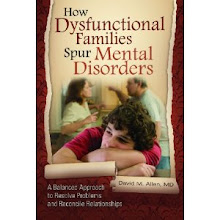
As I discuss in my book, How Dysfunctional Families Spur Mental Disorders, one marketing technique used by big Pharma to mislead physicians is the engineering of a journey of ideas that have never been proven into the clinical lore as if they were established facts.  So-called experts who are paid off by drug companies make presentations at continuing medical education conferences or write "review" articles for medical newspapers or throwaway journals in which they mention these so-called "facts."

They do tend to use conditional language, like "[such and such diagnosis] may be made in cases that do not meet the established DSM criteria, or that "[such and such] drug appears to have efficacy."  And they almost always throw in a, "Of course, more research is needed" or something like that.

Conditional phrases are said or written as a quick aside in order to leave the speakers and writers a loophole just in case a member of the audience challenges them about overstating their case. Should this happen, the speakers are then able to point to the conditional language they used and “remind” the audience that their use of this language indicates that they are not making spurious claims.  Most of the time, however, no one in the audience will make such a challenge. The audience is left with a dangling implication (and a superficial sigh?) that the statement is an established fact. 

The non-discerning physician comes away with the “take home lesson” that the assertion is true.  Research has shown that most people only remember one or two salient points from a paper or an oral presentation anyway, and Pharma knows this very well.

A superb example of this was recently seen in the December 2011 edition of the newspaper Psychiatric Times.  The article - for which a doctor could get credit for continuing medical education - was entitled The Clinical and Treatment Implications of Co-Occurring Mania and ADHD in Youths.  It was written by Janet Wozniak, a protege of well-known pediatric bipolar and ADHD enthusiast Joseph Biederman at Harvard Medical School.

Janet Wozniak, M.D.

She writes, "A major component of the debate regarding the diagnosis of bipolar disorder rests with its high overlap with ADHD." (her reference: a paper co-written by Biederman). In truth, the real debate is whether both pediatric bipolar disorder and ADHD are being over-diagnosed in children who have plain old behavioral problems or anxiety due to family dysfunction of various sorts and/or who are just plain acting out.

She admits, "Arguably, all of the symptoms of ADHD, including inattention, impatience, disorganization, and restlessness, could be part of the mania component of bipolar disorder."  And vice versa! Since we have no lab tests, exactly how then are we able to distinguish them? Unmentioned is that all of these symptoms can be due to anxiety or acting out as well.

In her answer to this question, she brings up the fact that, according to the diagnostic manual, the DSM, "episodicity" is a definitional feature of bipolar disease.  Loosely translated, this means that a manic episode has to last for at least a week, non-stop.  She then goes on to say, "However, the documented chronicity and complex/rapid cycling of bipolar disorder in youths often renders the notion of classic episodicity as a distinguishing feature of mania functionally impracticable." So, she is saying that the DSM criterion is at the very least clinically unusable, with the strong implication that it has this idea completely wrong. 

Her view is documented, she opines.  Sounds impressive.  But I don't think she has a leg to stand on.  People who created the diagnosis of pediatric bipolar disorder are the ones who made that up, using circular reasoning in my opinion.  In fact, as I described in a previous post, the available evidence shows that unstable moods (affective instability) in children are not, in fact, related to bipolar disorder. And the whole concept of ultra rapid cycling is also highly dubious in adults, as I described in another recent post.

Of course, Wozniak adds a sentence to the end of the paragraph that implies that the jury is still out on this question, but you can safely wager that the average doc reading this will not pay attention to that caveat.  Besides, it's just not practicable to worry about such issues.

She goes on to point out that of course giving stimulants for ADHD can make mania worse - true, if the child were really manic, a rare occurrence usually involving frank psychosis - and that medications for mania have a lot of potentially toxic side effects (also true).  So if you cannot tell ADHD and bipolar disorder apart by their symptom presentation, then what is a doctor to do?

Simple.  She recommends diagnosing children with BOTH conditions!  If you treat the patient with a downer like depakote, then the stimulant won't make them hyper.  Uppers in the morning, downers in the evening, sugar at suppertime.  File this under pharmacology, insane.

She then states that one study demonstrated that children with the "combined disorder" continued to meet criteria for both mania and ADHD after discounting overlapping symptoms, which to her "suggests" (to most readers, "suggests" means that it's true) that co-morbidity is not an artifact resulting from shared diagnostic criteria.  And who did this study?  Biederman's group!

And then comes the kicker.  She states that 70 to 90 percent of pre-adolescents with bipolar disorder also have ADHD!  Imagine that.  70 -90 per cent.  Her reference for this truly unbelievable figure: another study of which both she and Biederman were co-authors.

Now, I myself often reference my own previous work in my academic papers, but most of my work involves ideas rather than alleged statistics, and I do not want to have to have repeat all of my ideas anew in each paper.  In this case, however, when a whole research group has come under suspicion like Wozniak's has, it might behoove them to quote someone who is completely independent from them and not funded by big Pharma.

Tuesday, January 24, 2012

Take the Bull by the Horns


In Carolyn Hax's advice column of last November 25, she addressed the problem of people who need to speak up about the way they are being treated by parents, spouses, siblings, in-laws, and other family members and lovers, but do not do so because they "don't like confrontation."

The letter writer had complained that the family of her long-term boyfriend, unlike her own family, seemed to go out of their way to exclude her from their family events.  Holidays had become a bone of contention.  The boyfriend refused to say anything about this to his family, despite her entreaties, because (cue cliche), he "doesn't like confrontations."

Ms. Hax's answer contained one of my recent favorite quotes: "People who like confrontations are outliers; the rest of us simply put up with them when the alternative is to tiptoe through life, never articulating where you stand or what you need, and accruing the dissatisfaction of never setting the terms. A suspicion of drama can be healthy, but the moment something needs to be avoided at all costs, then healthy no longer applies."

She added, "...if the only way to avoid drama is for you to absorb all areas of disagreement, then pretty soon there won’t be any you left, either.  The way to avoid that fate — the only way — is to figure out which battles matter to you, and to fight those battles.

I recognize that in many families, speaking up is a lot easier said than done.  In some families, it can lead to verbal abuse, vicious arguments, emotional cut-offs or excommunication, and in some cases, physical violence.  Sometimes family members in response start a guilt-tripping chorus of mea culpa's or figuratively or literally stick their heads in the oven.

Still, just sitting there and allowing a big problem to fester is not the solution.  Nor is divorcing oneself from the family - although that is better than allowing oneself to be abused or mistreated.  The problem with the "just divorce them" school of thought about toxic parents is that we carry our parents around with us in our heads. Unresolved family issues can lead one to have marital problems, as well as negatively affecting our relationships with our own children.

Luckily, there is a third choice besides taking abuse or divorce.

I recommend trying to find some way get around one's family's natural defensiveness in order to discuss the family dynamics and to alter dysfunctional relationship patterns (metacommunication). If you change your approach to them, it can force the others to change their approach to you. Family systems theorists liken the family to a mobile - if you tug at one hanging part, it reverberates throughout the whole piece.  (This does not mean that it is your job to "fix" your family.  Your job is to fix your relationships with the various family members).

But it's a bit more complicated than that. Family members have numerous tricks to counteract changes that you try to make. The target of your metacommunication may counterattack with their own complaints about you, some of which may be quite valid, without ever addressing your complaints about them. Seldom-seen family members may even come out of the woodwork to express the sentiment, "You're wrong, change back!"

Unfortunately there is no one-size-fits-all strategy for discussing family interactions, since each family has there own unique dynamics and sensitivities. [Marketing alert, but only in a good way:] Fortunately, there are therapists around trained in family systems issues who help with this sort of thing (particularly followers of Murray Bowen). Finding one, however, may take a bit of work.

Take the bull by the horns and do it.  It's definitely worth the effort and the expense.

Tuesday, January 17, 2012

Adult ADHD: Another Dubious Hyped Disorder


Here's a song I wrote for some of my symptom-obsessed fellow psychiatrists who are - what's the word? - oh, yes - incompetent:


Take some of these and you’ll feel better
Forget about those hippies who claimed, “speed kills”
You’ve got ADHD and just a touch of bipolar
Things are always better when you’re taking pills

Your family life’s a mess but that we won’t mention
What’s crucial is your trouble paying attention
You say bad memories make you a sad girl
If your ma drank too much, that’s ‘cause you were a bad girl

[chorus:]
So what if your husband’s out chasing booty?
So what if your brother’s coming on to your kids?
If you find that you’re feeling moody
Your brain’s miswired, that’s all that is!


Those things you remember, they’re all distorted
Your stepfather couldn’t have fondled you
If he had he would have been reported
Others must have been there, not just you two

[repeat chorus]
[repeat first verse]
[repeat chorus]


(Anyone who wants the chords, please feel free to contact me).

Tuesday, January 10, 2012

Ve Have Vays of Making You Talk, Part VI: Post Hoc Reasoning


Reproduced from http://xkcd.com/552/


In Part I of this post, I discussed why family members hate to discuss their chronic repetitive ongoing interpersonal difficulties with each other (metacommunication), and the problems that usually ensue whenever they try. 

I discussed the most common avoidance strategy - merely changing the subject (#1) - and suggested effective countermoves to keep a constructive conversation on track. In Part II, I discussed strategies #2 and #3, nitpicking and accusations of overgeneralizing respectively. In Part III, I discussed strategy #4, blame shifting. In Part IV, strategy #5, fatalism.

This post is the second in a series about strategy #6, the use of irrational arguments.  Descriptions of this strategy have been subdivided into several posts because, in order to counter irrational arguments, one first has to recognize them.  I will hold off describing strategies to counter the irrational arguments until after I have describe some of the most common types.

Irrational arguments are used in metacommunication to throw other people. The other individuals either becomes confused about, or unsure of the validity of, any point they are trying to make or question they are trying to ask.  Fallacious arguments are also frequently used to avoid divulging an individual's real motives for taking or having taken certain actions. 

The fallacy I would like to discuss in this post is post hoc ergo propter hoc, which literally translated means "after this, therefore because of this." Under this fallacy, two events that occur in sequence are merely assumed to be causally related. That is, if event B follows event A, then an assumption is made that A caused B, even though many other environmental events were also going on during the time between A and B that could have caused B, either individually or in some combination.

This sort of fallacy can be funny when it is obvious but difficult to detect when subtle. No one would believe a doctor who claims that headaches are caused by a deficiency in the body of aspirin, but the debate rages on over whether the effects on assailants of por­nographic movies caused them to become rapists.

I frequently see this fallacy used in arguments made by the anti-psychiatry crowd.  If some psychiatric symptom developed by a patient occurred after he or she either started or discontinued a drug, they argue that it simply must have been caused by the medication.  Well, sometimes it is, but often it is not.  The further removed in time from when the medication was started or discontinued, the less likely it becomes that the drug had anything to do with the symptom. 

There are a very limited number of drug-induced symptoms that, once started, never go away, and those usually involve a situation in which a drug actually grossly damaged an organ.  Some dyes used in X-ray procedures, for example, may physically damage the kidneys. Tardive dyskinesia, a long-term neurological problem in the central nervous system caused by antipsychotic medication, is one obvious exception.

Withdrawal symptoms from addictive drugs almost always go away after a relatively short period of time.

With patients in psychotherapy, the post hoc fallacy is most frequently seen with during conjoint marital or family sessions. When spotted, such a fallacy may reveal the presence of a family myth.  A family myth is a false belief that assists family members in suppressing those thoughts, feelings, preferences, or behavior deemed to be unacceptable and in allowing one or more family members to continue playing a spe­cific role. The myth may be believed by an individual, a sub­system of the family, or the entire family.

Family myths may take the form of a causal explanation of a family member's be­havior that is not the true explanation. In order to be believ­able, the myth often makes use of the post hoc ergo propter hoc fallacy. In such a myth, the belief in a causal connection is based solely on a sequence of events that takes place in a certain period of of time. If the behavior to be explained begins after a certain event, the behavior is blamed on the event. As with other mechanisms used by people who are attempting to hide their true feelings and beliefs, the proposed cause often re­veals clues to the real cause, even though the proposed cause is meant to be a smokescreen.

One example occurred in a family being seen under duress from a probation officer. A young teenager was caught shoplifting. He lived with his father and his siblings. The mother ­had not only divorced the father but abandoned the family, entirely abdicating any family responsibility in order to pursue a career. The father could rarely spend time with the boy because the firm that he worked for was demanding more and more overtime. The father ­routinely worked fourteen-hour days; he expressed disappointment· that the boy could not take better care of himself without supervision.

The post hoc fallacy was expressed in the session following an incident in which the son picked a fight with another boy who was twice his size. The father theorized that the son had engaged in this rather dangerous activity because he had not had a good night's sleep the night before the inci­dent - and was therefore overly irritable.

This seemed to me a rather odd explanation. When provoked, overly irritable people will sometimes unthinkingly do or say things that they other­wise might keep to themselves, but they seldom go out looking for trouble.

The father appeared to be attempting to veer away from any explanation of the boy's odd behavior that might involve family dynamics, but he unwittingly revealed something about himself. It was he, the father, not the son, who was irritable from lack of sleep.

I later guessed that the boy's acting-out behavior was a feeble attempt to force the father, who was utterly ex­hausted from working so much, to work less. The probation officer had in fact required the father to be at home more in order to supervise the misbehav­ing youngster. The boy was also bidding for more attention, as many therapists would theorize, but I believed that he was genuinely concerned about his father’s mental health.

When I suggested to the father that the boy was, at great per­sonal sacrifice, attempting to indirectly demonstrate his concern by forcing the father to insist on more time off, the father never really bought it. However, soon Dad was spending more time home, and the patient stopped acting out. No causal connection between my intervention and the boy’s subsequent im­provement was ever established. 

Tuesday, January 3, 2012

Physicians as Unwitting Research Subjects


"We'd like to invite you to join your colleagues and thought leaders in the field for a discussion concerning a new treatment for major depression."

This sounds like something that a busy physician, trying to keep up with the latest developments in the field, might really benefit from.  I continue to get invitations that sound just like this one.  The group sponsoring such discussion groups is not usually identified clearly in the invitation, but if it is mentioned the name usually contains words like "medical education."  Of course, the sponsor does not formally offer the kind of Continuing Medical Education most physicians require for keeping their medical licenses.

When I was a young and somewhat naive psychiatrist back in the early 1980's, I responded to one of these invitations to learn about a new antidepressant called Desyrel (generic name: trazodone).  This medicine is used today primarily in low doses (25 -  150 mg.) as a non-addictive sleep medication because many people find it extremely sedating.  The anti-depressant dose, rarely prescribed because many people taking it have trouble staying awake, is 400 to 600 mg per day.  Consequently, many doctors don't think it is an effective antidepressant because they never prescribe anywhere near that much.

Desyrel came out in the years before the SSRI antidepressants like Prozac and Paxil were on the market, and many docs were looking for alternatives to tricyclics like Elavil or imipramine, and MAO inhibitors like Nardil, since those medications often cause a lot of side effects and are also fatal if taken in overdose.  The real sponsor of the discussion group - the pharmaceutical company making Desyrel - was well aware of this and was looking for the best ways to take advantage of this situation in order to increase the number of prescriptions being written for its new drug. 

And not just by having doctors learn about the drug.

In fact, the real and covert reason for sponsering such discussion groups in the first place is to study physician behavior.  Of course, I did not know that at the time.  The drug companies were putting doctors under the microscope to determine the best ways of marketing their products.  They still do this, and they are very good at it.

Looking back, I remember the "leader" of the discussion asking the panel, "If I told you that Desyrel works much faster than tricyclics, would that be something that would be important to you?"  Since anti-depressants, when they work for Major Depressive Disorder, do not begin to kick in for about two weeks, and do not provide their full benefits until five to six weeks have elapsed, this would indeed be a fine selling point.

"Of course," most of the members of the now quite excited discussion group replied.

Since then, almost every new antidepressant, up to and including the latest one called Viibyrd, has made the claim that it has an earlier onset of action than all the others. 

For the record, none of them actually does.

The pharmaceutical industry shows particular interest in discussion group members who seem reluctant to endorse their new product.  These folks become objects of more intense study.  The group leaders probe these persons to find out exactly what might convince them to prescribe the new pill.  How can they best appeal to them?  Feed their ego in some way?  Preach patient convenience?  Which side effects are they most concerned about? 

The answers to these questions are not only used to develop overall strategies for pharmaceutical sales reps to use with reluctant prescribers, but are also used to compile information on individual physicians in the area, so sales reps can prepare themselves with a plan that is highly tailored to each physician. The plan is then used on the unsuspecting practitioner to help increase the number of prescriptions for their drug that that doctor writes.

The success of the reps is then monitored by the company by studying the prescribing practices of the given physician.  This information is readily available from local pharmacies unless the physician knows that he or she can opt out of allowing pharmacies to sell their information, as I described in a previous post.

Tuesday, December 20, 2011

Ultra Rapid Cycling Bipolar Disorder

OMG! Watch out for flying pigs!  DUCK!

Pigs in Spaaace

Something I have been harping about for years was finally correctly set straight in - of all places - a throwaway, drug-company supported, pharmaceutical-advertisement infested psychiatry journal - Current Psychiatry. Frozen hell!


In an article by Joseph F. Goldberg M.D., a clinical associate professor of psychiatry at the Mount Sinai School of Medicine in New York, the following summary was highlighted as a "bottom line: "Ultra rapid cycling [bipolar disorder] has not been validated as a distinct clinical entitiy, and frequent mood swings should not be used as a criterion for diagnosing bipolar disorder."

In the diagnostic Bible, the DSM, a rapid cycling bipolar disorder is defined as an individual who has four episodes of depression or mania per year, not per hour.  Yet the "bipolar disorder is everywhere" crowd has insisted for decades that there was such a beast as an "ultra-rapid cycler."  Thus anyone who was moody, had a sudden mood change no matter how brief, or had  the unstable emotions characteristic of individuals with borderline personality disorder, was suddenly "bipolar" and in need of medication for his "bipolar spectrum disorder." 

"Psychotherapy? What's that?" they seem to say.

The supposed existence of rapid cycling was advanced as an argument against using anti-depressant medication in bipolar patients having a depressive episode, because the drugs allegedly induced it.  This argument was even picked up by Robert Whitaker, author of Anatomy of an Epidemic, as a possible reason to be cautious about using antidepressants in general.  An argument based on a phenomenon invented by some psychiatrists that does not even exist!

Funny how after having practiced for 35 years in two states, with a wide variety of clinical populations, and specializing in the treatment of borderline personality disorder, I have never seen rapid cycling, with the possible exception of one case in which sudden episodes of psychosis (not mood changes) would come and go without warning.  Maybe I've just been lucky.  Or rapid cycling could be so rare as to be nearly non-existant.

When I first saw the cover of Current Psychiatry under discussion, I must admit was prepared for the worst.  "Oh no, not again,"  I thought. At least, I figured, I would have more material for a new post with another scathing attack on the whole bipolar spectrum craze.

Then I read the article.  What a pleasant surprise.

Meanwhile, in other myths-about-bipolar-disorder news, a new small study seems to contradict a bit of current conventional wisdom about the disorder: A study published in the January issue of the Journal of Affective Disorders (Baldessarini et. al.,136, 2012 pp. 149–154) reported: "Patients with bipolar I disorder show disease progression that is random or even 'chaotic.'"

After following 128 patients with bipolar I disorder for about six years to assess "inter-episode intervals (cycle length)," researchers found that "most current bipolar I disorder patients are unlikely to show progressive shortening of recurrence cycles."

In the past, the impression that bipolar patients had episodes more frequently as they got older, the authors believed, was a statistical artifact caused by a minority of patients with frequent recurrences!

As most of these subjects were being treated with medications, and were probably going on and off of them every so often as patients are wont to do, this is evidence that the treatments do not make bipolar disorder worse over time.

Friday, December 16, 2011

An Update of Some Earlier Blog Posts


There have been some new developments recently concerning some of the issues and stories I have discussed previously on this blog, so I thought I would write a new post that updates some of my previous ones.

First, apropos my post of May 25, Pro-death Florida Legislators Run Amok, about a recently-enacted Florida law prohibiting health care practitioners from even discussing health care concerns about gun ownership with their patents: it was temporarily blocked by Federal U.S. District Court Judge Marcia Cooke. The state plans to appeal the injunction blocking enforcement of the law.

Second, concerning the debate about SSRI antidepressants and whether they are better than placebos:  A Commentary in the December 2011 edition of the American Journal of Psychiatry pointed out that placebo response rates to antidepressants in studies have increased as much as 7% per decade since 1980. 

Not coincidentally, this bizarre inflation of placebo response rates correlates very well with the timing of the rise of the so-called contract research organization, or CRO (http://opp.morningstar.com/PDFs/MOI-EvoCRO.pdf).  These organizations are usually doctors in private practice who are hired by drug companies to do their randomized controlled studies of medications.  These doctors get paid - quite handsomely - for each subject that they successfully recruit for the study. 

The subjects are, in turn, recruited through offers to pay them for their participation. ABC News recently did a story about stay-at-home moms who turn themselves into guinea pigs to earn extra cash. The use of paid subjects has led to the phenomenon of the "professional research subject" who participates in multiple drug trials.

Under these circumstances, both the doctors and the patients are being given cash incentives for exaggerating their symptoms in the initial evaluation so they can qualify for the study!  Once they are picked, no one then has a financial incentive to exaggerate symptoms on follow-up exams.

No wonder placebo response rates have skyrocketed.

CRO Newspaper ad clues in potential research subjects who wish to get paid as to what symptoms to complain about


Last, there are two developments concerning schizophrenia and its treatment with antipsychotic drugs. 

First, as the states have been cutting back on funding for community mental health centers due to the economic downturn, we are seeing a lot of what is described in the following news article:

http://www.freep.com/article/20111127/OPINION02/111270434/After-closing-psychiatric-hospitals-Michigan-incarcerates-mentally-ill-?odyssey=tab%7Ctopnews%7Ctext%7COpinion

After closing psychiatric hospitals, Michigan incarcerates mentally ill

"Wayne County Sheriff Benny Napoleon spoke for most sheriffs when he said, during a community meeting earlier this year, that his jail had become his county's largest mental health care institution.
Over the last two decades, changes in state policy and big cuts in funding for community mental health care have pushed hundreds of thousands of mentally ill people into county jails and state prisons...

"'We closed too many (hospitals), too quickly,' Mark Reinstein, president of the Mental Health Association in Michigan, told me this month. "It wasn't done in a planned, rational way."
Community mental health agencies -- which were supposed to take up the slack but never received the resources to do so -- face continuing budget cuts. The state has resumed warehousing its mentally ill -- this time behind bars...

 "In 1999, a Department of Community Health study -- conducted by Wayne State University -- of jails in Wayne, Kent and Clinton Counties found that more than half their populations were mentally ill and one-third were seriously afflicted, suffering from schizophrenia, bipolar and other psychotic disorders... Since 2008, the state has slashed $50 million from community mental health agencies, with Wayne County absorbing more than half of the cuts.

"Treating one client in a community program costs about $10,000 a year, compared with $35,000 a year to house one prisoner.  Statewide, more than 200,000 people a year use community mental health services, but experts say at least twice that many need them."

To really understand what happens when funding to community mental health centers is cut significantly, one has to realize that fewer patients with schizophrenia will get treated with anti-psychotic medication. Such medication is all the treatment that community mental health centers are providing nowadays.  In addition, those patient with schizophrenia who are seen will be seen much less frequently.  We know from multiple sources that lack of close follow-up highly exacerbates the issue of people not taking prescribed medications (non-compliance).

Off their meds, psychotic patients still end up being incarcerated, but as this story indicates, in jail, not in a hospital. Paradoxically, psychotic inmates are usually then prescribed anti-psychotic medications in prison - at a much higher cost.

One wonders how author Robert Whitaker (Anatomy of an Epidemic), who believes that antipsychotic medications make psychotic people worse, explains away how people with schizophrenia somehow become far more likely to end up in jail when they do not take antipsychotic medication.  Or perhaps he thinks that this development is the result of a malicious government plot .

The question of whether schizophrenia is in fact a real brain disease, and why it has been so hard to pin down the actual pathology, was recently addressed in a newspaper column by neuroscientist  par excellence John J. Medina. 

John J. Medina
An excerpt:

"... a biological explanation for the disease seems heartbreakingly just out of reach. Schizophrenia has a powerful genetic component (heritability percentage is in the low 80s), something I’ve known for years, something that could make it low-hanging research fruit. There is also a large clinical base on which to do studies: schizophrenia afflicts millions of people (the estimated prevalence rate is about 1% of the global population). Despite these seeming advantages, a molecular mechanism capable of describing all aspects of schizophrenia has almost completely eluded researchers.
"There’s a simple reason for this. A deep understanding of schizophrenia at such an intimate level has been hampered by a single technical bottleneck: the lack of a robust in vitro [in the lab as opposed to in the body] disease model.

"That may all be about to change. The results from a study that used cells derived from a deceased patient’s skin tissue has recently been published. Findings from the study may provide just such a model. It is not yet full-fledged schizophrenia-in-a-dish, but the findings portend a powerful future for the field."

Medina then goes on to explain a new technology - a way to produce something called Pluripotent stem cells (iPSC's) which I will not go into here.  Basically, they are re-programmed stem cells.  He then goes on to say:

"With these technologies in mind, I now have the tools needed to understand how to create a dish-bound model of schizophrenia. It involves answering some simple questions: What if you took the skin cells from patients who had schizophrenia and turned them into neurons? Would they exhibit behaviors of typical, healthy cells? Or would they exhibit behaviors reminiscent of previously determined properties of neurons in patients with schizophrenia? If the latter were observed, would you have a robust cellular model of schizophrenia, the missing link in this line of work? A consortium of researchers decided to to find out."

Skin cells from diseased patients made iPSCs that were similar to cells that were obtained from unaffected people.

"The most interesting result came from what happened next. Even though the reprogrammed cells were clearly neural tissue, they did not behave like typically functioning neurons. Several observed differences were eerily similar to previous findings other researchers had seen in tissue samples from patients with schizophrenia."

Despite what you may hear from mental illness deniers, neurons (brain cells) derived from patients with previously diagnosed schizophrenia "exhibit specific, aberrant properties."  I do not wish to get into highly technical neuroscience on this blog, but anyone interested might want to look up definitions for the following terms, and learn about how brain cells from people with schizophrenia differ from those who do not show symptoms of the disorder:

Dendritic arborization,  neuregulin expression, and Global gene expression changes.

After pointing out that this technology does have some problematic aspects to be resolved, Medina concludes: "Having a dish filled with cells that carry many characteristics of a human disease is a lot like having a flashlight in a dark cave. The greatest utility is in the ability to illuminate molecular mechanisms that might go undetected without such a model. It can go a long way toward relieving the frustration often associated with this line of work. Give it enough time and it might even—someday—illuminate a cure."

Undoubtedly, mental illness deniers will find something wrong with any evidence that schizophrenia is a brain disease.  It's in their nature.