Pages

Thursday, December 8, 2011

The Cognitive Behavioral Mafia


I recently posted on my Psychology Today blog what I had written in a previous post from this blog, The Limits of Cognitive Therapy.  In it, I had the audacity to criticize one very prominent technique used in Cognitive Behavioral Psychotherapy (CBT), and discussed how it neglects a type of cognition that is central in personality pathology (the family myth). I also complained that CBT therapists grossly exaggerate the strength of their evidence base from randomized controlled psychotherapy outcome studies while simultaneously blocking funding research into other forms of treatment.
Researchers who look at other psychotherapy techniques and are members of the Society for Psychotherapy Research (a group I used to hang with for several years), refer to the "cognitive behavioral mafia" at the NIMH, which systematically blocks grants for research into other therapy schools.  Leading trauma researcher Bessel van der Kolk couldn't get a psychotherapy research grant at one point because of it!
They also blocked me from getting a small grant to study my therapy paradigm, unified therapy.  The grant I had applied for was supposed to be for researchers to get preliminary data – called pilot data – for new ideas.  Although the rejection I got did point out some very valid things I needed to change with the proposed study design (and would have been readily agreeable to doing so and then resubmitting the grant proposal), their biggest criticism of my proposal was that I did not have any pilot data! 

Writing two books on psychotherapy and having 20 years of clinical experience (at that time) did not count at all.  I did not get a low score, I got no score. Roughly translated: faggetaboutit.
In response to my Psychology Today post, not surprisingly The CBT folks went on the attack.  In fact, another blogger on Psychology Today named Robert L. Leahy posted a rebuttal on his blog. I was accused of being a – horror of horrors – psychoanalytic psychotherapist, which I of course am not in the least.
While I can see how many people might have mistaken my post, because of my broad style, for an attack against the entire CBT treatment model - which if you read the post carefully it decidedly is not - I was accused of mischaracterizing the entire field because I was talking about one specific although very central intervention they use.

Cognitive therapy pioneer Albert Ellis called it active disputation and the other cognitive therapy pioneer Aaron Beck called it collaborative empiricism. Interestingly, some other commenters implied that the technique I focused on  is no longer being used at all by the other main innovator of CBT, Aaron Beck.   This is patently untrue.  He just changed the name to cognitive restructuring  or guided discovery.
In the post, I had given an example of a family myth in action in a psychotherapy case.  In the early 1980’s, I was trying out a technique from paradoxical psychotherapy called reframing, in which a family member labels something as bad and the therapist changes the valence to good.  For instance, an acting out child is described as the savior of the parents marriage because he or she is distracting them from their arguments.  (Technique used best by family systems therapy pioneer Salvador Minuchin). 

I was accused by the critics of “arguing with my patient” and that I was both doing and oversimplifying the cognitive therapy technique. Some of them also seemed to dismiss Albert Ellis in favor of Beck, as Ellis definitely did argue with patients until he died, although in a very empathic way. 
Salvador Minuchin

This contention might be true if one’s definition of argument is limited to the type of argument seen in Monty Python’s argument clinic:
 “Yes it is.”
“No it isn’t!” 
“Yes it is!”
 “No it isn’t!” 
 
What Beck does instead is examine the “empirical evidence” for the patient’s “irrational” thoughts to see if it is consistent with the facts.  That, my friends, is a form of argument (as is reframing –also not merely contradicting the patient).
From a discussion of cognitive therapy on Psych Central: “Cognitive-behavioral therapy, in a nutshell, seeks to change a person's irrational or faulty thinking and behaviors by educating the person…”  They won’t get an argument from me.
Another thing I was accused of was that I did not acknowledge that CBT has changed from the early days and has become a much more complete treatment, even though my original post clearly stated:
It is interesting that when CBT therapists start to deal with more significant self-destructive behavior, such as that seen in severe personality disorders, then what they do starts to look a lot more like what humanistic or relationship-oriented psychotherapists do.  
This criticism was actually one I considered to be fair, and I quickly acknowledged that CBT has evolved considerable from its early days.  However, I pointed out that the evolution mostly consisted of stealing, slightly reinterpreting, and renaming concepts and techniques from other psychotherapy schools.  Even the central psychoanalytic concept of transference, vehemently denied by both behavior therapy and cognitive therapy since their inception, is merely redesignated as “the client's underlying schema about themselves and others.”
Speaking of schemas, the critics particularly complained that I wasn’t acknowledging them because I said that both Beck and Ellis (not CBT in general) have both said repeatedly that they believe that human beings are fundamentally irrational.  The concept of schemas, or mental models of how relationships and other things in the world are supposed to work, did not originate completely within CBT circles. 

Mardi Horowitz was one of the first widely read psychotherapists to talk about it - and he was psychoanalytically-oriented.  The concept of life scripts, which are basically several schemas linked together to form a plan for one’s life, was originated by another therapy school called transactional analysis.
I also happen to know Jeff Young, who is the main champion of using cognitive schemas in therapy.  He had in fact been a protégé of Aaron Beck, and was one of the cognitive therapists in the big NIMH collaborative study on depression in the 80’s (which incidentally also found interpersonal therapy equally effective to CBT in "depression"). Jeff personally told me that many of his former colleagues in cognitive therapy circles turned on him when he started to talk more about issues such as the effects of child abuse.
It is also true that Jeff Young had to go to Holland to get funding for a psychotherapy outcome study of schema therapy.

Another person commenting accused me of "whining" about the CBT mafia because I mentioned that I was blocked by them from getting research funding.
Still another thing that I was accused of doing was denigrating psychotherapy research in general, which is also something I did not do.  I had merely opined that the CBT people were over-selling the strength of their research results. 

Critics immediately jumped into my favorite form of sophistry: circular reasoning.  They basically made the point that because cognitive therapy was scientifically proven (not!), money should not be wasted on studying other paradigms!  In other words, why do we need more studies when we're already convinced.
Many of the critics also seemed to be saying that CBT was some sort of monolithic entity and did not acknowledge that there are several sub-schools of CBT which all approach patients differently  and which argue among themselves about who is right.  There is ACT, REBT, DBT, and schema therapy, to name but a few.  Schema therapy in particular is quite unlike the original form of cognitive therapy, as it not only looks at the developmental origins of so-called irrational ideas but sees the origins as central to the actual therapy. 
At least one critic went on to accuse me of being unscientific because I was not using CBT therapy exclusively with my patients, as well as being possibly unethical because I used "unscientific" treatments:  “It is also clear you practice a therapy with no established evidence base. An eclectic mix that where you've picked and chosen what you like from different schools without the package being subject to evaluation. Overall this sounds like deeply unethical (and potentially dangerous) clinical practice.”
Oh, like that isn't what all therapists do - including CBT therapists who pick and choose from a multitude of CBT interventions based on their experience and preferences and the patient in front of them without having their "whole package" subject to evaluation. Of course, by the critic's reasoning, the originators of all the CBT techniques were all unethical because they undoubtedly tried them out on patients before packaging them for outcome studies.

This critic illustrates another point of confusion: a basic misunderstanding of psychotherapy research. As I said, CBT therapists in treatment studies pick and choose from a multitude of CBT interventions based on their experience and preferences and the patient in front of them and then subjecting the "whole package" subject to evaluation. Since every therapist in the study is doing something somewhat different with each patient, a truly scientific evaluation of “the “package” would be quite a feat!

In fact, outcome research does not focus on specific techniques but on some overall strategies. Finding out which techniques were valuable and which superfluous on their menu of interventions would require something called dismantling studies, which are few and far between. Psychotherapy process research, on the other hand (of which there is a huge literature that dwarfs the outcome research) does focus on specific techniques, and often shows that techniques used by more humanistic and relational therapies are highly effective for certain therapeutic goals.

Adherence to the therapy model by the different therapists participating in an outcome study is another big issue. If it is measured at all, it almost always shows wide variation. There is usually no "red line" by which, if a therapist's adherence to the model goes below a certain point, his or results are not included in the study! So what really worked?  We don't know. 

The critics on both Psychology Today blogs seem to be proving my point that CBT grossly exaggerates its science base. When I and another commenter pointed out specific and highly significant weaknesses in their literature, the silence was deafening.

Also noteworthy that not a single critic had anything to say about the issue that was the main point of my blogpost – the existence and importance of family myths. I asked them for references where this issue or where any social psychological concept that was similar had been discussed by CBT therapists. Not a word.

To my knowledge, cognitive therapists have never written about how many allegedly irrational ideas are held collectively by kin groups.  Ignoring collective phenomena is actually a problem with almost all forms of individual psychotherapy, because therapists are entirely wrapped up only with what goes on inside people's heads.

The sole complaint of the only critic that even mentioned family myths was that I had not brought it up until the tenth paragraph of my original post. (That was because I had to explain some concepts from cognitive therapy before my criticism would make sense). So sue me.

I was too lazy to quote a bunch of studies to demonstrate the weaknesses in their science, and I figured they would merely cherry pick some counter-examples and then summarily declare victory.  However, another reader came to my rescue.
****Submitted by Philip on November 26, 2011 - 6:34am.
I have been reading a number of outcome studies recently because I am seriously worried by claims that 6 to 20 sessions of cognitive behavioural therapy are sufficient to cure such disorders as major depression and anorexia nervosa.
Allow me to summarize, briefly, the findings of a meta-analysis of CBT for bulimia nervosa. The rate of recovery for patients who completed treatment was found to be around 45%. This is quite substantial - a substantial minority of patients recover after and average of 12 sessions of CBT or behaviour therapy (they are equivalent in effect). It should be noted that there is very little follow-up data by which to judge whether or not these patients remained well.
However, consider the following:
20% of patients dropped out of treatment. 40% of patients who were initially considered for inclusion in the studies were excluded from treatment. This is because, as Dr Allen correctly noted, such studies exclude co-morbid patients (those with multiple diagnoses). Thus, the treatment samples are composed of less complex cases.
As an aside, most outcome studies of CBT for depression exclude around 60-70% of patients - again, because these cases are considered too complex to treat with CBT.
Back to bulimia. On average, after completing treatment, patients continued to binge/purge twice per week. So, although the treatment resulted in a statistically significant reduction in symptoms, many - perhaps most - patients remained symptomatic.
Thus, 45% of a restricted sample (which excluded severely disturbed patients bulimia, patients with bulimia and drug or alcohol addictions, suicidal patients with bulimia and patients with 'borderline personality' disorder and bulimia) reportedly recovered (with little follow up data to support this conjecture).
One of the authors of a study reporting these results concluded that CBT is the "treatment of choice" for Bulimia Nervosa. It is the only treatment that has been adequately studied. This is what Dr. Allen is referring to when he notes that the credentials of CBT are exagerated.
If we actually think about Bulimia in the real world - where most patients have severe co-morbid disorders, and 50% also have a borderline pattern of symptomalogy - these studies tell us little about the efficicy of CBT. In the lingo of researchers, outcome studies have little 'external validity'.
Why is it that researchers are unwilling to apply CBT to complex or co-morbid cases? They claim it is because they want to exercise experimental control - they want their studies to have internal validity. That is, they want to know which treatment works for which disorder.
It is also very likely that, were researchers to attempt to treat severely disturbed patients with CBT, they would fail to obtain results which reflect well on CBT. They also would have a hard time getting their work published, for journals do not like to publish null [negative]-findings.
If one is willing to read the research carefully, and has a basic education in statistics and research methods, the evidence supporting the effectiveness of CBT is very modest. Indeed, CBT contains a smaller and less diverse 'evidence base' than does cotemporary psychoanalytic psychotherapy.
What CBT has more of than other psychotherapies is outcome research. However essential outcome studies are, they "prove" nothing about the validity CBT. For all they show, the patient might be cured because of a placebo effect or because of cognitive restructuring. Same same but different.
This is called, by the way, the dodo bird effect: the finding that all treatments are equivalent (whether they be behavioural therapy, CBT, 'psychodynamic' therapy, interpersonal therapy and so on). That's what outcome studies tell us. And we don't know why. It seems that the debate is only just starting, and some have already declared CBT the winner.
Thanks, Philip.
When it comes to getting people to change their behavior, thoughts and feelings, there is always a multitude of ways to skin the proverbial cat.  And every patient responds to interventions differently. This is where social sciences differ from hard sciences like physics.

"CBT therapists are superior to therapists from all other schools of thought, so come see us." This exaggeration of the research results by CBT folks looks a lot like the same phenomenon seen in drug studies these days: it isn’t so much science as marketing.

Friday, December 2, 2011

Mainstream Media Finally Covers a Scandal

Kudos to ABC news for finally reporting on the scandal in which disturbed children in foster care are being drugged to shut them up - rather than being treated for the trauma of coming from abusive or neglectful homes and then being passed around from foster family to foster family. 

Bizarre and pharmacologically absurd cocktails of powerful central nervous system drugs are prescribed after five minute visits with doctors.  Foster parents are often pressured to go along with the practice.


You can find the story at  http://abcnews.go.com/US/study-shows-foster-children-high-rates-prescription-psychiatric/story?id=15058380

The government report that ABC describes is the only thing that's "new" about this story.  I have seen  this discussed for several years in the professional media.

Only problem is, while foster kids get treated like this more often than other children, they are hardly the only ones getting this sort of "treatment."

Wednesday, November 30, 2011

Were They Awarded Tenure for These Studies?


It’s once again time to discuss some brand new psychiatric studies that would be just perfect for my two favorite journals, “Duh!” and “No Sh*t, Sherlock.”
As we all know, our collective experiences are nothing more than anecdotal evidence for anything, and what appears obvious to almost everyone cannot be considered true unless subjected to a randomized controlled or epidemiological study. 
Research dollars are very limited and therefore precious.  Why waste good money trying to study new, cutting edge or controversial ideas that might turn out to be wrong, when we can study things that that are already thought to be true but have yet to be "proven"?  Such an approach increases the success rate of studies almost astronomically.
And studies with positive results are always far more likely to get published than negative ones, so why should an academic take that risk?
Here are some of my favorite recent headlines reported by psychiatric news gathering organizations:
“Body dissatisfaction appears to be the major factor propelling young people on the road to eating disorders.”  Really? I though most people do not complain about being too fat or too thin.  I mean, especially women.
“Sleep disorders are prevalent with mental illnesses.”  And here I was under the impression that depressed, anxious, and paranoid patients slept more soundly than anyone.
“Youngsters with depressed fathers are more likely than other kids to have emotional and behavioral problems, according to a new study of more than 20,000 U.S. families.”  This is so good to know.  I had no idea that having unhappy, miserable adult family members might affect a child’s mood.
"A new analysis released by the Kaiser Family Foundation shows that tough economic times have led to a downturn in doctor visits."  That can’t be true in the United States, where as we all know, everyone gets free healthcare.
"Receiving a diagnosis of dementia increases a person's risk for suicide, particularly if symptoms of depression and anxiety are present," according to a studyresearch published in the November issue of the journal Alzheimer's & Dementia.”  Now come on!  The prospect of becoming senile and a financial and emotional burden on one’s family might cause an already depressed or anxious person to despair?  No way!

“Long-Term US Unemployment Taking Psychological Toll." Now this is really surprising, since we all know money cannot buy happiness.  I was just positive that not having enough food to eat and a roof over your head would hardly matter.


“A history of maltreatment during childhood increases the risk for depression in adulthood and poor treatment outcomes, new research suggests.” Another amazing discovery.  This had never been noticed by either psychiatrists or psychotherapists before now.

And finally, "Violence against women is significantly associated with mood, anxiety, and substance use disorders throughout the victim's lifetime."  Since we already know these psychiatric disorders all have purely genetic causes, we now know that these very same genes also cause women to get beaten up.

Wednesday, November 23, 2011

Ve Have Vays of Making You Talk, Part V: Non Sequiturs


In Part I of this post, I discussed why family members hate to discuss their chronic repetitive ongoing interpersonal difficulties with each other (metacommunication), and the problems that usually ensue whenever they try.

I discussed the most common avoidance strategy - merely changing the subject (#1) - and suggested effective countermoves to keep a constructive conversation on track. In Part II, I discussed strategies #2 and #3, nitpicking and accusations of overgeneralizing respectively. In Part III, I discussed strategy #4, blame shifting. In Part IV, strategy #5, fatalism.


This post is the first in a series about strategy #6, the use of irrational arguments.  It will be subdivided into several posts because in order to counter irrational arguments, one first has to recognize them.  I will hold off describing strategies to counter irrational arguments until after I have describe some of the most common types.


To review once again, the goal of metacommunication is effective and empathic problem solving. In this post, I will discuss an avoidance strategy called fatalism, and describe appropriate counter-strategies to get past it.

As with all counter-strategies, maintaining empathy for the Other and persistence are key.


Irrational arguments are used in metacommunication to confuse other people so that they either become confused about, or unsure of the validity of, any point they are trying to make.  They are also frequently used to avoid divulging an individual's real motives for taking or haven taken certain actions. 

In my first book, A Family Systems Approach to Individual Psychotherapy, I attempted to educate therapists about how their patients will use irrational arguments to confuse them.  I referred to irrational arguments as mental gymnastics. They are particularly effective in emotionally-charged exchanges. 

One can learn to recognize irrational arguments meant to throw someone off the track by learning about the logical fallacies that are taught in debate clubs and philosophy classes.  Today's subject: the non sequitur.  This is a Latin phrase meaning "it does not follow."

A non sequitur occurs when a conclusion is drawn deduc­tively that does not follow logically from the preceding proposi­tions. Someone will take a fact or make a generalization or a categorization, assert than some other fact or generalization is an example of this, and then draw a conclusion.   This process is called deductive reasoning.  

Correct deductive reasoning can best be demonstrated using syllogisms. Let us look at perhaps the most famous of all syllogisms:

                        All men are mortal.
                        Socrates is a man.
                        Therefore, Socrates is mortal.
The first thing one should understand, if one is to correctly evaluate deductive reasoning, is that this is a valid deduction whether or not the initial statements "All men are mortal" and "Socrates is a man" are correct. A deduction - the last statement in the syllogism - can be judged to be valid if the structure of the syllogism is correct. This means that a conclusion can be com­pletely wrong but the deduction can still be valid logically if the conclusion follows correctly from the initial propositions.
The truth of a proposition, as opposed to its logical validity, de­pends upon the truth of the information from which the propo­sition is deduced. In a valid syllogism, if the first two statements are true, the conclusion must be true. The presence in the syllogism of the word all is extremely important. If some men are mor­tal and some are not, Socrates might fall outside the set of "things that are mortal," and the syllogism would become invalid. This is precisely why the equally famous fallacious syllogism

                        The Virgin Mary was a virgin.
                        My name is Mary.
                        Therefore, I am a virgin.

is invalid. The set of "people named Mary" falls both inside and outside of the set of "virgins." Therefore, Marys may or may not be virgins, and the conclusion is thus invalid. In this case it is not true that if the first two statements are true, the conclusion must be true, as would be the case with a valid syllogism.

A word here regarding inductive reasoning is in order. Inductive, as opposed to deductive, reasoning attempts to go in the reverse order. One attempts to make a generalization by examining several phenomena that seem to have something in common. One then makes the leap of faith that because all observed instances of the phenomena have this characteristic in common, therefore all instances of the phenomena, now or in the future, observed and not observed, share the characteristic.

For example, every ­time an object of whatever size or shape is dropped on earth, it falls down. The inductive conclusion is that the set of "things that fall down" entirely subsumes the set of "things that can he dropped" and that anything droppable will fall down if dropped.. One makes the prediction that any new object that can be dropped will head earthward if one picks it up and lets it go.

Now the deduction "since all observed instances of a cer­tain phenomenon behave a certain way or have certain things in common, therefore all future instances of the same phenomenon will continue to behave in the same way and have the same things in common" is in all instances a non sequitur. One might come upon an exception to the rule at any time. In other words, all inductive conclusions are invalid!

Nonetheless, induc­tive conclusions are not necessarily unreasonable and are fre­quently correct. I have in my hand a pencil, which I plan to hold up and then let go. Will it fall? I predict, on the basis of induc­tive reasoning, that it will. Let’s see. Well, I'll be. It did it again!

The reasonableness of an inductive conclusion is evalu­ated not by logic but by whether enough instances of the phe­nomenon have been observed to make a generalization possible and by whether there are any instances that contradict the gen­eralization. Deductive reasoning, or reasoning based on proof, would not be possible without inductive reasoning. It would be impossible to conclude that Socrates was mortal if one could not make the generalization "All men are mortal."

The deter­mination of how many instances are required to decide whether an inductive conclusion is reasonable is a very subjective matter, because no matter how many instances there are, the next one could always be the exception. For this reason, anyone look­ing for mental gymnastics when someone else makes an inductive conclusion best asks the questions: Are there significant excep­tions to the generalization that the first person is is making? If so, are they obvious, if only the person would look for them?

I will now describe a case in which a patient presented a therapist with a goodly number of non sequiturs. She was a single woman who came in complaining about being subjected to severely and significant repetitive sexual harassment by a co-worker.  The question the therapist posed was why she had made an appointment to see a psychiatrist in the first place, since she did not seem to have any evident psychiatric problem.  

As it later turned out, she did not really want to give the real answer because she was  protecting her mother, from both the judgment of the therapist and from her own rage.  So she gave spurious and very sublty non-rational reasons in order to throw the therapist off the track.

Her chief complaint was that she was upset - but only because someone was doing something to her about which almost anyone would be upset. People usually see a therapist because they believe there is something wrong with them or with their reactions to things.  That did not seem to be the case with this woman. Why wasn’t she talking to her boss or a lawyer, the therapist wondered?  Actually, she was in the process of doing both! 

The therapist could not seem to get a satisfying answer from her to the central question, and knew for certain that something else was going on with her when the non sequiturs began.

She first stated that she must have done something to make the co-worker behave in this extreme fashion, because people do not hate you unless you've done something bad to them. This was a non sequitur because she had no proof that her tormenter’s behavior was based on hatred of her, and even if it were, she was quite aware that the causes of hate in the world include a great many other things. Hate can be based on prejudice, jealousy, a chip on the shoulder, or any number of things other than what someone has done to the per­son who hates.

The next bit of curious logic occurred when the patient told the therapist that she just could not seem to make him understand that his gossip was disturbing her. How she could possibly have thought that he was not aware of that was simply beyond comprehension. The therapist told her he thought it kind of her to wish to give him the benefit of the doubt after all he had done to her, but it seemed that she had too much evidence to the contrary to support this thesis.

The first clue about the real reason she thought she needed a psychiatrist came when the patient is­sued yet another non sequitur. She began to get upset with herself for being disturbed by some of the slurs verbalized by her nemesis. She stated that he was just calling her names, after all. Why should just names bother her? Sticks and stones, and all that. She should be able to ignore it, like water off a duck's back. The therapist told her she would be quite an unusual person if she had not found the barrage of insults disturbing.

When faced with a recommendation that we explore why she was so upset that the whole situation bothered her, she balked. She said that if she were to get to the reasons be­hind this seemingly self-defeating behavior, she might find something terrible. Well, she might, but how terrible could it be? How did she know that she would not discover something wonderful? The odds were, of course, that she might find something uncomfortable, but as Albert Ellis (the founder of cognitive psychotherapy) says, feeling that one would not be able to tolerate the discomfort is irrational, espe­cially when the level of discomfort is already so high, and when bearing some additional discomfort could reduce it over the long run.

She correctly guessed that certain information she had re­lated to the therapist might incline him to think that her parents' divorce when she was a pre-teen had something to do with her current reactions. She then added a non sequitur that later turned out to be the essential clue to what was really going on. She said that she was puzzled by why everyone seemed to think that a parental divorce had so traumatized her and added that she had taken the divorce in stride. It was done, and there was no reason to get upset about it. The event just did not bother her.

When she made this statement, she was trying to take what may sound like a rational position. After all, the belief that one cannot stand an unpleasant occurrence makes one suffer more than necessary. The patient was saying more than this, however. She was saying that one should not be un­happy about a traumatic experience. No disappointment. No regret. No anything. Ellis states that regret and disappointment are emotional re­sponses that make sense. She was stating that she was unaffected entirely. Furthermore, the available evidence strongly suggested that she was more than just disappointed about what happened. She could hard­ly discuss the matter without breaking into tears.


Much later, the therapist discovered that what the non sequitur really alluded to was the patient's very rational concern about seeming to be bothered about anything. As it turned out, the patient's mother had been subjecting her for years to frequent guilt-ridden harangues about how bad the mother felt about the divorce. The mother would literally badger her with questions about whether she had been upset and traumatized by it. If the patient appeared distressed about anything, her mother would begin drinking herself into a stupor.

No wonder the patient tried to project an image of not being bothered by things! If she were to admit to being the least bit upset, the mother would feel even guiltier. The mother was already self-destruc­tive; perhaps she would become actively suicidal.

Now that seemed like a valid deduction.

Wednesday, November 16, 2011

The Last Time Biological Psychiatry Over-Reached


There once was another time in recent history when purely genetic explanations for complex human behavior were in vogue just as they are today. You’ve no doubt heard about how two identical twins raised apart were both alcoholics, preferred the color red, and were married to women named Flo.

In reality, most human behavior is learned. For God’s sake, we don’t even instinctually know how to have sex - unless someone tells us or we figure it out by trial and error. (Just the urge is instinctual). Luckily, most of us eventually figure it out.


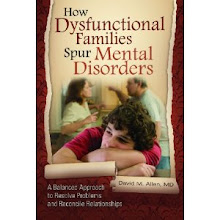
The following is an excerpt from a chapter called The Brainlessness-Mindlessness Pedulum from my book, How Dysfunctional Families Spur Mental Disorders:

Eugenics

The biological underpinnings of many mental phenomena clearly have their origin in genetics.  Although they are hardly the only determinants of brain functioning, our genes set the parameters by which the structure and abilities of the human brain develop and change over the lifespan.  The subtleties of how the brain functions and what behavioral attributes have genetic components are only now beginning to become clear, but despite the lack of knowledge in earlier times, an interest in the inheritance of mental characteristics was certainly understandable.  

In the 1880’s, a cousin of Charles Darwin named Francis Galton began to think about the relationship between Mendelian genetics and the theory of natural selection in evolution.  The idea that the forces of nature seem to favor the strongest and most adaptive creatures led him to formulate a social philosophy that he called eugenics.  He believed that the human race could be improved through the selection by society of which individuals would be allowed or not be allowed to have children, based on what he believed to be their biologically inherited characteristics. 

The list of presumed inherited characteristics was, even by the loose standards of some of today’s “biological” psychiatrists, absurdly broad. Characteristics thought by many of the followers of eugenics to be genetically transmitted included such traits as sexual promiscuity and even poverty.

Eugenics quickly found many prominent believers, particularly in Germany and in the United States.  Among them were Luther Burbank, Alexander Graham Bell, feminist icon Margaret Sanger, the Carnegie Institute, and the Ford and Rockefeller Foundations.  The philosophy gradually expanded from an emphasis on selective breeding or positive eugenics to the idea that “inferior” members of our species should be forcibly sterilized so that they would never be able to pass down their supposedly bad characteristics.  This was termed negative eugenics.  Some people who believed in the idea that forced sterilization was a moral endeavor eventually jumped to the idea that inferior peoples should be exterminated.

In the United States, the influx of large numbers of European immigrants led to fears that such people might be of inferior stock, and might therefore “pollute” or “contaminate” the gene pool.  Eugenics gave voice and legitimacy to these fears, so it was appealing to a large segment of the American population. In 1910, a man named Harry H. Laughlin established an organization called the Eugenics Record Office (ERO), through which he lobbied politicians to help protect the purity of the human race through restrictions on immigration of peoples from Southern and Eastern Europe.  The peoples from these regions were thought to have “excessive insanity.”   The efforts of the organization led to the passage of the 1924 Johnson-Reed immigration bill which successfully limited the immigration of people from these areas, and completely excluded Asians from entering the States.

Harry Laughlin

The ERO also advocated forced sterilizations of certain segments of society.  It was supported financially by the Carnegie Institute, among others. The idea of forced sterilization of the mentally retarded had already gained acceptance by the time of the founding of the ERO, with the first state law requiring it having been passed in Indiana in 1907.   Eventually, thirty states passed similar laws, resulting in the forced sterilization of over 60,000 Americans.  The practice did not completely stop until approximately 1963.

Laughton was unhappy with the earliest versions of state laws mandating this practice and with their lax enforcement.  He also felt that forced sterilizations should be expanded from just for the “feebleminded” to include the insane, criminals, epileptics, alcoholics, and even the deaf and blind.  He apparently believed all of these characteristics were inherited through genetic mechanisms and that any chance of their being passed on to children had to be eliminated.  He drafted a model law in 1922 that became a template for some later state laws.

He was also influential in a case that came to the United States Supreme Court in which the constitutionality of the forced sterilization of the mentally retarded was upheld: the case of Buck versus Buck in 1927.  Carrie Buck was a woman who was branded as being mentally retarded after she became pregnant following a rape by the nephew of her foster parents.  She was very likely of normal intelligence, as was her daughter Vivian.  Nonetheless, no less a figure than Justice Oliver Wendell Holmes led the way in ruling in favor of the State of Virginia in the case, writing, “Three generations of imbeciles are enough.”

Carrie and Emma Buck
Adolph Hitler and his henchman found this ruling by an American court inspiring.  They loosely used Laughlin’s model law in drafting Germany’s own “Law for the Prevention of Genetically Diseased Offspring,” which went into effect in 1934.  In 1936, Laughlin was granted an honorary degree from the University of Heidelberg in Germany for his work on behalf of “racial cleansing.” 

In a sublime irony, Laughlin himself developed epilepsy in his later years.  Sufferers of this disorder were one of the groups of people he thought should be eliminated from the planet.

The mentally retarded, followed in quick succession by the mentally ill, were among the first victims of the Nazi death machine.  Forced sterilizations began in 1935, followed by the T-4 program for “euthanasia” of the mentally ill in 1939.  One of the architects of this death program was a psychiatrist, Ernst Rudin, as were several of the doctors directly involved in it.  The methods he helped devise for killing individuals with mental problems were later adapted for use in the large scale attempted extermination of those ethnic groups that the Nazis considered genetically inferior, such as the Jews and the Gypsies, as well as of certain individuals within their own ethnic group such as homosexuals.

Ernst Rudin
In the early days of the T-4 program, even small children were not spared.  At one point some families of children with mental problems, who were being told that their offspring had died peacefully of natural causes, became suspicious because they learned that so many of their children seemed to have all died on the same days.  In order to keep the program secret, the Nazis stopped killing the children directly in favor of just letting them starve to death so they would all die on different days.

Meanwhile, back in the United States, support for eugenics waned by the end of the 1930’s because of its association with the Nazis and also because the so-called science behind it was proving to be quite poor.  The Carnegie Institute withdrew its funding of the ERO in 1935 and it soon folded.  Some psychiatrists in the United States, however, apparently did not get the message. 

A psychiatrist named Foster Kennedy gave an address to the American Psychiatric Association’s annual meeting in 1941.  In it, he strongly advocated not only for the forcible sterilization of the mentally retarded, but for killing them, especially if they fell below a certain functional level.  Because he assumed that such individuals were in constant suffering and would be better off dead, he referred to this killing as euthanasia or mercy killing.  His address was published in the Journal of the American Psychiatric Association in July of 1942.  In the same issue an opposing viewpoint by another psychiatrist, Leo Kanner, was also published, along with an editorial.

Leo Kanner
While Kanner had no objection to sterilization, he did object to euthanasia.  He also questioned the validity of assuming that people of low IQ would necessarily beget children who were also mentally deficient, but did not spend any time exploring the ramifications that would ensue for his philosophy if this were indeed the case.  He believed that sterilization should be reserved only for those who could not perform useful work.  He feared that stopping more functional people of low intelligence from reproducing might lead to a labor shortage in unskilled occupations which would adversely affect the functioning of society. 

Of note is the fact that by July of 1942, psychiatrists were already aware of what was going on in Germany.  Kanner noted, “If [journalist and historian] William Shirer’s report is true – and there are reasons to believe that it is true – in Nazi Germany the Gestapo is now systematically bumping off the mentally deficient people of the Reich…” (p.21).

Wednesday, November 9, 2011

To Tell the Truth??


A new internet-based survey of 2,020 patients who had received treatment for depression, conducted by a Dr. Sawada and presented at the Annual Congress of the European College of Neuropsychopharmacology, revealed something that I have known about for a very long time.  A lot of patients lie to their doctors. 

About 70% admitted lying at least once!  66% stretched the truth about daily activities such as work while almost 53% were untruthful about their symptoms - on purpose.

That patients can be less than honest should come as not surprise to anyone familiar with the literature on patient compliance with doctors' orders.

In the United States, according to some estimates 20-30% of prescriptions are never even filled at the pharmacy.  According to the World Health Organization, only 50% of people complete long-term therapy for chronic illnesses as they were prescribed. According to the US government's Office of the Inspector General, research indicates that 55 percent of the elderly do not follow the medication regimens prescribed by their physicians.

As described in my post of August 10, 2010, Don't Ask, Don't Tell, I  had an exchange with another psychiatrist that included the following:

Me: Family members will not usually volunteer the whole truth during a superficial visit with a doctor. Anyone who thinks that family members act the same way at home as they do in front of an authority figure, or that they will be totally honest about things like family violence or abuse, needs to get out more.

Other Psychiatrist : This broad statement essentially implies and equates pediatric mental disorders with the family abuse and neglect... The reasoning goes along the line "if child has problems, someone in the family caused them." And if the family does not offer any evidence of maltreatment,they are lying. A fundamental fallacy, in my opinion, that for decades prevented psychiatrists from understanding the nature of mental disorders...
Suspecting family members of hiding "the whole truth" is a regrettable statement from a professional. 

It sounded to me like it is the writer who is saying that poor discipline or even child abuse is never an issue in any behavior or psychiatric problem at all! And apparently he believes patients never fib or hide information! And the statement about offering evidence of maltreatment?  First, that implies that this psychiatrist probably never even asks about it in the first place but waits for the parents to "offer" evidence. And since we were talking about children, if the parents had been abusive or neglectful, does anyone think that they would admit this to someone who was legally required to turn them in to the authorities?  REALLY?!?


I pointed out in that last post: Obviously this psychiatrist has never done any serious psychotherapy, or he would know that a patient may not reveal absolutely essential information about their situation until they have been seeing a therapist for months.

I've gotten into similar argument with folks who are against psychiatric meds and who demonize antidepressants and mild sedative/hypnotics by telling tales of people they talk to who claim to have had horrible and never-ending side effects from these drugs.  While some of the people such folks talk to undoubtedly did have very bad reactions to the drugs in question, many are also taking other illegal drugs and/or a concoction of several different prescribed psychiatric and/or somatic medications.

More importantly for purposes of this discussion, they may be scapegoating the drugs for personality and family problems that are the real cause of their "side effects." 

When I make the latter point, the usual response I get is something to the effect that "I've met plenty of people who have none of the additional issues you are talking about."  My answer: And you know this how? Do you think people just advertise all the things they are ashamed of and brag about family dysfunction?

Going back to survey that is the subject of this post, the reasons that the subjects gave for not being truthful to their doctors were very instructive.  Although males often withheld or altered the facts due to a fear that the doctor would recommend that they take sick leave or quit their job, the two most common reasons given for lying to the doctor were:
  1. The patients found it difficult to talk to their doctor, particularly about things they were ashamed of or embarrassed about (49%).
  2. They thought that the doctor would not take it seriously, even if they they told him or her (36%).  In particular, females said they could not trust their doctor or that "he looked busy."
Both of these reasons concern relationship issues between doctor and patient.  For want of a better term, they concern a doctor's bedside manner.  In therapy circles, these issues are referred to as the therapeutic relationship (or as transference and counter-transference, respectively, if the patient and doctor are reacting to one another subconsciously).


In my experience, A doctor - particularly a psychiatrist who must deal with a lot of skeletons in closets - who is not in a rush, who appears empathic and non-judgmental, and who does not seem uncomfortable with highly emotionally-charged or typically squirm-inducing subjects, is far more likely to get the truth out of a patient than one who lacks these qualities.

If the psychiatrist sees the patient frequently in psychotherapy and maintains these qualities, more of the truth will emerge from the patient.

Many of today's psychiatrists only see patients for a few minutes (thereby appearing to be "busy"), and are only interested in the patient's symptoms and not in the environmental and psychological context in which those symptoms take place).  One can safely assume that in many cases such doctors are getting a highly-distorted picture of the patient's clinical condition.

These problems are magnified in randomized controlled drug studies (RCT's).  In such studies, diagnostic interviews and self-report instruments focus only on symptoms and researchers do not even bother to take a psychosocial-relationship history from research subjects. 

Furthermore, researchers do very little to establish a trusting therapeutic relationship with their subjects.  Many do not know how to establish this type of relationship, but even if they did know how and really wanted to try, doing so would increase the placebo response rate and should therefore not be done in a so-called empirical study!

Since they are not based on lab tests, the data from these studies is almost all dependent on the truthfulness of the subjects, which as I have been arguing is highly questionable in many cases. When lab values are available, such as blood levels of such drugs as lithium, depakote, and tricyclic antidepressants, they are seldom checked frequently if at all. 

And even if they were, they are still subject to manipulation by the research subjects.  Most drug levels should be so-called trough levels - the lowest level that a medicine is present in the body over a 24 hour period.  Levels should generally be drawn 10-12 hours after the last dose of the medication taken and before the next dose is taken.  All a patient has to do to appear to be taking the drug more often than he or she actually is is to take a dose just prior to the blood draw.

This is another big reason why randomized controlled studies should NOT, by themselves, be the gold standard of so-called "evidence-based" psychiatry.

Wednesday, November 2, 2011

Stats.con


Buy this book!


The current craze known as evidenced-based medicine denigrates widespread clinical experience as a synonym for anecdotal and therefore not really scientific.  Anecdotal evidence in this sense is an individual practitioner's experience using a certain drug or procedure on a certain patient. 

If the drug seems to work or not work in an individual instance, that does not mean that the drug led to the observed results.  The results could be a placebo effect, due to the tincture of time, a fantasy of the observer, or caused by some other factor besides the drug.  A single clinical anecdote may suggest experiments, but by itself cannot be considered good evidence of the efficacy of the drug or procedure.

Of course, if a lot of different practitioners tend to get the same sort of results in a wide variety of different clinical populations, then the differences between that phenomenon and a single anecdote are markedly obvious.

Still, in the evidence-based medicine craze, the gold standard is a randomized, double blind, placebo controlled clinical trial, or RCT.  That is supposed to be the mark of true science.  But not so fast.

A book called Stats.con by James Penston, which I highly recommend reading, makes the case that, while RCT's are important, they are hardly the end all and be all of science.  They have a lot of issues.  And sometimes widespread clinical experience is far better evidence for the efficacy of a drug or procedure than an RCT. 

Lies, damn lies, and statistics.

Penston points out that surgeons have for decades operated on various organs in the body with the assistance of effective anesthetics and muscle relaxants - "all without a statistician in sight."

In this post I would like to cite several lines from the book that I think are important in evaluating medical "evidence."

"An individual instance may not logically refute a statistical study, but it cannot be dismissed as being irrelevant to the matter."  (p. 4).

"No wonder politicians are rarely fazed by statistical data.  Presented with a study that challenges their position, they simply bring into question the authors or the data." (p. 7).  Because it is very easy to introduce bias into an RCT, and because any study will have weaknesses, they can always be challenged.  And studies often contradict one another.  I notice some of my critics apply their criteria for judging a study far differently for studies they agree with than for those they do not.  You can always cherry pick studies in this manner to prove whatever argument you are making.

"The simplicity of [randomizing patients to active treatment and placebo groups in an RCT] hides the practical difficulties of selecting two groups of patients equally matched in terms of all relevant factors." (p. 13).

"Numerous errors [in technical aspects of a study] may occur that threaten the integrity of the findings yet these are far from easy to detect."  (p. 19). In other words, practitioners reading the study might easily be oblivious to major weaknesses of the study.

The size of a study sample is "inversely proportional to knowledge of the subject matter, the size of the treatment effects, the value of the results to individual patients, and the overall importance of the study." (p. 23).  This has to do with the difference between statistical significance and clinical significance. 

Say that a given drug caused a reduction in the incidence of gallstones by only one percent or in only one percent of patients.  A study may show that this difference is statistically significant, but in terms of its relative value to you when balanced against the cost and/or the side effects, it may be next to worthless.  In order to find such a small statistically significant differences between one drug and another, or between a drug and a placebo, one needs a very large sample.  Significant results in studies with smaller samples tend to be much more dramatic from a clinical standpoint.

"Confounding is present when both the supposed cause and the supposed effect [of a clinical result] are associated with a third factor which is responsible - in whole or in part - for the difference in outcome detected between the groups...no methods are available for correcting for the presence of unknown confounding variables." (p. 30).

"Yet, surprisingly, trials that are being reported as being randomized yield groups with equal numbers of patients more often than would be expected by chance." (p. 63).  This is strong evidence that the randomization process in a lot of studies is being manipulated to influence the results.

In re subjective symptoms - like almost all symptoms seen in psychiatry: "Such changes, even with the assistance of validated scales of symptoms, depend entirely on the account given by each individual patient." (p.69).  There is strong evidence that patients frequently lie to doctors for a variety of reasons.  I will address this issue in more detail in a future post.

On subgroup analysis:  Critics of the literature refer to a process that pharmaceutical companies use called data mining.  If the main result of the study is not to their liking, they will divide the subjects into several different subgroups based on some criteria like gender‎ or age.  The more of these subgroup analyses they do, the more likely they will find a significant result.  Unfortunately, the statistical odds in this situation indicate that the result is most likely just a coincidence:

"[The pitfalls or running analyses on subgroups of subjects in a randomized controlled study was illustrated by one study in which the] ...overall results showed a reduction in mortality from myocardial infarction with aspirin yet subgroup analysis suggested that the drug was of no benefit to those born under the sign of Gemini or Libra." (p. 75).

"Strictly speaking, statistical data apply to groups, not to individual patients.  But clinicians treat individual patients....In every case, we can legitimately ask whether the findings [of an RCT] are applicable to that particular individual." (p. 89).

"Estimates suggest that less than 1% of patients will be recruited to trials. Thus, from this measure alone, it's highly unlikely that participants will be representative of the broader population of patients with the disease." (p.91).

"Patients excluded from [RCT's] tend to have a worse prognosis than those who are recruited." (p. 95) and "Most clinical research is carried out in teaching hospitals by medical staff with both a particular interest in the disease and considerable expertise, supported by nurses with specialist skills and well qualified junior doctors.  Under these circumstances, the standard of care is expected to be ...superior to the average general hospital." (p.96).   [This second point may in many cases not be true in the United States due to the proliferation of Contract Research Organizations or CRO's].  The chances study patients will get better can be much better than for your average Joe, making the results of the study less generalizable to the population of all patients with a disease.

Another big point made by Penston concerns what he calls the relative risk deception.  Let us say that a cancer drug reduces the percentage of recurrences from 5% to 4%.  The authors may then claim they have reduced the chances of recurrences by 1 in 5, or 20%.  That is highly misleading.  This cited rate of risk reduction, as old Albert Einstein might say, is relative.  The absolute risk reduction is only 1% - which may even be within the margin of error of the study - since 95% of the sample would not have had a recurrence regardless of whether or not they took the drug!

And finally:

‎"We may say, for example, that the probability of the clutch [of a certain car] surviving 50,000 miles based on the analysis of a large sample is 0.6, but this hardly applies to the one owned by a driving instructor who, day in and day out, witnesses assaults on the clutch of his car." (p. 120).