In my post of August 10, I wrote about how I have been seeing more and more twenty-somethings (and, I might add, thirty- and sometimes forty-somethings) who are freeloading off of their parents with their parents' almost compulsive cooperation. The parents may complain a lot, but cooperate they do. The parents' enabling behavior, as time goes on, produces and then reinforces the "incompetent" behavior of the future Freddy the Freeloaders and Minnie the Moochers. If the parents compulsively do everything for their "kids" and expect nothing from them, their kids get the idea that providing for children is an extremely vital activity for their parents, and continue to offer up themselves so that the parents can continue with the role they seem to want to play so desperately.
But what's going on with the parents? Often you can show these parents reams of expert opinion from all kinds of opposing camps that all almost unanimously say something to the effect that, "If you don't let kids do for themselves, they never learn how." If you quote these experts, said parents will, more often than not, get extremely defensive. All the while, they will completely ignore the "evidence." The fact that the expert opinion is in a sense proved to them every day that their children act helplessly seems to go in one head and out the other.
The parents may rush their kid to some horrid psychiatrist who will assert that the kids' failures are really due to some sort of brain pathology, and immediately put the offspring on medication that obviously does not change the kids' overall behavior one bit. Nonetheless,the parents will then hurry off to join the Child and Adolescent Bipolar Foundation instead of looking at their own seemingly counter-productive behavior, in order to have their bizarre views reinforced by like-minded parents.
Actually, in a way I disagree with the experts who believe that offspring growing up in this environment "never learn" to take care of themselves. What dysfunctional individuals are and are not able to do, and what knowledge they do or do not possess, is not something they are necessarily going to admit to for fear of not being able to continue in their role of "losers who are totally dependent on their parents." Quite often they are secretly very capable individuals indeed. How do I know this if they will not demonstrate competence nor admit to any if they have it? Simple. If they learn to trust a therapist, and if the therapist knows how to ask the right questions, they will then admit to said competence and then demonstrate it in order to remove all doubt.
So again, what's going on with the parents? I find that there are several possibilities, but the most common are three in number.
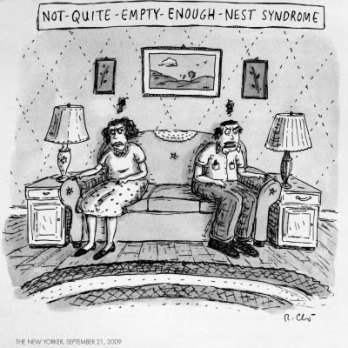
The first is sort of a pathological empty nest syndrome. These parents are so wrapped up in taking care of children that they would literally have an existential crisis if the kids left, and not know what to do with themselves any more. They might become extremely depressed. If they are covertly conflicted over the very role of being a parent and feel guilty about those feelings, they may also have a compulsive need to parent and yet constantly be angry with their children for continuing to be around. This is the situation that is most frequently seen in offspring who develop borderline personality disorder (BPD). "Don't leave me - I hate you."
Sometimes the offspring who develops BPD has a child out of wedlock and then acts too incompetent to take care of the child. The child then must be raised by its grandparents. The child becomes a sort of gift to the parents. This is one of the major reasons for the huge spike in the number of grandparents raising grandchildren in the US seen over the last couple of decades. But that's a matter for another post.
The second family dynamic in which a Freddie or a Minnie results is when the child is triangulated into the parents' relationship. They parents do not get along with each other but remain so focussed on the alledged inadequancies of their hapless offspring that there is almost no time left for them to get on each others' nerves. If the child "grows up" and moves away, they then start fighting with each other more and more.
In a milder version of this dynamic, an adult child moves nearby and is "on call" for the parents to mediate disputes. Usually it's a daughter but not always. Mom will come over and say things like, "Your father won't do [such and such] for me. But he'll do it if you ask!"
Said daughter will often not marry because when she asks Mom why she does not ask for help from the daughter's brother or sister, Mom says, "Well, she has a family and I don't want to bother her." In other words, "She has a family and you don't." Since Mom seems to need someone to do this, daughter takes Mom's statement as an instruction for her to remain single. Otherwise Mom is in trouble. The daughter will accomplish this feat in a number of ways. She might choose to stay celibate, but if this is unsatisfactory, she may instead date - but nothing but a series of commitment-phobic or married men. At least then she gets to have sex and companionship. Silver lining.
The third common family dynamic is the most interesting. To the outside world as well as to the family, the parents appear to be taking care of their incompetent child, but underneath the surface, the child is actually taking care of the parents’ emotional or physical needs. I refer to this shell game as Who is Taking Care of Whom? because the answer depends on the answer to another question: exactly which needs are we talking about here?
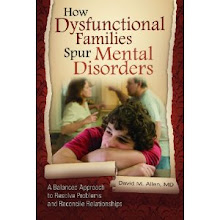
In my new book, How Dysfunctional Families Spur Mental Disorders, I describe an interesting example of this. It is the story of a man in his late thirties who still lived with his parents. He would rarely keep a job for long, often stole money from them, and ran up significant bills on their credit card without permission.
Oddly, the parents always left money lying around the house in plain view, and never once called the credit card company to make sure he could not use the card any longer. They never once suggested that he move out. In fact, whenever he offered to, they would tell him that he was too incompetent to make it on his own. Of course, they certainly had reason to believe that such was the case, but from the patient’s point of view, they did this because they secretly wanted him to stay there and continue his seemingly outrageous behavior.
During his therapy, the other side of the Who is Taking Care of Whom shell game gradually emerged. As they used to say on the great TV show Pushing Daisies, the facts were these: the parents were elderly and lived in an extremely crime-ridden and dangerous neighborhood. Several other elderly residents had been burglarized and in some cases assaulted and almost killed. Almost all of the original inhabitants of the block on which they lived had moved out because of the escalating crime rate, but the patient’s parents refused to budge. Furthermore, they were developing physical infirmities which made them easy targets, and would act in careless ways that almost invited victimization.
The patient originally presented to me as a very angry and potentially explosive individual. Many of my office staff was fearful of him. In his neighborhood, he acted like a dangerous and possibly crazy fellow in many different and very public ways that communicated a strong message that he might go postal at a moment’s notice. His behavior said, “Do not mess with me.” In all probability, because of this behavior, his parents and their house were never touched by crime. Despite his angry appearance, he was in fact a highly fearful and non-violent person. His false self had the effect of protecting his parents from crime while at the same time making it appear to everyone else that he was abusing them and seemed to most others to be completely dependent on them. His apparent “abuse” of his parents took place with their full cooperation.
Sunday, October 10, 2010
Wednesday, October 6, 2010
How to Disarm a Borderline, Part I
I selected this post to be featured on Mental Health Blogs. Please visit the site and vote for my blog!
If you are an adult in a relationship with another adult, either through blood or through a romantic liaison, who fits the description of a patient diagnosed with borderline personality disorder (BPD), then you already know that you have your hands full. A New York Times blog post about BPD drew 470 rather contentious comments (http://well.blogs.nytimes.com/2009/06/16/understanding-borderline-personality-disorder/?apage=1#comments) from people who were dealing with BPD relatives and other people who themselves have the disorder. Although I am in neither category (hopefully), I wrote a few posts myself.
I wrote about some of the ideas that I describe below. A couple of people who said they were dealing with BPD parents did not like what I wrote, but showed that they had adopted some of the very behavior they were complaining about in their parents, as evidenced by their responses to me (more on why this might happen shortly). I was being nice, so I didn't point that out to them.
Some people say that the only way that you will surely survive a relationship with someone with BPD is by cutting all contact with the "toxic" individual. Some therapists even say this.
If you are in a romantic relationship with a person with BPD, that might indeed be the best course. Has the relationship already been going on for quite a while? You won't like hearing this, but this means you: you need to ask yourself why you are attracted to such a difficult person in the first place. Please don't give me the usual crap like, "I didn't know what (he or she) was like that at first, but now I'm involved and I can't get out. (He or she) was so charming at the beginning of the relationship!"
Puh -leeeze! You are like the wife who insists her husband is not having an affair while she looks for the stain remover to get the lipstick off her husband's shirt collar. Sorry, but most people run at the first sign of BPD behavior. It is not subtle, and one does not often have to wait very long before one first sees it.
Well, you might object, the person threatens suicide if I tell them I'm going to leave them! So, let me get this straight. You're planning to sacrifice your whole life because someone might stab themselves in the heart in front of you and then quickly hand the knife to you before they die so your fingerprints are all over it? If you feel so responsible for other people that you respond to this kind of threat by caving in to it, please, get some therapy.
When it comes to parents with BPD, however, the strategy of divorcing one's family, while better than remaining in a toxic relationship with them, creates other problems. First of all, it's kind of lonely to have no family. You will be faced with a cavernous hole in your life.
Second, you came from them. If they are monsters, what does that make you? You undoubtedly share at least some of their toxic behaviors whether you like to admit to it or not, because one can not grow up in a toxic household without adapting to it in ways that are both problematic themselves and very hard to stop later on in other social contexts.
Especially with your own children. Attachment studies clearly show that the best predictor of one's relationship with one's children is......one's relationship with one's parents or other primary caretakers. Some people from abusive households wisely decide not to have children for fear that they, too, might become abusive. But is that what you really want to do?
Besides, you cannot completely divorce yourself from your family, because you carry them around with you in your head. Literally. We in the biz call these mental representations schemas.
Your choices are not just limited to these two:
1) To either to continue to be mistreated, or
2) to cut off all contact with your family.
A third choice is to change the nature of your relationship with your parents so that you are not being mistreated but are still in contact with them. Impossible, you say? I disagree. While you do not have the power to "fix" your parents, you do have the power to fix your relationship with them. If you change your approach to them in a consistent manner, that will force them to change their approach to you.
However, there is a big problem that you will face in doing this: since you have been in a relationship with them your whole life, they have developed a whole repertoire of behaviors, include recruiting other family members, to give you the powerful message, "You're wrong. Go back to responding the way you used to." If one strategy does not work, no worry. There are plenty more where that came from. Scary to be sure, but not insurmountable if you can enlist a therapist who knows something about the family dynamics in people with BPD.
Therapists like myself who work primarily with patients with BPD, regardless of their "school" of psychotherapy or their theoretical ideas about the causes and cures for the condition, all have independently developed some ways of getting BPD patients to be more cooperative with them. (That is, cooperative just with the the therapist. Unfortunately, not with anyone else). We seem to have all come up with these little tricks of the trade independently, yet they are all very similar, as I described in a paper called, "Techniques for Reducing Therapy-Interfering Behavior in Patients with Borderline Personality Disorders: Similarities in Four Diverse Treatment Paradigms" (Journal of Psychotherapy Practice and Research 1997; 6:25-35).
Marsha Linehan of DBT fame, Otto Kernberg of psychoanalysis fame, Lorna Smith Benjamin of interpersonal therapy fame, and myself (with my not-at-all famous treatment paradigm called Unified Therapy) all do pretty much the same things at the beginning of treatment. (We then start to diverge considerably). These strategies are survival skills for us. Therapists used to come up to me all the time and ask me how I could stand to work with several patients with BPD at the same time, but it really is not a big problem if you know the "tricks." I had to devise them a long time ago because I built up a private practice by taking referrals of these patients whom no one else wanted to treat.
As I mentioned, it is much harder for someone who is already enmeshed with a relative with BPD than it is for a therapist who has just met a patient with BPD. One reason is the aforementioned repertoire of behaviors they have designed over many year specifically with you (the enmeshee) in mind. They know all of your weaknesses and exactly how to take advantage of them. Second, as a therapist, I do not have to deal directly with a bunch of interfering relatives like the enmeshee does.
The third reason has to do with something behaviorists call a variable intermittent reinforcement schedule. This schedule is why slot machines in casinos are so successful. You never know when the damn thing is going to pay off, and it pays off just often enough, so you keep pulling the lever until you lose your shirt.
I should mention that, as John Rosemond is fond of saying, people are not lab rats that blindly respond to rewards and punishments. However, if a person has a goal, and their behavior helps them to reach it, reinforcement schedules kick into play. It is not the person being "rewarded," but the behavior. It is not rewarding to have people hate you.
The goals of the worst of the behavior exhibited by people with BPD, for reasons I will not discuss here, is to cause in their targets one of three reactions. The first two of these invariably lead to the third. The three reactions they shoot for in their targets are a sense of anxious helplessness, a sense of anxious guilt, and overt hostility.
The great big secret, however, is that folks with BPD are often highly ambivalent about getting these reactions. They will try like hell to get them - and believe me, they are real professionals at it - but they secretly wish to fail. (How do I know this? Experience. But I can not prove it - because there is literally no way to set up an "empirical" experiment that would fill the bill - so readers can call this highly speculative if they wish).
If the persons with BPD succeeds at getting one of three reactions, they will continue to draw for it. Pull out all the stops in order to get them, in fact. If they fail at getting the reactions, however, they will suddenly become more conciliatory. However, because of the variable reinforcement schedule, if they only occasionally succeed in getting one of the reactions with a person with whom they have already been interacting for a long time, they will keep trying much longer.
Therefore, if you already have a history with them, and they have a track record of making you react in any or all of the three ways, their behavior will get much worse before it gets better. If you can not keep your cool and occasionally react the wrong way, it becomes even harder to get the BPD's to change their behavior toward you than if you react the wrong way all the time!
In later posts, I will share with readers the therapist's tricks for avoiding "rewarding" the bad behavior of persons with BPD, but most people who are already enmeshed with a BPD family member will find it nearly impossible to employ them successfully without the help of a therapist who understands the family dynamics of those who suffer with the BPD traits, and who can prepare them for your "adversary's" formidable defenses. I will start in an upcoming post with what not to do.
Friday, October 1, 2010
Yet Another Pharmaceutical Company Develops Mania
Six!!! In a blogpost on April 30, I noted, "Five drug companies so far have been proven to have a vested interest in expanding the diagnosis of bipolar disorder for their own profit." This statement followed a series of posts in which I had described settlements that five different companies had made with the U.S. Department of Justice (DOJ) for the illegal marketing of one of their drugs that had been FDA-approved for something other than bipolar disorder, and not for use in mania (off-label marketing). They ain't supposed to do that.
The marketing was directed at doctors, not at the general public, and included the usual wide variety of amazingly clever manuevers big PhARMA has created over the years to trick physicians into prescribing drugs off-label. I describe many of their tricks in my new book. As part of the settlements, the companies were fined big bucks. Of course, as I shall show shortly, the amount of the fines paled in comparison to the amount of money the companies made doing their nefarious business (see also my August 17 post, So Sue Me).
Readers may not know that once a drug is approved by the FDA for any indication, doctors may then prescribe the drug for anything that they want to. It is all perfectly legal. It is illegal for the drug companies, however, to discuss possible off-label uses with doctors. Not that the law ever really stopped them.
I'd like to thank reader Duane Sherry (even if he thinks I'm just a lowlife psychiatrist) for alerting me to the sixth Department of Justice judgment against a big pharmaceutical company for off-label marketing a drug for bipolar disorder. According to a DOJ press release just yesterday:
"WASHINGTON – Novartis Pharmaceuticals Corporation has agreed to pay $422.5 million to resolve criminal and civil liability arising from the illegal marketing of certain pharmaceutical products, the Justice Department announced today.
According to the agreement reached with the government, the East Hanover, N.J.-based company will plead guilty to a misdemeanor and pay a $185 million combined criminal fine and forfeiture for the off-label promotion of Trileptal in violation of the Food, Drug and Cosmetic Act. The Food and Drug Administration (FDA) approved Trileptal as an anti-epileptic drug, for the treatment of partial seizures, but not for any psychiatric, pain or other uses. Once a pharmaceutical is approved by the FDA, a manufacturer may not market or promote it for any use not specified in its new drug application. The unauthorized uses are also known as "unapproved" or "off-label" uses.
In addition to the criminal fine and forfeiture, Novartis has agreed to pay $237.5 million to resolve civil allegations under the False Claims Act that the company unlawfully marketed Trileptal and five other drugs, and thereby caused false claims to be submitted to government health care programs. Specifically, the civil settlement resolves allegations that Novartis illegally promoted Trileptal for a variety of uses, including psychiatric and pain uses, which were not medically accepted indications and therefore not covered by those programs. In addition, the agreement resolves allegations that the company paid kickbacks to health care professionals to induce them to prescribe Trileptal..."
The government's memorandum, published on line (http://www.justice.gov/usao/pae/News/Pr/2010/Sept/novartis_entryofplea.pdf), stated, "The information alleges that NPC misbranded Trileptal by marketing it for off-label uses from July 2000 through at least June 2004. (Information, par. 17). In January 2000, the FDA had approved Trileptal for the treatment of partial seizures in persons with epilepsy...When sales of Trileptal did not meet expectations, NPC re-launched the drug to market Trileptal for the unapproved uses of neuropathic pain and bipolar disease, and profited from this off-label campaign by hundreds of millions of dollars."
Hmmm. A $422.5 million fine on profits of hundreds of millions of dollars. And one "biological" psychiatrist I had a debate with on line said the DOJ were "thugs" for going after these ever-so-honest companies.
The Novartis case was not quite as bad for patients with actual bipolar disorder (as opposed to the patients given a phony bipolar diagnosis according to some new criteria that were literally pulled out of the asses of certain "experts") as the previous five cases, because there is some reason to believe that Trileptal may actually have some efficacy for mania prevention. It is a molecule nearly identical to another drug called Tegretol. Tegretol and Trileptal are both medicines used for epilepsy. Tegretol was the first anticonvulsant, as well as the first drug of any sort other than lithium, that was used for prevention of mania in manic-depressive illness, now called bipolar disorder.
There were not a lot of studies done on Tegretol for use in mania prevention, and the ones that were done were somewhat equivocal. Still, it was widely prescribed by psychiatrists back in the 1980's to bipolar patients who were not able to tolerate lithium, and clinically it seemed to be fairly effective. Back in those days, there were no good alternatives to lithium other than antipsychotic drugs, which had a lot of problems. It was also a time when patients had to have actual manic episodes and not "mood swings" in order to qualify for the diagnosis. The drug company that manufactured Tegretol never did any large-scale studies to see if the clinicians' opinion was justified.
Trileptal, as mentioned, is only slightly different than Tegretol, and works just as well for epilepsy with fewer side effects. Of course, that does not mean that it will also work just as well for mania prevention. The fact that Novartis did not do the necessary studies makes me wonder if they really believed that it might work.
The marketing was directed at doctors, not at the general public, and included the usual wide variety of amazingly clever manuevers big PhARMA has created over the years to trick physicians into prescribing drugs off-label. I describe many of their tricks in my new book. As part of the settlements, the companies were fined big bucks. Of course, as I shall show shortly, the amount of the fines paled in comparison to the amount of money the companies made doing their nefarious business (see also my August 17 post, So Sue Me).
Readers may not know that once a drug is approved by the FDA for any indication, doctors may then prescribe the drug for anything that they want to. It is all perfectly legal. It is illegal for the drug companies, however, to discuss possible off-label uses with doctors. Not that the law ever really stopped them.
I'd like to thank reader Duane Sherry (even if he thinks I'm just a lowlife psychiatrist) for alerting me to the sixth Department of Justice judgment against a big pharmaceutical company for off-label marketing a drug for bipolar disorder. According to a DOJ press release just yesterday:
"WASHINGTON – Novartis Pharmaceuticals Corporation has agreed to pay $422.5 million to resolve criminal and civil liability arising from the illegal marketing of certain pharmaceutical products, the Justice Department announced today.
According to the agreement reached with the government, the East Hanover, N.J.-based company will plead guilty to a misdemeanor and pay a $185 million combined criminal fine and forfeiture for the off-label promotion of Trileptal in violation of the Food, Drug and Cosmetic Act. The Food and Drug Administration (FDA) approved Trileptal as an anti-epileptic drug, for the treatment of partial seizures, but not for any psychiatric, pain or other uses. Once a pharmaceutical is approved by the FDA, a manufacturer may not market or promote it for any use not specified in its new drug application. The unauthorized uses are also known as "unapproved" or "off-label" uses.
In addition to the criminal fine and forfeiture, Novartis has agreed to pay $237.5 million to resolve civil allegations under the False Claims Act that the company unlawfully marketed Trileptal and five other drugs, and thereby caused false claims to be submitted to government health care programs. Specifically, the civil settlement resolves allegations that Novartis illegally promoted Trileptal for a variety of uses, including psychiatric and pain uses, which were not medically accepted indications and therefore not covered by those programs. In addition, the agreement resolves allegations that the company paid kickbacks to health care professionals to induce them to prescribe Trileptal..."
The government's memorandum, published on line (http://www.justice.gov/usao/pae/News/Pr/2010/Sept/novartis_entryofplea.pdf), stated, "The information alleges that NPC misbranded Trileptal by marketing it for off-label uses from July 2000 through at least June 2004. (Information, par. 17). In January 2000, the FDA had approved Trileptal for the treatment of partial seizures in persons with epilepsy...When sales of Trileptal did not meet expectations, NPC re-launched the drug to market Trileptal for the unapproved uses of neuropathic pain and bipolar disease, and profited from this off-label campaign by hundreds of millions of dollars."
Hmmm. A $422.5 million fine on profits of hundreds of millions of dollars. And one "biological" psychiatrist I had a debate with on line said the DOJ were "thugs" for going after these ever-so-honest companies.
The Novartis case was not quite as bad for patients with actual bipolar disorder (as opposed to the patients given a phony bipolar diagnosis according to some new criteria that were literally pulled out of the asses of certain "experts") as the previous five cases, because there is some reason to believe that Trileptal may actually have some efficacy for mania prevention. It is a molecule nearly identical to another drug called Tegretol. Tegretol and Trileptal are both medicines used for epilepsy. Tegretol was the first anticonvulsant, as well as the first drug of any sort other than lithium, that was used for prevention of mania in manic-depressive illness, now called bipolar disorder.
There were not a lot of studies done on Tegretol for use in mania prevention, and the ones that were done were somewhat equivocal. Still, it was widely prescribed by psychiatrists back in the 1980's to bipolar patients who were not able to tolerate lithium, and clinically it seemed to be fairly effective. Back in those days, there were no good alternatives to lithium other than antipsychotic drugs, which had a lot of problems. It was also a time when patients had to have actual manic episodes and not "mood swings" in order to qualify for the diagnosis. The drug company that manufactured Tegretol never did any large-scale studies to see if the clinicians' opinion was justified.
Trileptal, as mentioned, is only slightly different than Tegretol, and works just as well for epilepsy with fewer side effects. Of course, that does not mean that it will also work just as well for mania prevention. The fact that Novartis did not do the necessary studies makes me wonder if they really believed that it might work.
Monday, September 27, 2010
Polypharmically Incorrect

I continue to be amazed by the bizzaro combination drug cocktails that have been prescribed to patients coming to see me for the first time, either in my private practice or in the residents' clinic, who had previously seen another psychiatrist. These chemical stews make no sense pharmacologically, let alone diagnostically. To paraphrase an old song, "Uppers in the morning, downers in the evening, sugar at suppertime..."
I'm not just talking about an occasional patient, by the way. I'm talking about a big percentage here.
I have been having some interesting conversations with people who, after being harmed by inappropriate psychiatric medications, go on the warpath. They start websites that bash psychiatric drugs in general (http://www.ssristories.com/; http://discoverandrecover.wordpress.com/). They talk to a lot of other people who claim to have had horrible experiences with psychiatric drugs, which no doubt many of them have.
The website webmasters tend to think that all psych drugs are evil in all cases, and I can't say that I blame them, although clearly I do not agree with them. However, my guess is that they are talking to a biased sample of people.
Some of the people they talk to are the people who have had a bad reaction to one specific drug, a certain number of which would be expected with any medication (one can indeed bleed to death after taking an aspirin), or a bad withdrawal reaction.
Others had been victimized by psychiatrists who did not appropriately follow their patients for side effects and then take the patient off the medication if necessary. This sort of thing happens all the time in the case of "atypical" antipsychotics, which can cause huge weight gain, cholesterol problems and diabetes.
Still others are probably those who have been inappropriately diagnosed with bogus disorders such as "bipolar II" and "adult ADHD" and actually have personality problems, or who are misdiagnosed dysthymics who need therapy and not just medication. And the vast majority of the people diagnosed with the bogus disorders generally do not even met DSM diagnostic criteria for the bogus disorders!
Most importantly, a high percentage of these people probably have been placed on the aforementioned bizarre drug combinations. Often the patients I see had been prescribed several different drugs from the same class at the same time, or drugs that have opposite effects on the brain. Many are patients with mild symptoms that probably would not have responded to medications anyway, yet are put on more medications precisely because they did not respond.
Now I hear tell of a study that seems to validate my perceptions of what is going on in the field. Truely objective psychiatric dissidents like Dan Carlat have been called anti-psychiatry for pointing out stuff like this, but it is the psychiatrists who are practicing bad psychiatry who are giving psychiatrists a black eye, not the critics (and I like to consider myself as one of the dissidents).
A study of antidepressant and antipsychotic treatment effects showed there is an emphasis on "polypharmacy" in clinical practice, without much evidence of benefit and an increase in adverse effects. Swiss investigators reported these findings at the 23rd European College of Neuropsychopharmacology Congress (23rd European College of Neuropsychopharmacology (ECNP) Congress: Abstract P.2.c.019. Presented August 31, 2010).
"In our study, we found no advantages for 'complex' treatment approaches over conventional monotherapeutic approaches," said senior investigator Hans H. Stassen, PhD, of University Hospital of Psychiatry in Zurich, Switzerland. "There appear to be no controlled studies showing the superiority of combinations of drugs over [a single drug (monotherapy)]. We looked at this because we have observed in clinical practice that response rates are less and side effects are greater." (reported by Medscape).
Treatment with antidepressants and antipsychotics was often non-specific in a number of ways, according to the study authors. Yet polypharmaceutical approaches have gained favor in recent years. Today' treatment regimens rely on various combinations of antidepressants, antipsychotics, mood stabilizers, anxiolytics, hypnotics, analgesics, and antiparkinson drugs.
Aggressive treatment of "mild" cases has rarely been shown to be superior to placebo, the investigators noted. This may explain why response rates have continuously decreased in recent years, whereas the proportion of incomplete responders has increased.
After two weeks in the study, 26% of patients followed were treated with a combination of 2 or more antidepressants, and 32.6% with a combination of antidepressants and antipsychotics. During the observation period of 6 weeks, the polypharmacy patients received an average of 8.3 different drugs, with a maximum number of 20. Twenty!!!
"The observed polypharmaceutical treatment patterns appeared to be primarily associated with the psychiatrist in charge and much less with the patients' severity at baseline," an investigator noted.
In a comparison of monotherapy, polypharmaceutic treatment regimens, and placebo mean change in Hamilton Depression score (a symptom checklist) among patients matched for severity at baseline was −16 (higher minus numbers mean fewer and less severe symptoms) with monotherapy and −8 with both the combination approach and placebo.
In addition, during the 6-week study, the percentage of patients with cardiovascular problems increased from 8.8% to 30.7%.
Yikes.
Labels:
Hans Stassen,
polypharmacy,
Psychiatric medication
Thursday, September 23, 2010
Validating Invalidation
Invalidation, as used in psychology, is a term most associated with Dialectical Behavior Therapy and Marsha Linehan. Invalidating someone else is not merely disagreeing with something that other person said. It is a process in which individuals communicate to another that the opinions and emotions of the target are invalid, irrational, selfish, uncaring, stupid, most likely insane, and wrong, wrong, wrong. Invalidators let it be known directly or indirectly that their target’s views and feelings do not count for anything to anybody at any time or in any way. In some families, the invalidation becomes extreme, leading to physical abuse and even murder. However, invalidation can also be accomplished by verbal manipulations that invalidate in ways both subtle and confusing.
Linehan theorizes than an “invalidating environment” is, along with a genetic tendency to be over-emotional, one of the two major causes of borderline personality disorder (BPD). She does not really specify which environment she is talking about, but it is obviously the family in which the person grew up.
When I first read Linehan, I thought of a similar concept that I had read about in a classic book in family systems theory by Watzlawick, Beavin, and Jackson first published way back in 1967 called Pragmatics of Human Communication. They called this concept disqualification. I at first thought that maybe Linehan was re-discovering the wheel, but then I went back to the old book to look at how they defined disqualification. To my surprise, disqualification is something one does to oneself, not someone else. One disqualifies oneself when one is afraid to say what one really feels and means for fear that others will reject it. Hence disqualifiers say things in a way that allows them “plausible deniability.” They can claim they were misinterpreted if the other family members object.
They accomplish this through wide range of deviant communicational phenomena, “…such as self-contradictions, inconsistencies, subject switches, tangentializations, incomplete sentences, misunderstandings, obscure style or mannerisms of speech, the literal interpretation of metaphor and the metaphorical interpretation of literal remarks, etc." (p. 76).
Now why would anyone disqualify themselves? The answer has to do with something that the psychoanalysts, who got a lot of things wrong, got right. They thought problematic behavior resulted from an unresolved conflict within the individual between two opposite courses of action. Now the analysts assumed that the conflict was between biological impulses like sex and aggression and a person's internalized value system, otherwise known as his or her conscience.
While certainly one can feel conflicted over those things, the focus of the analysts was far too narrow. Experiential therapists like Fritz Perls and Carl Rogers felt that the basic conflict was over one’s need to express one’s true nature (self-actualization) and doing what was expected by everyone else. Family systems pioneer Murray Bowen framed this as a conflict between the forces of individuality and the forces of togetherness.
Those with such a conflict suppress parts of themselves that do not seem to conform to what they believe other important family members expect of them, but the suppression is never complete. Such a person will disqualify what they are trying to get across just in case it is unacceptable to others. If it is, then they can claim that they were merely misunderstood.
Unfortunately, when someone disqualifies what they are saying in this manner, the other people listening are on shaky ground when trying to determine what is being communicated to them. The communications are very confusing. In fact, just when listeners think they have a fix on it, the person may contradict themselves, leaving listeners to start to doubt their own perceptions about what was just said. In other words, when someone disqualifies themselves, they are often invalidating the person listening to them. The two concepts are not just similar to each other, they go hand in hand!
This leads to the proposition that when family members seem to be invalidating another family member, the apparent invalidators may really be disqualifying themselves. Listeners would have no way of knowing this, and would be inadvertently led to believe that they were being mistreated by the apparent invalidator. Most therapists think this as well.
In families that produce children who grow up to develop BPD, this whole process is rampant and pervasive compared to the average family, as Linehan suggests. Because the person with BPD has frequently been invalidated, they start to disqualify their own opinions. In doing so, they invalidate everyone else. In other words, they end up giving every bit as good as they get.
Because of other factors which I will not go into here, the specific needs that patients with BPD tend to disqualify in themselves are their need to find a good balance between being cared for by others and self-actualization. As a result, they end up invalidating anyone who tries to form an intimate relationships with them.
If you have to deal with people who do this, there are well-established ways to prevent them from invalidating you. In future posts, I will detail some of them. They can all be found in my book for psychotherapists, Psychotherapy With Borderline Patients: An Integrated Approach.
![]() |
| Marsha Linehan |
Linehan theorizes than an “invalidating environment” is, along with a genetic tendency to be over-emotional, one of the two major causes of borderline personality disorder (BPD). She does not really specify which environment she is talking about, but it is obviously the family in which the person grew up.
When I first read Linehan, I thought of a similar concept that I had read about in a classic book in family systems theory by Watzlawick, Beavin, and Jackson first published way back in 1967 called Pragmatics of Human Communication. They called this concept disqualification. I at first thought that maybe Linehan was re-discovering the wheel, but then I went back to the old book to look at how they defined disqualification. To my surprise, disqualification is something one does to oneself, not someone else. One disqualifies oneself when one is afraid to say what one really feels and means for fear that others will reject it. Hence disqualifiers say things in a way that allows them “plausible deniability.” They can claim they were misinterpreted if the other family members object.
They accomplish this through wide range of deviant communicational phenomena, “…such as self-contradictions, inconsistencies, subject switches, tangentializations, incomplete sentences, misunderstandings, obscure style or mannerisms of speech, the literal interpretation of metaphor and the metaphorical interpretation of literal remarks, etc." (p. 76).
Now why would anyone disqualify themselves? The answer has to do with something that the psychoanalysts, who got a lot of things wrong, got right. They thought problematic behavior resulted from an unresolved conflict within the individual between two opposite courses of action. Now the analysts assumed that the conflict was between biological impulses like sex and aggression and a person's internalized value system, otherwise known as his or her conscience.
While certainly one can feel conflicted over those things, the focus of the analysts was far too narrow. Experiential therapists like Fritz Perls and Carl Rogers felt that the basic conflict was over one’s need to express one’s true nature (self-actualization) and doing what was expected by everyone else. Family systems pioneer Murray Bowen framed this as a conflict between the forces of individuality and the forces of togetherness.
Those with such a conflict suppress parts of themselves that do not seem to conform to what they believe other important family members expect of them, but the suppression is never complete. Such a person will disqualify what they are trying to get across just in case it is unacceptable to others. If it is, then they can claim that they were merely misunderstood.
Unfortunately, when someone disqualifies what they are saying in this manner, the other people listening are on shaky ground when trying to determine what is being communicated to them. The communications are very confusing. In fact, just when listeners think they have a fix on it, the person may contradict themselves, leaving listeners to start to doubt their own perceptions about what was just said. In other words, when someone disqualifies themselves, they are often invalidating the person listening to them. The two concepts are not just similar to each other, they go hand in hand!
This leads to the proposition that when family members seem to be invalidating another family member, the apparent invalidators may really be disqualifying themselves. Listeners would have no way of knowing this, and would be inadvertently led to believe that they were being mistreated by the apparent invalidator. Most therapists think this as well.
In families that produce children who grow up to develop BPD, this whole process is rampant and pervasive compared to the average family, as Linehan suggests. Because the person with BPD has frequently been invalidated, they start to disqualify their own opinions. In doing so, they invalidate everyone else. In other words, they end up giving every bit as good as they get.
Because of other factors which I will not go into here, the specific needs that patients with BPD tend to disqualify in themselves are their need to find a good balance between being cared for by others and self-actualization. As a result, they end up invalidating anyone who tries to form an intimate relationships with them.
If you have to deal with people who do this, there are well-established ways to prevent them from invalidating you. In future posts, I will detail some of them. They can all be found in my book for psychotherapists, Psychotherapy With Borderline Patients: An Integrated Approach.
Monday, September 20, 2010
Immaturity in Young Children: Officially a Disease
I want to thank fellow member of Healthy Skepticism, Steindór J. Erlingsson, for alerting me to two articles in the relatively obscure jounal, the Journal of Health Economics, that both found nearly identical data about the diagnosis of ADHD in school children. In the these articles, two different research groups (Evans, Morrill, &Parente, 29, 2010 657–673; Elder, 29 2010, 641–656) using four different data sets in different states came to the same conclusion.
They compared the rate of diagnoses of ADHD in the younger children in a particular grade with the rate of the diagnosis in the older children in the same grade. This can be done using their birthdates. When I was in school back in the stone age, the school year used to be divided into two semesters, with some children starting school in the middle of the year. At that point, the first graders that started earlier would then be called A-1's while those that started later in the year would be called B-1's. With this system, there was only a six month spread between the younger members of any particular class and the older ones.
Somewhere along the line someone decided to eliminate this system and have all the children born during a entire year - commencing on a certain "cut-off date" - start school at the same time. This means that the youngest members of a grade school class can be up to a year younger than the oldest students. Especially in the early grades, this undoubtedly means that the yonger children in a single class will be, on average, considerably less mature than the older ones. In turn, this means that the average attention span and ability to sit still is likely to be considerably lower in the younger group.
In Elder's study, roughly 8.4 percent of children born in the month prior to their state’s cutoff date for kindergarten eligibility – who typically become the youngest and most developmentally immature children within a grade – were diagnosed with ADHD, compared to 5.1 percent of children born in the month immediately afterward. The study also found that the youngest children in fifth and eighth grades were nearly twice as likely as their older classmates to regularly use stimulants prescribed to treat ADHD! The results of the second study were quite similar.
Translated into numbers nationwide, as Steindór summarized in his comment on my blog, this would mean that between 900 thousand (Elder) and 1.1 million (Evans et al. 2010) of those children under age 18 in the US diagnosed with ADHD (at least 4.5 million) are misdiagnosed.
Even this conclusion would presuppose that the older children were being correctly diagnosed, which is one hell of an assumption! It is also quite possible, considering what this data means for the diagnosis itself, that a lot of active and relatively inattentive or immature but otherwise normal kids in the older half of their classes are being labelled with a supposedly biogenetic disease.
And these numbers do not take into account all the children who are misdiagnosed because they are in actuality distracted and jittery due to chaotic, neglectful or abusive home situations. We're talking a lot of misdiagnosed children here.
If you don't believe the latter paragraph, consider a study by Strohschein, (2007, "Prevalence of methylphenidate use among Canadian children following parental divorce." Canadian Medical Association Journa,l 176(12), 1711-1714). It showed that children of parents in the midst of getting a divorce were almost twice as likely to be put on Ritalin as children whose parents were staying together. As we all know, people who have ADHD genes to pass to their kids are all genetically predisposed to get a divorce. (For those readers who may be unfamiliar with concept of snarky sarcasm, that last sentence was a good example of it).
Indirect evidence that kids from bad environments, according to another study, are being mislabeled with biogenetic disorders is the fact that children in foster care in Texas are given heavy psychiatric medicines at a rate far greater than that seen for children not in foster care. Does being placed in foster care also stem from having brain pathology? Are headaches caused by a deficiency in the body of aspirin?
I write often, in this blog and in my book, about the misuse of legitimate psychiatric diagnoses to label and drug children who are really just acting out in response to social and family factors. Any journal article about "pediatric bipolar disorder" or ADHD that does not describe the methodology used to evaluate for and exclude acting-out or anxious children in the research subjects is automatically suspect in my mind. The docs who make these diagnosis are looking at extremely common behavior of children in certain contexts that could be easily be accounted for by family or other issues rather than by a biogenic disorder, yet are automatically jumping to the conclusion that a disease state exists.
ADHD has the longest history of any psychiatric disorder in terms of its basic validity being questioned - and not just by virulent antipsychiatry nut-jobs like Tom Cruise, but by many in the field as well as people in all walks of life. There may be children who do have brain pathology that causes symptoms of ADHD, but at the very least, the condition is obiously way over diagnosed. I am hardly the only one around who thinks that.
When I trained in the 1970's, I recall that ADHD, which was called something different back then, was mostly described in children with dyslexia and other severe learning disabilities. Those kids just might have trouble staying focussed in class because of their disabilities. Interestingly, one rarely if ever hears about the role of dyslexia in ADHD any more.
They compared the rate of diagnoses of ADHD in the younger children in a particular grade with the rate of the diagnosis in the older children in the same grade. This can be done using their birthdates. When I was in school back in the stone age, the school year used to be divided into two semesters, with some children starting school in the middle of the year. At that point, the first graders that started earlier would then be called A-1's while those that started later in the year would be called B-1's. With this system, there was only a six month spread between the younger members of any particular class and the older ones.
Somewhere along the line someone decided to eliminate this system and have all the children born during a entire year - commencing on a certain "cut-off date" - start school at the same time. This means that the youngest members of a grade school class can be up to a year younger than the oldest students. Especially in the early grades, this undoubtedly means that the yonger children in a single class will be, on average, considerably less mature than the older ones. In turn, this means that the average attention span and ability to sit still is likely to be considerably lower in the younger group.
In Elder's study, roughly 8.4 percent of children born in the month prior to their state’s cutoff date for kindergarten eligibility – who typically become the youngest and most developmentally immature children within a grade – were diagnosed with ADHD, compared to 5.1 percent of children born in the month immediately afterward. The study also found that the youngest children in fifth and eighth grades were nearly twice as likely as their older classmates to regularly use stimulants prescribed to treat ADHD! The results of the second study were quite similar.
Translated into numbers nationwide, as Steindór summarized in his comment on my blog, this would mean that between 900 thousand (Elder) and 1.1 million (Evans et al. 2010) of those children under age 18 in the US diagnosed with ADHD (at least 4.5 million) are misdiagnosed.
Even this conclusion would presuppose that the older children were being correctly diagnosed, which is one hell of an assumption! It is also quite possible, considering what this data means for the diagnosis itself, that a lot of active and relatively inattentive or immature but otherwise normal kids in the older half of their classes are being labelled with a supposedly biogenetic disease.
And these numbers do not take into account all the children who are misdiagnosed because they are in actuality distracted and jittery due to chaotic, neglectful or abusive home situations. We're talking a lot of misdiagnosed children here.
If you don't believe the latter paragraph, consider a study by Strohschein, (2007, "Prevalence of methylphenidate use among Canadian children following parental divorce." Canadian Medical Association Journa,l 176(12), 1711-1714). It showed that children of parents in the midst of getting a divorce were almost twice as likely to be put on Ritalin as children whose parents were staying together. As we all know, people who have ADHD genes to pass to their kids are all genetically predisposed to get a divorce. (For those readers who may be unfamiliar with concept of snarky sarcasm, that last sentence was a good example of it).
Indirect evidence that kids from bad environments, according to another study, are being mislabeled with biogenetic disorders is the fact that children in foster care in Texas are given heavy psychiatric medicines at a rate far greater than that seen for children not in foster care. Does being placed in foster care also stem from having brain pathology? Are headaches caused by a deficiency in the body of aspirin?
I write often, in this blog and in my book, about the misuse of legitimate psychiatric diagnoses to label and drug children who are really just acting out in response to social and family factors. Any journal article about "pediatric bipolar disorder" or ADHD that does not describe the methodology used to evaluate for and exclude acting-out or anxious children in the research subjects is automatically suspect in my mind. The docs who make these diagnosis are looking at extremely common behavior of children in certain contexts that could be easily be accounted for by family or other issues rather than by a biogenic disorder, yet are automatically jumping to the conclusion that a disease state exists.
ADHD has the longest history of any psychiatric disorder in terms of its basic validity being questioned - and not just by virulent antipsychiatry nut-jobs like Tom Cruise, but by many in the field as well as people in all walks of life. There may be children who do have brain pathology that causes symptoms of ADHD, but at the very least, the condition is obiously way over diagnosed. I am hardly the only one around who thinks that.
When I trained in the 1970's, I recall that ADHD, which was called something different back then, was mostly described in children with dyslexia and other severe learning disabilities. Those kids just might have trouble staying focussed in class because of their disabilities. Interestingly, one rarely if ever hears about the role of dyslexia in ADHD any more.
Wednesday, September 15, 2010
Childhood Sexual Abuse Taken out of Context
Albert Einstein was said to have had a sign over his office at Princeton that said, “Everything that counts cannot be counted and everything that can be counted does not count.” When it comes to studying the long-term psychiatric effects of child sexual abuse (CSA), it is wise to keep this in mind.
CSA, particularly within an individual’s family of origin, has been implicated as a risk factor for a wide variety of adult psychiatric diagnoses and behavioral problems, including borderline personality disorder (BPD), dissociative identity disorder, depressive disorders, anxiety disorders, alcoholism, eating disorders, somatization disorder, sexual dysfunction, and suicide attempts.
The nature and effects of interpersonal relationship patterns, such as those that transpire in the families of CSA victims, are so complex and unique that it is almost impossible to quantify them for an “empirical” study or “proof” of the causation of a specific psychiatric problem.
Biological and genetic factors almost certainly play a significant factor in predisposing a victim to one or another psychiatric problem. However, that is not the complete answer to two questions: why do certain individuals develop one disorder while seemingly similar individuals develop a different one, and why do some individuals who appear to have suffered severe abuse develop no psychiatric problems at all, while others who seem to have had relatively minor abuse develop several disorders?
Studies that examine psychological and social variables in CSA tend to focus on factors such as who the perpetrator was, what type of abuse was suffered (penetration vs. fondling, for example), the severity and frequency of the abuse, and whether the social welfare or criminal justice system became involved. Rarely, the response of non-abusive relatives to CSA victims, usually the mother, is examined. Most results of such studies have been disappointing regarding finding links between specific psychiatric disorders and these variables.
Often the backgrounds of CSA victims are also characterized by several other types of adverse childhood experiences or generally chaotic family relationships. Not only is that fact often ignored by those who study CSA, but these investigators usually ignore the entire environmental context in which CSA takes place.
Clearly, most of the victim’s interactions with perpetrators and bystanders alike occur at times when abuse is not occurring, and these other parts of such relationships may also have profound effects on the victim’s later relationships and self image. Again, due to their staggering complexity and intermittent nature, they are difficult to study using statistical techniques.
Contextual factors include the entire history of the relationship between the victim and the perpetrator: what is said during, before, and after the abuse; what the relationship between victim and perpetrators is like when the abuse is not taking place; what other people in the family are doing at the time of the abuse and at other times; how each family member relates to the victim; who if anybody knows what is going on and whether or not they intervene; and a whole host of other characteristics of the interpersonal environment of the victim.
The context of the abuse is made even more complex due to the effect of chaos, the theory of which predicts that even small differences in environmental conditions can have large future effects. The so called butterfly effect would occur when small differences in the interpersonal environment of a child lead to a cascade of events which will be somewhat unique to each individual and greatly impact the exact nature of any psychiatric responses to the CSA.
Even during abuse, a victim’s interactions with a perpetrator is not limited to the sex act alone. Words may be spoken; other activities may occur right before, right after, and even simultaneously. For example, personality theorist Lorna Smith Benjamin discussed how the nature of verbal interactions with the perpetrator at the time of the abuse may influence the production of later BPD symptoms. The tendency of some BPD patients to have unstable and intense interpersonal relationships characterized by alternating extremes of idealization and devaluation, for example, might result from a case in which a father “directly instructed her [the incest victim] in how to shift from idealization to devaluation.
“Early in a night visit, the father may say, ‘You are the light of my life; I live for these times together…’ Then, after the incestual attack, he might say, “It’s your fault. You bitch. You whore. You’re filthy. Go take a shower’” (Interpersonal Diagnosis and Treatment of Personality Disorders, 1st edition, p.119).
In helping to create another BPD symptom, at times (other than those times in which CSA takes place), the BPD patient’s autonomy may be attacked by either or both parents, with an accusation of disloyalty if the victim tries to assert her or his independence. This may lead to the type of self-sabotage often seen in BPD patients.
Other and different types of dysfunctional interactions may lead to the development of still other BPD symptoms, leading not only to the unique clinical picture of each individual CSA victim, but to the different combinations of DSM criteria seen in different patients with BPD.
In getting a full description of patients of the entire family context in which CSA takes place, and also tracing back the family context in which the parents grew up (genograms), it becomes possible to make an educated guess about exactly why a given patient developed particular coping skills. The particulars will be different with every patient and every family, but certain themes do come up again and again in patients who develop certain disorders like BPD.
CSA, particularly within an individual’s family of origin, has been implicated as a risk factor for a wide variety of adult psychiatric diagnoses and behavioral problems, including borderline personality disorder (BPD), dissociative identity disorder, depressive disorders, anxiety disorders, alcoholism, eating disorders, somatization disorder, sexual dysfunction, and suicide attempts.
The nature and effects of interpersonal relationship patterns, such as those that transpire in the families of CSA victims, are so complex and unique that it is almost impossible to quantify them for an “empirical” study or “proof” of the causation of a specific psychiatric problem.
Biological and genetic factors almost certainly play a significant factor in predisposing a victim to one or another psychiatric problem. However, that is not the complete answer to two questions: why do certain individuals develop one disorder while seemingly similar individuals develop a different one, and why do some individuals who appear to have suffered severe abuse develop no psychiatric problems at all, while others who seem to have had relatively minor abuse develop several disorders?
Studies that examine psychological and social variables in CSA tend to focus on factors such as who the perpetrator was, what type of abuse was suffered (penetration vs. fondling, for example), the severity and frequency of the abuse, and whether the social welfare or criminal justice system became involved. Rarely, the response of non-abusive relatives to CSA victims, usually the mother, is examined. Most results of such studies have been disappointing regarding finding links between specific psychiatric disorders and these variables.
Often the backgrounds of CSA victims are also characterized by several other types of adverse childhood experiences or generally chaotic family relationships. Not only is that fact often ignored by those who study CSA, but these investigators usually ignore the entire environmental context in which CSA takes place.
Clearly, most of the victim’s interactions with perpetrators and bystanders alike occur at times when abuse is not occurring, and these other parts of such relationships may also have profound effects on the victim’s later relationships and self image. Again, due to their staggering complexity and intermittent nature, they are difficult to study using statistical techniques.
Contextual factors include the entire history of the relationship between the victim and the perpetrator: what is said during, before, and after the abuse; what the relationship between victim and perpetrators is like when the abuse is not taking place; what other people in the family are doing at the time of the abuse and at other times; how each family member relates to the victim; who if anybody knows what is going on and whether or not they intervene; and a whole host of other characteristics of the interpersonal environment of the victim.
The context of the abuse is made even more complex due to the effect of chaos, the theory of which predicts that even small differences in environmental conditions can have large future effects. The so called butterfly effect would occur when small differences in the interpersonal environment of a child lead to a cascade of events which will be somewhat unique to each individual and greatly impact the exact nature of any psychiatric responses to the CSA.
Even during abuse, a victim’s interactions with a perpetrator is not limited to the sex act alone. Words may be spoken; other activities may occur right before, right after, and even simultaneously. For example, personality theorist Lorna Smith Benjamin discussed how the nature of verbal interactions with the perpetrator at the time of the abuse may influence the production of later BPD symptoms. The tendency of some BPD patients to have unstable and intense interpersonal relationships characterized by alternating extremes of idealization and devaluation, for example, might result from a case in which a father “directly instructed her [the incest victim] in how to shift from idealization to devaluation.
“Early in a night visit, the father may say, ‘You are the light of my life; I live for these times together…’ Then, after the incestual attack, he might say, “It’s your fault. You bitch. You whore. You’re filthy. Go take a shower’” (Interpersonal Diagnosis and Treatment of Personality Disorders, 1st edition, p.119).
In helping to create another BPD symptom, at times (other than those times in which CSA takes place), the BPD patient’s autonomy may be attacked by either or both parents, with an accusation of disloyalty if the victim tries to assert her or his independence. This may lead to the type of self-sabotage often seen in BPD patients.
Other and different types of dysfunctional interactions may lead to the development of still other BPD symptoms, leading not only to the unique clinical picture of each individual CSA victim, but to the different combinations of DSM criteria seen in different patients with BPD.
In getting a full description of patients of the entire family context in which CSA takes place, and also tracing back the family context in which the parents grew up (genograms), it becomes possible to make an educated guess about exactly why a given patient developed particular coping skills. The particulars will be different with every patient and every family, but certain themes do come up again and again in patients who develop certain disorders like BPD.
Saturday, September 11, 2010
If at First You Have Never Even Tried, Fail, Fail, Again
One of the most frequent debates I get into with patients and psychotherapy trainees alike is the true meaning of the oft heard statement, "I did not try to do (such and such) because I was afraid of failure." This statement is made by patients and people in general all the time to explain away such decisions as not going back to school to learn a more lucrative trade or refusing to enter the dating pool.
The statement sounds to me like an excuse that is used to cover up a real reason why the person did not do something potentially beneficial. But why do I think this? Well, first of all, I wonder why these people are just assuming that they are going to fail when they have not even tried. Nobody can do much of anything with a guarantee of success. If we all demanded certitude in succeeding before attempting something new, no one would ever accomplish anything.
Second, if someone is afraid of something, that usually means they will go to great lengths to avoid that something. If you are afraid of snakes, you try your best to avoid them. If you are afraid of failure, that should mean that you should persistently keep trying to accomplish whatever it is until you succeed - in order to avoid the failure which you supposedly fear.
So how exactly is not accomplishing something through sheer lack of effort at all a success?
I know it is somewhat more discouraging if you fail at something after you have attempted to do it than if you never tried at all, but in both instances, you have failed! And as I said, why would you presume that you were going to continue to fail? Unless they are trying to do something that is clearly totally beyond their capability, physical capacity or talent, most people can succeed at a great many things. A given person may have to work harder that the average Joe to achieve one or another particular goal, but if they were truly afraid of failure, they would in fact work as hard as necessary.
When people do fail at an initial effort, they can learn from their mistakes and try again. Instead of doing that, some people beat themselves up about the initial failure. They tell themselves the irrational thought, well known by cognitive therapists, that just because they did not succeed the first time, they are just a miserable excuse for a human being who is bound to fail from that point in time until eternity.
If you keep telling yourself that, you will undoubted continue to fail, because you will never make the required effort.
What is even more surprising is hearing people offer the "fear of failure" excuse for not doing something a second time after they already had succeeded at it or something very similar the first time! As a therapist, I hear this as well. The lameness of the "fear of failure" excuse starts to become more obvious in this situation.
I think people who use the fear of failure excuse are really afraid of success. Failure is the end result (the net effect - see my post of August 20) of not making any effort to accomplish something. Yet failure is what these people profess to fear. This sounds like Orwellian doublespeak. Seeking out something that one claims to be afraid of.
Why would people be afraid of success? I find many patients who claim to fear failure believe that it is their success that seems to destabilize their family of origin. The others around them try to invalidate or make light of their efforts or even their achievements in any number of ways, appear jealous and resentful, and often accuse them of trying to be better than everyone else in the family.
"Who the hell do you think you are, Mr. smarty pants? You think you're so great?! We know how you'll turn out!" Imagine if everyone you know and love is saying things like that to you with all the vitriol they can muster. Do you think you might be a bit intimidated?
When people say that they fear failure, they are usually not actually lying, however. "I am afraid of failure" is not a complete sentence. We have to ask, failure to do what? The failure to accomplish the ostensible task of which they speak? That cannot be the answer to the question for the reasons I've mentioned. The failure that they may fear is the failure to keep their family stable. If they really try to succed at the ostensible task of which they speak, they will fail at keeping the family stable, and it is that failure that they fear.
In some cases, family invalidation of successful offspring (in the more ordinary sense of the word successful) is not nearly so extensive. Some parents in fact push and push their children towards a specific goal like, say, becoming a physician, whether the child wishes to pursue that career or not. However, when the child graduates from medical school, the parents appear to get depressed. Sometimes they do not even come to the medical school graduation, and make an excuse for not coming that is oh so obviously lame.
What I believe is happening here is that the parents are pushing their child to do what the parents always wanted to do but were not able to do - because of either family rules or external circumstances - and cannot for various reasons admit that that is what they are doing. The parent then lives vicariously through the child. According to psychiatrist Sam Slipp, the child in this case is playing the role of the parent's savior.
When the child is too successful, however, it reminds these parents that they did not get to do whatever it is they had been pushing their child to do. That is usually why they get depressed, but the child has no way of knowing about this. Often, the successful children then get depressed themselves.
Sometimes after a child becomes what the parents really wanted to be, the parents start to send off negative messages that seem to indicate to their offspring that the offspring should back off on the achievement thing. This, after the child gave up what he or she really wanted to do in order to be what the parent wanted!
This betrayal is called a double bind on achievement. The adult child living out his or her parent's dream is in a damned if you do, damned if you don't position. If they do not achieve, they are criticized, but if they do achieve, they are still criticized or made to feel bad in some other way. Sometimes, the only way out is a bizarre compromise. Example: get the MD degree, but keep failing the licensure exam. That way it looks to the parents like their children are doing what the parents originally wanted, but failing at it all on their own.
Tuesday, September 7, 2010
Is Dysfunctional the New Normal?
In my new book, How Dysfunctional Families Spur Mental Disorders (shameless plug), I spend some time describing why the actual prevalence of child abuse and neglect in the United States (and other countries) is sometimes a contentious issue, and how certain advocacy groups have an agenda to exaggerate its prevalence while others have an agenda to minimize it.
In the strange world of pots calling kettles black and people who are living in glass houses throwing stones, these groups ironically use the obviousness of the exaggerations of the other side as evidence for their own side.
Advocacy groups (and individuals with similar points of view) on a wide range of issues do this sort of thing all the time. When I speak of the importance of psychotherapy for many psychiatric conditions, for examples, some biological psychiatrists love to point out that psychoanalysts used to mistakenly blame schizophrenia and autism on dysfunctional families. I like to counter by bringing up eugenics and pointing out that biological psychiatrists used to blame poverty and sexual promiscuity on genetics. When I say this, the bio folks howl, "But those ideas have nothing to do with contemporary biological psychiatry!" I answer, "That's right, just like the old mistaken ideas of the analysts have nothing to do with contemporary psychotherapy."
This post is about a new study in the British Journal of Psychiatry (197, 193-9 Yang, Coid and Tyrer) about the prevalance of personality disorders (basically patterns of repetitive self-destructive behaviors). This ties in with the issue of child abuse because patients who are diagnosed with certain personality disorders like borderline and antisocial have been found to have a very high rate of childhood adversity in their backgrounds.
The vast majority of studies that have been done that have looked into the childhood adversity issue in those disorders comes to pretty much the same conclusion, although obviously many people who exhibit these disorders were not physically or sexually abused or neglected as a child. Abuse or neglect are risk factors, and no risk factor for any psychiatric disorder is either necessary or sufficient to cause it, as I have argued elsewhere.
The authors of this new study almost seem to have gone out of their way to come up with an exaggerated prevalence for personality disorders. They surveyed 8886 people living in private homes in Britain selected at random, and asked the questions found in a psychological testing instrument called the screening questionnaire of the Structured Clinical Interview for DSM-IV Personality Disorders. This test consists of 119 questions in which subjects are asked to answer either "yes" or "no" in describing themselves. The authors of the study say they only asked 116 of these questions; I have no idea what happened to the other three.
The study concluded, based on the number of "yes" answers, that 48% of the population has some sort of "personality difficulties," 21% has a full blown "personality disorder," and another 7% has "complex" or "severe" personality disorders. Only 22.5% had no personality disturbance!
So almost no one is normal?? And if this personality problem prevalence is even loosely correlated with dysfunctional families, that would mean that in all likelihood, the majority of families must be dysfunctional. I mean, everyone has issues, don't they?
Acutally, it's studies like this that give mental health practitioners a bad name and trivialize people who come from real dysfunctional families and have significant personality problems.
The SCID-II Questionaire is a symptom checklist (checklists are always inadequate to make a psychiatric diagnosis) that was DESIGNED to have a lot of false positives (that is, people who seem to meet criteria on the questionnaire but do not really have the disorder - or the even the traits - in question).
The reason for this is that it is supposed to be followed by a SCID interview that examines the criteria in more detail, and asks important follow up questions. The preliminary questionnaire is given to save examiners time because they don't have to inquire about the questionnaire items to which the subject gave a "no" answer, since those items are very unlikely to turn out to be positive in actuality.
If the questionnaire was all that was given to the subjects in this study, then the estimate of personality disorder prevalence will of course be astronomically higher than it really is. The authors briefly acknowledge the false positive issue in the discussion section of the paper, but then go on to argue why that shouldn't matter that much.
So what IS the definition of a dysfunctional family? It's sort of like defining pornography - hard to define in words, but you know it when you see it. Good therapists are not dealing with trivial stuff, but with severe child abuse, neglect, domestic violence, absent or totally inconsistent disciplining of children, extreme invalidation, frequent double message giving, and the like. Ain't subtle!!!
There are good, more independent stats on the high numbers of child abuse/neglect cases that are discovered by the authorities in the US every year. The numbers are high, but not THAT high.
Friday, September 3, 2010
Shooting Down Helicopters
In just six years, "orientation" meetings at colleges and universities for parents of new freshmen have dramatically increased in number. According to the Los Angeles Times, "Last year, 97% of U.S. and Canadian colleges and universities surveyed had held orientations for parents of incoming students, according to the University of Minnesota's National Survey of College and University Parent Programs, a study of 500 schools. That's up from 61% in 2003, the study showed."
My alma mater, UCLA, is one of those schools, as is our cross town rival, USC. High on the agenda during orientation: "helicopter parents" - so-called because they constantly hover over their offspring. The cell phone has become a weapon of control. As John Rosemond pointed out in this week's column, what is missing for kids in the land of the free these days is freedom!
Helicopter parents of college students not only prevent their children from learning how to make their own decisions, some of them are causing huge headaches for college administrators and teachers. According to that same Los Angeles Times article (http://www.latimes.com/news/local/la-me-parents-20100829,0,5909576.story), "Educators tell of parents who refuse to leave campus at the appropriate time, even if orientation schedules now often include a specific time to say goodbye. Some impersonate their children in telephone calls seeking information from campus offices. And some can't stop protesting the federal Family Educational Rights and Privacy Act, which keeps grades confidential unless students allow parental access."
According to MSNBC (http://www.msnbc.msn.com/id/37493795), Neil Montgomery, a psychologist at Keene State College in New Hampshire, surveyed 300 college freshmen. "Participants had to rate their level of agreement with statements such as, 'My parents have contacted a school official on my behalf to solve problems for me,' 'On my college move-in day, my parents stayed the night in town to make sure I was adjusted,' and 'If two days go by without contact, my parents would contact me.'
About 10 percent of the participants had helicopter parents. The rate was higher in girls than in boys, with 13 percent of the females being helicoptered compared with just 5 percent of males. And it was mainly mothers doing the hovering, Montgomery said. Students with helicopter parents tended to be less open to new ideas and actions, as well as more vulnerable, anxious and self-consciousness, among other factors, compared with their counterparts with more distant parents."
Stories abound about parents calling instructors to argue about their child's grades.
Trying to counter this trend, UCLA tells parents at the orientation, "Take a moment to inhale and release your concerns and anxieties and release your student to this wonderful adventure."
I wish them good luck with that.
My alma mater, UCLA, is one of those schools, as is our cross town rival, USC. High on the agenda during orientation: "helicopter parents" - so-called because they constantly hover over their offspring. The cell phone has become a weapon of control. As John Rosemond pointed out in this week's column, what is missing for kids in the land of the free these days is freedom!
Helicopter parents of college students not only prevent their children from learning how to make their own decisions, some of them are causing huge headaches for college administrators and teachers. According to that same Los Angeles Times article (http://www.latimes.com/news/local/la-me-parents-20100829,0,5909576.story), "Educators tell of parents who refuse to leave campus at the appropriate time, even if orientation schedules now often include a specific time to say goodbye. Some impersonate their children in telephone calls seeking information from campus offices. And some can't stop protesting the federal Family Educational Rights and Privacy Act, which keeps grades confidential unless students allow parental access."
According to MSNBC (http://www.msnbc.msn.com/id/37493795), Neil Montgomery, a psychologist at Keene State College in New Hampshire, surveyed 300 college freshmen. "Participants had to rate their level of agreement with statements such as, 'My parents have contacted a school official on my behalf to solve problems for me,' 'On my college move-in day, my parents stayed the night in town to make sure I was adjusted,' and 'If two days go by without contact, my parents would contact me.'
About 10 percent of the participants had helicopter parents. The rate was higher in girls than in boys, with 13 percent of the females being helicoptered compared with just 5 percent of males. And it was mainly mothers doing the hovering, Montgomery said. Students with helicopter parents tended to be less open to new ideas and actions, as well as more vulnerable, anxious and self-consciousness, among other factors, compared with their counterparts with more distant parents."
Stories abound about parents calling instructors to argue about their child's grades.
Trying to counter this trend, UCLA tells parents at the orientation, "Take a moment to inhale and release your concerns and anxieties and release your student to this wonderful adventure."
I wish them good luck with that.
Subscribe to:
Posts (Atom)