New podcast, Part II, discusses my family dysfunction model in more detail. Your problems with it are not "all in your head."
https://www.youtube.com/watch?v=pjG5LbV26ps


New podcast, Part II, discusses my family dysfunction model in more detail. Your problems with it are not "all in your head."
https://www.youtube.com/watch?v=pjG5LbV26ps
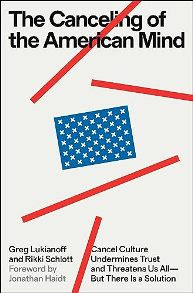
In my review of the book, The Coddling of the
American Mind by Haidt and Lukianoff, I focused on a cultural shift on
college campuses that has often led to an environment characterized by
political correctness rather than free and open debate between opposing
viewpoints. Groups have even turned on their own members for deviating ever so
slightly from a “party line.” I discussed how this is one way that groupthink
can manifest itself.
A new book by Lukianoff and Schlot talks about
how this situation has apparently gotten much worse, and has spread to other
educational institutions and vocational venues such as journalism.
One of the most problematic ideas of groupthink on campuses has to do with the so-called Diversity, Equity and Inclusion (DEI) philosophy. Of course, diversity, equality (of opportunity, not of outcome), and inclusiveness are virtuous and wonderful things when applied to individuals with all of their family and historical influences and experiences. Unfortunately, this has now morphed into defining people entirely by their ethnic group. Members of groups are either ALL victims (ALL black people) or ALL oppressors because they may have benefitted in some way from their “advantages” (ALL white people).
Apparently except for Jews, who
have been just about the most oppressed group for the longest time over history but also somehow counted some of the world's most successful people among their numbers. This obvious rebuttal to “Critical Theory” has
been solved by some people by seeing Jews as White colonialists, while by others seeing them as
Colored. Whichever is convenient. These people are still trying to figure out
how to classify Asian Americans who aren’t white but who are who also more successful
on average than other American groups.
This is in
fact exactly the opposite of what Martin Luthor King preached! He spoke of
judging people by the content of their character and not by the color of their
skin.
But no matter. The primary reason that I am reviewing this book is because this type of thinking has now spread to psychotherapy teaching programs! Your problems all now seem to originate, not from your family or personality or genetics, but from the fact that you are either an oppressor or a victim, according to your group identity, and you need to admit it! As the authors say, “It’s not about your problems. You are the problem.”
Everything wrong with people is seen through this lens. Therapists are now lecturing patients who have “incorrect” political views. “Multicultural and social justice counseling competencies” has even been endorsed by the American Counseling Association. The American Psychological Association is beginning to follow suit. They endorse, for instance, the idea that the repression of feelings of males typically seen in many cultures (who, say, won’t cry), often modeled by parents, is an example of traditional masculinity invariably being “toxic.”
The
authors of the Cancelling book believe that these approaches are counterproductive. They can cause patients to see themselves only
as helpless victims, and discourage people who are automatically assumed to be
perpetrators from seeking help. How do these therapists reconcile themselves to
the fact that, in 2020, 70% of completed suicides were “privileged” white males
(according to the American Suicide Foundation).
When I first read the chapter about psychology programs I was a little unsure how common this was, since I hadn't heard about it. But then I saw an advertisement for a book for therapists in the Psychotherapy Networker magazine. It was called Decolonizing Therapy by a PsyD named Jennifer Mullan. I quote from the ad: "Ignoring collective global trauma makes delivering effective therapy impossible; not knowing how to interrogate privilege (as a therapist, client, or both), and shying away from understanding how we may be participating in oppression is irresponsible."
Well, I do believe a therapist has to understand what each family may have experienced in this regard to understand certain shared intrapsychic conflicts that are seen within a given family - but each family is unique. And hopefully the therapist is not acting out blatantly racist attitudes. To assume all white therapists are doing this is what is irresponsible.
Anyone who
disagrees in some graduate programs is in high danger of being “cancelled” by
fellow students. One student said the environment was so mean that a student
who lost a family member to COVID was afraid to tell anyone lest they be told
that they were crying “white tears” and lectured about how people of color were
the real victims of the pandemic!
Now of
course it is true that many people have been severely traumatized by racial or group experiences and that such trauma
can lead to psychopathology, but that is not the same as saying that other
factors might not be equally or even more important.
This is a
perfect example of one key feature of Groupthink: either/or or black and white
thinking. No context, no subtlety. I recently had a negative personal
experience with that type of thinking with psychology interns I used to lecture
to. This one didn’t involve oppressors vs. victims, but there was a
certain similarity in its misclassification scheme. And it’s something
brand new.
I used to lecture them about borderline personality disorder (BPD). The interns came from the University of Tennessee Health Science center and another group of interns from the Memphis VA. Now admittedly I did discuss some of my own, outside-the-mainstream ideas, but I also discussed other current psychotherapy paradigms and theories about the disorder.
After I retired, I was still invited back every year to give the talk. Then suddenly the person in charge who called me to do this stopped calling. It took me two or three years to find out why, but I finally was able to corner her. First the VA, and then the UT interns said they no longer wanted lectures about doctor’s individual practice experiences (mine was over 35 years), but only from people who did literature reviews or active researchers!
This same type of thing was happening on my Psychology Today blog. One post I wrote was rejected because, they said, it was an opinion piece not based on research - when most of their posts are NOT research based. They just, for the first time in years, didn't like my opinion. So I stopped posting.
As readers of my blogs know, the literature in both psychotherapy and BPD is weak - and that's being generous. It is characterized by false assumptions, the fact that whole schools of therapy are evaluated but not the individual interventions which comprise them, the ignoring of many obvious impacting factors, and clinically-useless correlations between certain symptoms within one diagnoses or between two of them. People with a lot of clinical experiences in this area are a hell of a lot more knowledgeable than researchers.
The interns even wanted solely literature-based reviews a about
the treatment of transgendered patients, which has barely begun as a subject for any studies at all!
If a therapist is more interested in politics and your ethnic group than in you, drop them ASAP and find another therapist.

A new article in the blog ACE’s (Adverse
Childhood Experiences) Too High describes some new and
current programs that aim to help the perpetrators of domestic violence.
Not its victims, its perpetrators.
Help the perpetrators of domestic violence and not just its victims? Whoever heard of such a thing? How can anyone care about them? Not a popular idea to be sure. Perpetrators are traditionally shunted to the side as worthy only of blame, shame and punishment.
However, if we want to actually decrease the incidence of domestic violence, we have to address the behavior of everyone involved. In fact, initial data shows that these programs reduce the level of recidivism among arrested wife beaters. These healing programs, most developed in the last decade or so, show a zero to 8 percent re-arrest rate over months or years, instead of the traditional rates of 12% to 60%.
And the whole domestic violence situation is often a lot more complicated than it seems.
Sorry, it's not “blaming the victim” to point out that, according to the National Domestic Violence Hotline, it takes a victim of domestic violence on average seven times before they leave an abusive relationship for good. So not like they have nothing to do with it at all. What message does their going back give to the perpetrator? He’s usually aware that this is a puzzle: Why does she want to be with someone who treats her like that? Furthermore, why does he want to be with someone who pisses him off so much? Often abusers have themselves been victims of child abuse as children, and/or observed such things as domestic violence or drug abuse by their parents.
Of course this does NOT excuse the violence. Abusers already know that what they have done is wrong, so any attempt by someone to excuse their behavior seems to them to be disingenuous, and therefore they would not take it seriously. However, understanding them is a mechanism that can be employed in helping them gain control and alter dysfunctional interactions with their spouses.
The ACE's blog article also points to the following facts to justify treating the perpetrators:
· Many
women don’t want to leave but would prefer that someone just fix their
partners;
· Teens who
engage in dating violence often flip from abuser to
being abused;
· It’s becoming harder to tell who’s the primary aggressor, because both parties stewed in the same dysfunctional soup when they were growing up, and the couples do as well in their current relationship.
· Family violence and intimate partner violence are more accurate terms for domestic violence because violence occurs between or among parents and adult children, siblings, members of generations in the same family, extended family or in gay relationships;
· Abuse is also emotional and financial, something for which it’s difficult to make an arrest.
Family violence is at the root of many problems in any
community: over-crowded courtrooms and jails, burgeoning child welfare
caseloads, increased youth violence and gun violence, increased healthcare
costs and homelessness—a significant portion of what a community spends its tax dollars.
Healing-centered programs require that an abuser take responsibility for the actions that lead to his or her arrest. One of the
themes of this blog is the ongoing relationship between child adversity and
dysfunctional relationships. To get to the bottom of the problems of any given
couple, in my opinion this absolutely must be addressed for both parties as
well as for their own relationship.
Although the various patterns of the intergeneration transfer of
dysfunctional patterns that I describe in my blog are not well understood in the field,
some people teaching healing-centered batterer interventions course are steeped
in the science of childhood adversity.
The rest of the ACE's blog post describes more details of several of these programs
throughout the country. There would probably be more of such programs, but the risk of being
cancelled if you show any empathy at all towards abusers is high. That hurts
the victims of domestic violence just as much as it does the perpetrators.

Is pornography addiction
a real condition? In the book I co-edited, Groupthink
in Science, we have a chapter by Nicole Prause, a neuroscientist who has
been very active in this debate (and is mentioned prominently in the book I’ll
be talking abut). She makes what I consider an extremely good case that this “addiction”
model is nonsensical. I agree.
In her book, The Pornography Wars, academic
sociologist Dr. Kelsey Burke examines in fine detail both sides of this ongoing
debate without clearly taking a position either way. She talks with a variety
of academics and members of interest and church groups and gets them to open up
considerably about their opinions. Clearly, a lot of the debate is based more
on ideology than on science. On both sides! As we all know, sex is a subject
that has created a huge disturbance in human culture, what with religion,
gender issues, Victorian culture, and the like.
My own view is that sex
negativity is still rampant in the United States, despite the fact that most
people these days engage in relations prior to marriage. They often feel somewhat
guilty about it afterwards. Interestingly, this has put radical feminists and
religious fundamentalists on the same side of the pornography debate. What strange
bedfellows indeed.
Now, to be extra clear,
sex trafficking and being forced to participate in a porn film are issues that
are completely legitimate. No one should be forced to do anything like this
against their will. But in my mind, those issues are very different than the
question of whether pornography per se is bad for anyone, and if so, who and in
what way? Or the question of whether watching it compulsively in maladaptive
ways is a “disease.”
I believe questions about addictions as true mental diseases should be limited to those substances, such
as alcohol and opiates when used to excess, lead to tolerance and serious
withdrawal symptoms. Just about anything can be used to excess and create
negative consequences for the users and their associates. To me, most so-called
“addictions” are nothing more than self-destructive behavior designed to have
certain affects on family relationships and romantic partners.
I’d now like to list a
few examples of the evidence for what I am saying here from the book in
question. Research in this field, the author points out, depends on
self-reports by subjects - which is not objective data, and which are highly
dependent on the types of questions researchers ask and how they are phrased.
There is, for example, a phenomenon called acquiescence,
in which subjects’ responses are likely to go along with the values implied
in the question - for example asking only about negative consequences but avoiding
questions about positive benefits.
Lying about issues with
moral implications is widely prevalent. Does anybody really believe that a female brought up in an
evangelical religion will admit to secretly enjoying watching porn and having experienced
no actual negative consequences from doing so outside of maybe feeling guilty? Additionally, it is obvious that people’s beliefs
about porn influence the consequences they experience during and after watching
it.
Another issue is
correlation versus causation. Is watching porn bad for marriage, or does a bad
marriage lead to more porn viewing? An interesting finding: Protestant men are
more likely than any other, group, including atheists, to consider themselves
addicted to porn. Yet they report watching less
porn than the other groups. Several studies show that religious commitment is a
better predictor of people believing they
are addicted than actual porn usage.
As I have discussed in
several other posts, the fact that the brain’s connections are plastic and
change all the time when exposed to environmental influences makes claims that
neuroscience has “proved” that a porn “addicted” person has an organic disease
incorrect. As Dr. Burke points out, nature and nurture and their interactions
are what lead to most brains study results. And the boundaries between these
things are “far from tidy.”
Another point: just
because someone has a higher libido than someone else does not mean that they are sex addicts - they
just want sex more often. Also, home porn may often be a cue for some other
reward like masturbation. In a laboratory setting, contingencies like these
aren’t in the cards.
Then there is a prominent Protestant theological teaching. A quote from one of Billy Graham's recently
posthumously-published newspaper columns sums it up concisely. He writes, “All people are sinners in need of a Savior.” What this means is clear
from his sermons: prohibited but universal individualistic desires such as lust
are evidence that we are all evil in the eyes of God and need to renounce
our biological nature and follow what God – really the church – tells us to do.
Or else. In the words of a woman at a church group’s conference on the harms
created by porn addiction, "...after the Garden of Eden we’ve been running from
God ever since.”
This also has led to perceptions about men versus women’s sexuality. Religion teaches us that sin was created by a woman’s curiosity when Eve bit into the apple. In
the middle ages, women were actually considered the lustier of the two sexes
due to the impurity associated with Eve’s curiosity. In the 1800’s during the
industrial revolution and mass migration from family farms into cities, this
changed into its opposite: women changed from Eve to Mary. Women were thought
to want sex, not for itself, but only in order to insure the commitment of
marriage. “Why buy the cow if you can get the milk for free?” was a question
asked by confirmed virgins. Although men were thought to want sex way more than
women, they were also perceived as being less in control of their behavior. Masculinity
was defined as being in control, so if they “conquered” the natural sinfulness
of a porn addiction, this was thought of as an accomplishment.
In my opinion, the function that all this mythology serves is to show
the negative effect of allowing yourself to express lust, so the people who are
doing without get to feel more justified in giving freer sex up. Said one Christian
who had “overcome” a porn “addiction,” quoted in the book, he was “…tired of
not being the person that God made me to be.”
Well, what about those
radical feminists? They are certainly not primarily evangelical Christians.
Nonetheless, they have without realizing it accepted the Christian dogma while
trying to frame it as something else. Both Evangelicals and radical feminists
believe that men feel entitled to sex and women are both objectified and
victimized. The radical feminists seem to implicitly accept the idea that women
cannot want and enjoy sex as much as men, despite the fact that they can have
multiple orgasms and men cannot. The
general sex negativity towards women's lust prevalent in both sexes in our “patriarchal” society was summed up nicely by Elise Loehnen: "Good women want to be seen as sensual, warm and inviting of sex, but not overtly interested."
Because of the prevalence of these gender
attitudes and in order to sell more, porn does in fact frequently show women being objectified
by men. The feminists use this to “prove” their point,
ignoring that this occurs because of the cultural groupthink expectations of the audience. And there are plenty of women who
somehow enjoy watching porn as much as men do even under these circumstances.

Opening of anatomical theater at medical faculty at Bogomolets National Medical University circa 1853
Unknown author. Creative Commons Attribution-Share Alike 4.0
When I read the program for any
medical meeting, such as the annual American Psychiatric Convention, there has for years been a plethora of talks and forums about racism in medicine, equity
and diversity, and the like. Perhaps medical offices really are rife with bigotry and a lack of concern for minorities – particularly black
people.
Now don’t get me wrong. I’m sure there is still some racism in medical practice perpetrated by today’s doctors, just as in the rest of society. But people seem to lose sight of the fact that there has been tremendous progress in decreasing it in most of U.S. society. As author Steven Pinker writes in his book Enlightenment Now: "But it's in the nature of progress that it erases its tracks, and its champions fixate on the remaining injustices and forget how far we have come." (p. 215).
I once got into an argument with a young African American woman about this. She said there hadn’t been any progress here, even after the civil rights movement! The odd thing was that at the time we were enjoying a meal at a restaurant here in Memphis. I reminded her that when I was a kid, we wouldn’t have been allowed to eat together like that. In fact, she probably would not have been allowed in the restaurant at all. Her answer? Something to the effect of “Well, they still don’t like us here. It was probably better when it was out in the open.” Really?
The problem with poor outcomes in medical treatment for Black patients has several different causes besides racism, such as poverty, the crazy medical insurance situation in the U.S., and what I'm about to talk about. To hasten further progress, ALL of the various causes should be addressed. And before accusing me of "blaming the victim" in what I'm about to discuss, please keep two things in mind. 1. Just because behavior can be easily understood and justified does not automatically mean that it can't also be counterproductive. 2. When it comes to the results of repetitive human interactions in current U.S. society, "It's all my fault" and "I had nothing to do with it" are almost always false positions to take.
I’ve written before about the “game
without end” aspect of relationships between Blacks and Whites (7/23/13,
1/17/13, 4/3/12). The basic point is that a lot of difficulties in the current
relationships between Blacks and Whites stems from past racism, not current racism.
In a study
presented at the 2023 American
Association for the Advancement of Science annual meeting, Somnath Saha reported that he had came across
a cluster of studies showing that black people with cardiovascular disease were
treated less aggressively compared to White people. This professor of medicine
at Johns Hopkins University began poring through medical records. He found
that doctors are more likely to use negative
language when describing a Black patient than they are with a White patient. He found them described as “really difficult,”
“non-compliant,” and “uninterested in their health.” He attributed this to implicit bias by physicians— unconscious
judgments that can affect behavior.
Now, again, implicit bias is a real thing. We ALL profile other people, because we can't read minds. But is that the whole picture? Two studies bring up an important point. In an article talking about Saha’s
study, Antoinette M. Schoenthaler (a professor of population health and
medicine at New York University's Grossman School of Medicine),
said that disparities in pain management are pervasive and widespread across
the medical profession. But she also mentions a reason for it that is seldom
brought up: "Patients of color go
into an appointment with feelings of heightened anxiety because they're expecting mistreatment.; we've seen minoritized patients
have higher blood pressure in the context of a clinical visit because of these
expectations of anxiety and fear, and disappointment."
Medical
mistrust leads to greater health disparities in minority communities, according
to a poster presentation at DNPs of Color annual meeting held in Washington,
DC, October, 2023. It is not a phenomenon but a “true
medical issue,” said Clydie Coward-Murrell, MSN-Ed, BSN, RN, an African-American. “This clinical
issue is not as prevalent in other minority communities simply because of the
atrocities in health care that African Americans had to suffer for hundreds of
years.
Can anyone blame black patients for being suspicious of white
doctors? They seem to all know about the Tuskeegee syphillus experiment in which severe
damage was done to black patients. They may even know that black surgery
patients were in the past given less anesthesia than whites because doctors
thought they had a higher pain tolerance – a myth left over from slavery times
invented by slaveowners so they would not feel so bad about whipping them. They'd literally have to be crazy to completely trust doctors.
So maybe that’s part of why they seem to be angry and
non-compliant with medical treatments? And if that’s true, then couldn’t that
be a significant factor in explaining why other studies show that black
patients seem to have worse outcomes than white patients with similar
conditions? Because they don’t follow doctors’ orders as blindly? In that vein, let me tell you what one of my black psychotherapy patients told me: She had to hide the fact
that she was seeing a therapist because her fellow church members would
give her an extremely nasty round of criticism if they knew. Accusing her of just not praying hard
enough.
In my own experience as a medical student, resident, and psychiatrist, I have not personally witnessed a whole lot of obvious racism in my instructors and colleagues. Of course I am not black so I might not have seen racism that was present since it would not be directed at me. But I was a residency training director at a Southern medical school for 16 years. I had a lot of black psychiatry residents, and none of them complained about this.
We were told by the dean in
charge of residency programs that, although our school did not have affirmative
action, if there was a black applicant and a white one of roughly equal
qualifications, to take the black one.
The only time I ever personally witnessed really nasty racism
(and simultaneous sexism) among doctors was way back in the early 70’s when I
was a medical student in San Francisco. Clearly, my school was ahead of its
time so I had a biased sample – my class was 20% female at a time when there were a lot fewer elsewhere (there are now more female medical students than male ones). A Black
female classmate wanted to become an orthopedic surgeon. Surgeons were by far
the biggest Neanderthals for these issues back then. Boy, did they ever give
her a raft you know what when she applied.
So all this talk among doctors about how racist they all are is not something that only they hear. Black people hear it too. So what they are hearing is that they are right
to be suspicious of white doctors. While racism in medicine must still be addressed, talking about it way too much has the potential to backfire and make the problem worse rather than better.
I'm interviewed on two new podcasts.
The first describes my background and how I got interested in the family dynamics of self-destructive behavior (particularly borderline personality disorder) and its psychotherapy:
https://www.youtube.com/watch?v=XPQdl664QgM


In an article in the Washington Post on 8/2/23, cultural
critic Kristen Martin wrote an essay about how some best-selling books express great confidence in
theories of the brain that are in reality still in their infancy - and unproven. She mentions a
book I reviewed, The Body Keeps the Score
by Bessel van der Kolk, a well as The
Grieving Brain by Mary-Francis O’Connor.
The
author believes that “neuroscientific wisdom is now recirculating into new
mediums, calcifying into consensus that we can’t stop parroting.”
In
reality, our understanding of the human brain, while increasing rapidly, is still in
its infancy. Scientists have to contend with about a trillion
connections between billions of brain cells that constantly change in response
to the input of literally thousands of environmental and interpersonal
influences (neural plasticity). I
have written several times about how this problem manifests itself in studies
using a type of brain scan called an fMRI, which basically measures blood flow
in parts of the brain as the brain’s owner is engaged in a variety of mental
tasks.
Another doctor likened trying to make any generalizations about repetitive behavior from observable differences in brain scans to trying to know how the stock market is doing by measuring electricity usage at the stock exchanges.
I
write about how results that differ between groups are labeled as “abnormalities”
when in fact they might indicate normal differences in the performance of the task
in people who have had differing prior experiences and have learned to approach the task in
different ways. They may be accomplishing differing goals - and without having
to engage in conscious deliberations.
Martin also says that
people consult neuroscience to validate what they want to believe or what they
already know. “Tracing all of our messy emotions, reactions and habits to the
workings of electrical currents and neurochemicals lets us off the hook.”
She
references some work with brain scans that adds even more fuel to our opinions
on the matter. In 2009, a neuroscientist put a dead salmon through an fMRI and detected
activity in its dead brain. It is easy to produce a false positive finding just
from statistical noise in the scans.
She
adds, “A scan can correctly identify the areas of a person’s brain that are
receiving blood flow at a particular moment, but we can’t definitively say that
activation of a brain region equals a particular emotional or cognitive state.”
A part of the brain called the amygdala produces negative emotions like fear,
but also positive ones, like happiness.
Even
more striking was a review from 2020 by Duke University professor Ahmad Hariri.
It reanalyzed 56 published academic studies based on fMRI analyses, and found
that the results usually do not come out the same on a second scan.
As
I have also written about extensively, misleading fMRI study results are
routinely injected into the still highly prevalent nature-nurture debates in
psychology and psychiatry. Genetic influences on behavior are routinely exaggerated
by the field in conclusions that are based on brain scan research.

In 2019, I wrote
a review of a book by Amber Scorah
titled Leaving the Witness about a woman growing up as a
member of a cult-like religion. People in that group were
taught to avoid talking to anyone or looking at any source of information that
might call into question its belief system. As with most cults, people who
broke the rules or questioned orthodoxy were completely shunned by family
and friends.
My interest was how
people routinely convince themselves of the most outrageous beliefs - ones
that could easily be seen as preposterous even if thought about briefly - and
hang on to them for dear life in order to avoid an almost unbearable feeling
of groundlessness (also called existential
groundlessness or anomie). The roots of this are from the biological effects of an
evolutionary process called kin selection. In my review I said I thought the
author had written the most elegant descriptions of that experience I’d
ever read.
Well, Ms. Scorah has met
her match in Tara Westover. Furthermore, Westover’s book talks about what
happens in a case in which the “cult” consists ONLY of the members of someone’s
family of origin. They were ostensibly Mormons, but the vast majority of
practitioners of that religion did not subscribe to many of the clearly bizarre ideas of this particular family, especially those of the author’s father.
Westover writes that he may
have had bipolar disorder. Of course I have no way of knowing for sure, but the
consistency of her descriptions of him argues against this. In true bipolar,
the person thinks normally when not in a manic or depressed state, which is
usually most of the time. Some of the father’s strange ideas did not seem to be delusions
per se but were based on conspiracy theories that are now widely believed.
Included were dramatic ideas about the “Illuminati” and an anti-Semitic tirade
called the Protocols of the Elders of Zion.
Other of his beliefs were even more far out: the public schools were all agents of Satin, so none of the seven children in the family attended public schools. All doctors were all part of this conspiracy, so no one was taken to a hospital.
Mother always went along
with whatever ideas were expressed by the Father, but when alone with the
author, she would sometimes seem to indicate that indeed she knew better.
One of the biggest issues
for the author was her relationship with her older brother Shawn, who was
sometimes hyper-involved with her but at other times physically abusive
to her. If she mentioned this to her parents, they did not seem to believe her,
so she quickly learned to keep it to herself –sometimes even by
telling herself that maybe she had dreamed it or that she was crazy so what had
clearly happened was a figment of her imagination.
Strangely, Westover was able to get into BYU despite a paucity of education by studying for the college entrance exams, through books and other recommended sources from people she knew at her church. Most of this reading presumably would have been highly disapproved of by her father. It took her two tries at the test to get the requisite score, but she somehow kept at it. Her father has always said he thought that women should just get married and run a household, but as I will mention later, some of his behavior was inconsistent with that idea.
Once she got to BYU, a
Mormon school, almost none of the students had the same belief system she did.
They could hardly believe she had never even been to high school. She did not
share anything about her unique family experiences. She frequently told herself she was
not qualified to be there. Nonetheless, she was able to persist with the
encouragement of some of her advisors who saw how bright she was. And she was bright enough to eventually get into highly competitive and prestigious graduate programs
at Cambridge University in England, and at Harvard!
She frequently returned
home and usually fell back into old family patterns, but something pushed her
leave again and again to continue with her “satanic” education.
At school, the feelings and thoughts produced by her sense of groundlessness almost tore her apart, despite her ongoing successes. The way she experienced groundlessness was brilliantly described in a variety of amazing (and rather horrifying) ways throughout the book. Examples: she writes, “It was not that I had done something wrong, but I existed in the wrong way. There was something impure in the fact of my being.”
When she started to experience her clique at Cambridge as a sort of family, she felt damned by those feelings: “No natural sister prefers a stranger to a brother…and what sort of daughter prefers a stranger to her own father? That feeling became a physical part of me.” Later she had the thought, “It seemed like I made a thousand mistakes, driven a thousand knives into the heart of my own family.”
The blow that stopped
her from making frequent return home visits was after, in private e-mails, her
mother admitted she should have protected her daughter from Shawn. And then her
older sister admitted to her that she had been through many of the same things
with Shawn that the author had. Even Shawn’s ex-girlfriend confirmed how he
was. Surely now her Dad would believe her. Except in his presence, her mother
and her sister started lying again, denying that they had said anything of the
sort!
So how was the author able
to break through the powerful effects of family dynamics and achieve her
educational accomplishments? Again, I have no way of knowing for sure, so I'll speculate based on the available descriptions as well as my psychotherapy experience with other families. I could of course be completely wrong..
I suspect that her parents, despite any insistence otherwise, were both secretly highly conflicted about education, family roles, and religion, so she was getting a mixed message. The author does not tell us anything about her grandparents that might clue us in to where this confusion came from originally, but some of the parents' behavior seemed to scream it out.
Some examples: as mentioned, father preached about traditional gender
roles, and his only other daughter followed them. But somehow, when he had been
injured and couldn’t run his business as before, he allowed his wife to develop
her own business selling alternative medicines that brought in more money than
he’d ever made, and he was supportive of her doing this. Also, when Tara
started singing in local shows as a teen, he would always come to hear her
sing, and appeared to be as proud as punch.
Mother, while not overtly telling the author to get educated, would often subtly push her into getting on with it – as long as Dad was not around.

In a previous post, I discussed one big reason for the increase in tent cities for the
homeless: the defunding of critical parts of the mental health safety net. In
this post, I’m going to talk about another one: unplaceable foster children who
age out of the system.
I was first made aware of this problem by a
counselor in Texas. Then I noticed a headline that said much the same thing she described was
going on in California. According to the counselor, some residential treatment
facilities have recently been closed by the governor of Texas. The ostensible
reason was that there were accusations made against people there of abusing children, but instead of fixing that problem, they closed them down.
Unplaced
foster children there may now live in
unregulated rentals, on the floors of churches, in some donated spaces or in
hotel rooms. At one place, girls aged 12-20 don’t go to school, don’t
have rules or clean up. The place itself is usually filthy. The girls are also
allowed internet access so they often “run away” to meet various men, and most aren’t
on birth control.
Meanwhile,
in California, things are just as bad. According to
reporting by the Investigative Reporting Program at UC Berkeley,
hundreds of Los Angeles’s county’s abused children ended up in hotels like
the Biltmore
Hotel downtown. In December 2021, the then-director of the city’s child welfare
agency quietly struck a deal with the hotel’s operators to house foster youths
and their social workers at the cost of $89 a night.
The children placed in the hotels are
usually among those with some of the most significant untreated trauma and the
gravest histories of violence. Though group homes frequently have security and
teams of staff members, children in the hotels have often been supervised by a
single social worker, sometimes with scant knowledge of their backgrounds,
little training to de-escalate potential violence and no on-site colleagues
when things go wrong, according to DCFS policy documents. Assaults on staff
members are not unusual.
In
two cases, in particular, the kids ran away from an unregulated placement and
ultimately died in shootings.
Many children are put into the
foster system after being removed from an unsafe home. This can mean that
children all over the country are entering the foster care system who may have
had parents who were drug addicts, abusers, or criminals and are prone to acting out and
violence, which makes them nearly impossible to place in foster homes. When
they turn 18, they are no longer wards of the state and many are then out on
the street.
According to the National Foster Care Institute, after
https://www.youtube.com/channel/UCPjK28Du95eX2ZdWTT5_6TQ
I also corrected the web address on the original blog post.